Divers Just Found a 2,400-Year-Old Shipwreck Off Greece
September 26, 2026 · HistoryBytes Team
A chance find that stayed hidden for centuries
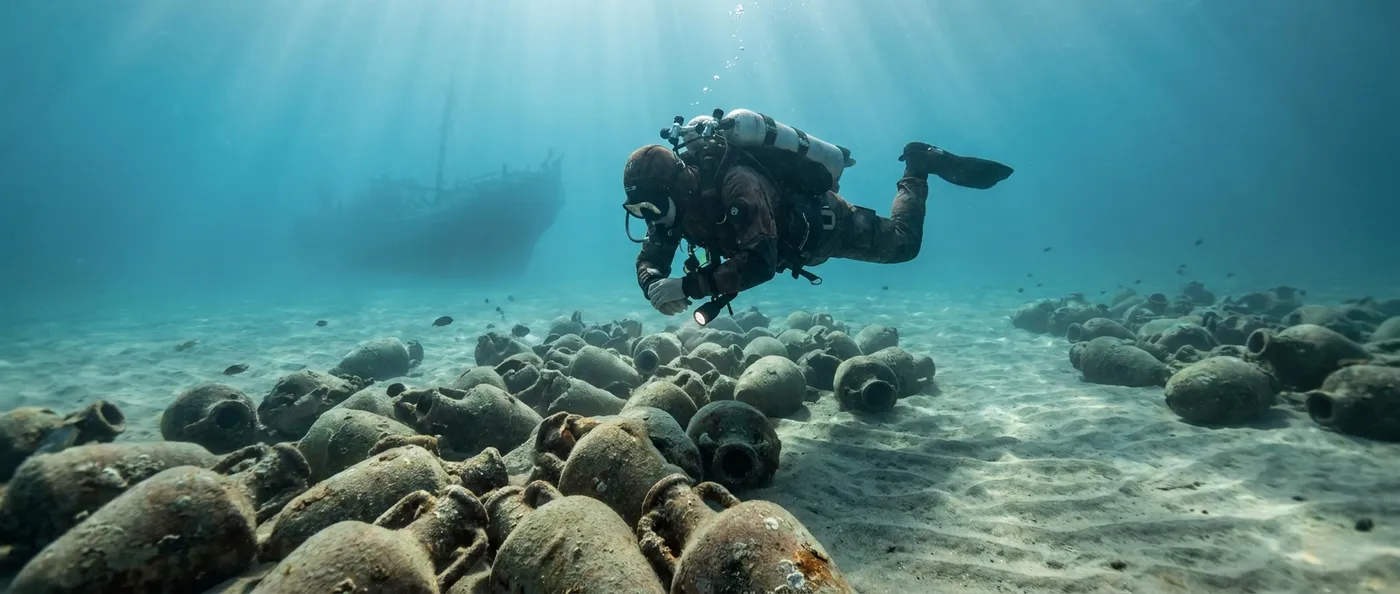
In late July 2026, a private individual reported an unusual discovery to Greek authorities: off the coast of the Aegean island of Andros, at a depth of 39 to 44 meters, hundreds of ancient clay vessels lay scattered across the seafloor. What followed was a careful investigation by the Ephorate of Underwater Antiquities of Greece's Ministry of Culture — and confirmation of a remarkable find: the remains of an ancient merchant ship that sank roughly 2,400 years ago, carrying an almost intact cargo of an estimated 600 to 650 amphorae.
What sounds like a minor footnote actually opens a window into one of the least visible, yet most important systems of antiquity: the sea trade that held the entire ancient Mediterranean world together.
A merchant ship, frozen at the moment it sank
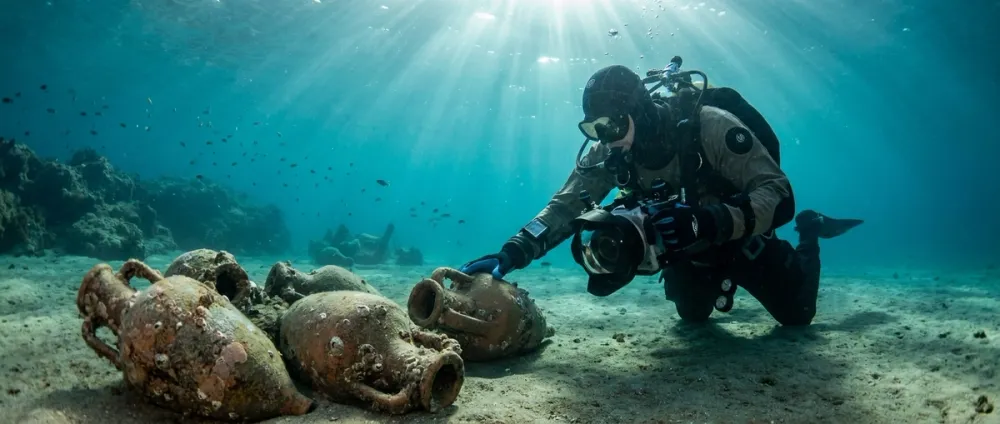
Dating of the recovered amphora samples narrows the ship's sinking to the late 5th to early 4th century BCE — a period of intense Greek sea trade across the Aegean. The investigation team, made up of diving archaeologist Dionysios Evangelistis, diving conservator Angelos Tsombanidis, and underwater technician Louis Mercenier, identified three distinct amphora types at the site so far — named after their presumed regions of origin: Mende, Peparethos, and Solokha 2.
Alongside the clay vessels, divers also discovered the remains of a lead anchor stock and several stones likely used as ballast to stabilize the hull. The ship's actual wooden structure has, naturally, long since decomposed after more than two millennia in seawater — what remains of an ancient merchant ship is almost entirely its cargo.
The amphora — antiquity's shipping container
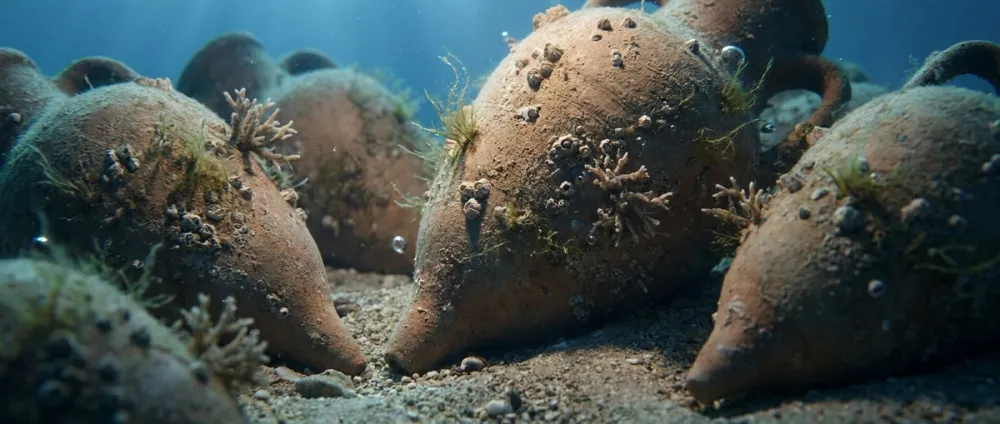
For roughly 2,000 years, from about 1500 BCE to 500 CE, the amphora was the standard transport vessel of the entire Mediterranean world — roughly comparable to the modern shipping container. Its distinctive shape wasn't accidental, but carefully engineered: the two handles let workers safely carry a filled vessel weighing 15 to 25 kilograms. The tapered, pointed base let amphorae be wedged tightly together in sand or specialized racks inside the hull, so they wouldn't tip over or knock against each other in rough seas.
Wine and olive oil were the primary cargo — the two most important Greek export goods — but far from the only ones. Chemical DNA analysis of amphorae from other ancient wrecks has found, alongside grape and olive residue, traces of ginger, walnuts, juniper, mint, and oregano — evidence that the same containers were repeatedly refilled with different goods over their working life. Experienced merchants could often tell what a jar contained just by its shape, before it was even opened.
When a clay jar became the prize itself
Most amphorae, like those found at Andros, were purely functional transport vessels — plain, practical, with no artistic ambition. There was one notable exception, though: the so-called Panathenaic prize amphorae, produced specifically in Athens for winners of the Panathenaic Games, one of the most prestigious athletic festivals in the ancient Greek world. These vessels were elaborately painted — typically showing the goddess Athena on one side and the specific athletic event they were awarded for on the other.
These prize amphorae were filled with roughly 40 liters of olive oil harvested from groves sacred to Athena — oil of considerable material value. A Panathenaic prize amphora was thus both an honor and real wealth at once: symbolic prestige and hard currency contained in a single vessel.
This is HistoryBytes.
Short lessons, real duels, and immersive visuals from a world of history — download it now.
A cargo from multiple regions of origin
Particularly revealing about the Andros find: this isn't a uniform cargo from a single source, but a mixed shipment from at least three different regions of origin — likely Chalkidiki, the Sporades, and the area around the Black Sea. That gives archaeologists a rare glimpse into just how complex ancient trade networks actually were: rather than a single shipment from A to B, the find shows how goods from multiple regions were gathered along a route and transported onward together.
Aristophanes, the famous Athenian comic playwright, even explicitly mentions the quality of certain amphora origins in his play "Ecclesiazusae" — a character praises the sweet wine of Thasos and "blesses" the Thasian amphorae it was shipped in. This shows that origin and packaging mattered to ordinary ancient people — much like wine lovers today pay attention to a bottle's region of origin, ancient buyers could recognize quality and origin just from the amphora type itself.
From a private tip to an archaeological investigation
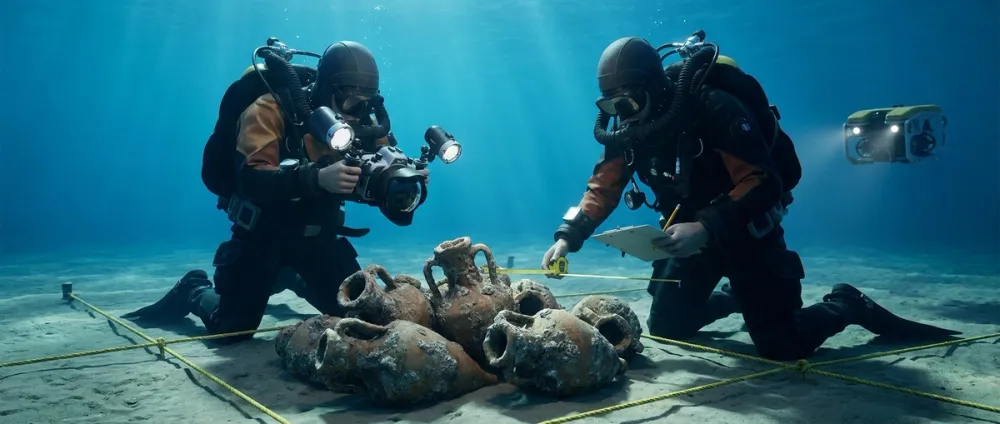
What's also notable about the Andros find is the path of discovery itself: this wasn't a targeted archaeological expedition, but a tip from a single private individual who happened upon the site while diving and alerted the authorities. Greece's Ephorate of Underwater Antiquities then carried out an official investigation — following strict archaeological methodology: the site was fully documented in its original position before a single piece was recovered. Of the three identified amphora types, exactly one representative sample of each has been recovered for lab analysis so far — the bulk of the cargo deliberately remains at the site, pending a full excavation.
This methodical, patient approach is typical of modern underwater archaeology: contrary to what adventure films suggest, the goal isn't to quickly grab treasure, but to record every detail of the original find context before anything is moved at all.
Not an isolated case — a busy summer for underwater archaeology
The Andros find joins a whole series of recent Mediterranean discoveries over the past few weeks — around the same time, Italian divers also made headlines with further ancient find sites. That's no coincidence: the combination of improved diving technology, systematic coastal monitoring, and a growing number of attentive recreational divers who report finds instead of keeping them to themselves is currently driving a genuine wave of new discoveries along the historically busy ancient trade routes of the Mediterranean.
A frozen moment, not a site that grew over centuries
What makes shipwrecks like the one at Andros especially valuable archaeologically: they're literal snapshots in time. A land site like an ancient city was often inhabited, rebuilt, and reused over centuries — different time layers blend together. A sunken ship, by contrast, shows exactly what was being transported on a single day, unchanged since the moment it went down. Amphorae that on land were often broken, reused, or repurposed as building material remain underwater — protected from oxygen, light, and human interference — often in remarkably good condition.
That's exactly what makes every new Mediterranean shipwreck find a potentially valuable snapshot of ancient daily life — not just another pile of old pottery shards, but a glimpse frozen from a single moment in antiquity.
History that's still being written
Fresh finds like this one show that ancient history isn't a closed chapter, but something that's literally still unfolding — with every new wreck, every new excavation, details emerge that nobody knew just weeks earlier. In the Echoes of Olympus season, HistoryBytes takes you deep into exactly this world of the ancient Aegean — trade, seafaring, the everyday life behind the big, familiar names. History never stops being rewritten, as long as something is still waiting to be found — in the ground, or on the seafloor.
600 silent witnesses to a forgotten day of trade
In the end, the Andros wreck doesn't tell a dramatic story of battles or kings, but something far more ordinary — and precisely because of that, more valuable: the completely everyday course of a trading day 2,400 years ago, frozen at the moment it sank. 600 amphorae that never reached their destination still lie exactly where the ship went down — silent witnesses to a trade system that connected the entire ancient Mediterranean world. Further study will no doubt reveal more about this one ship's origin, route, and cargo — a chapter of ancient history that's quite literally still being written as you read this.