Oda Nobunaga: From Fool to Japan's Most Feared Warlord
September 22, 2026 · HistoryBytes Team
The man nobody took seriously
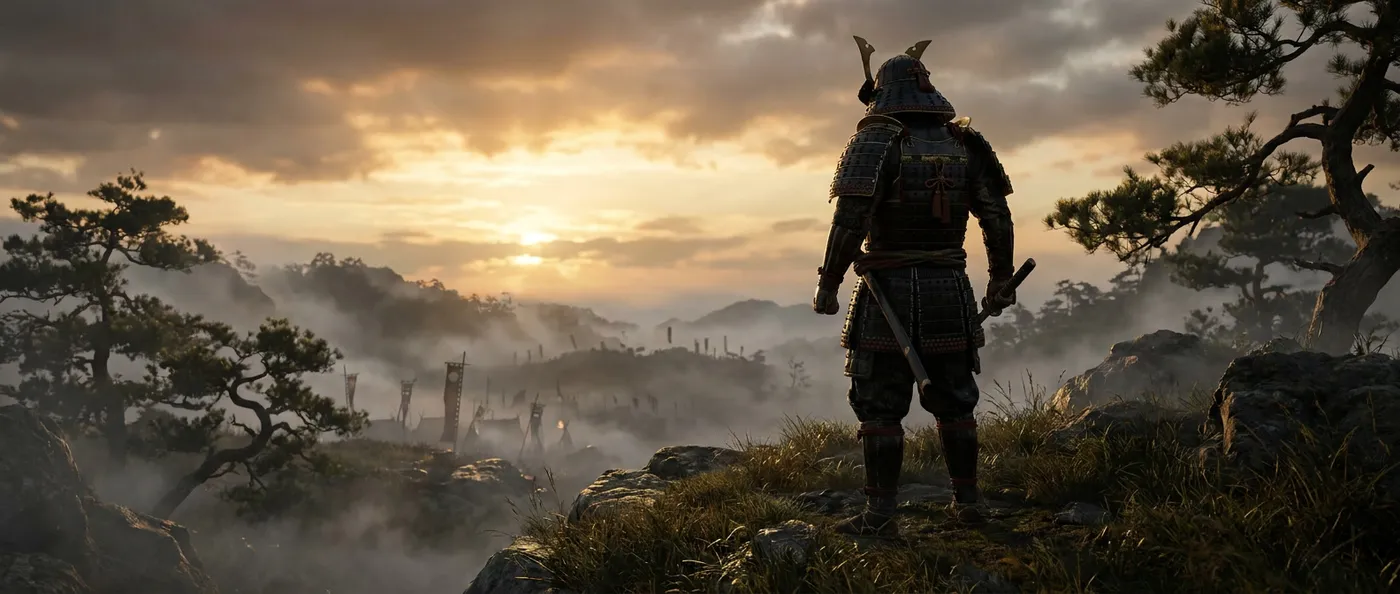
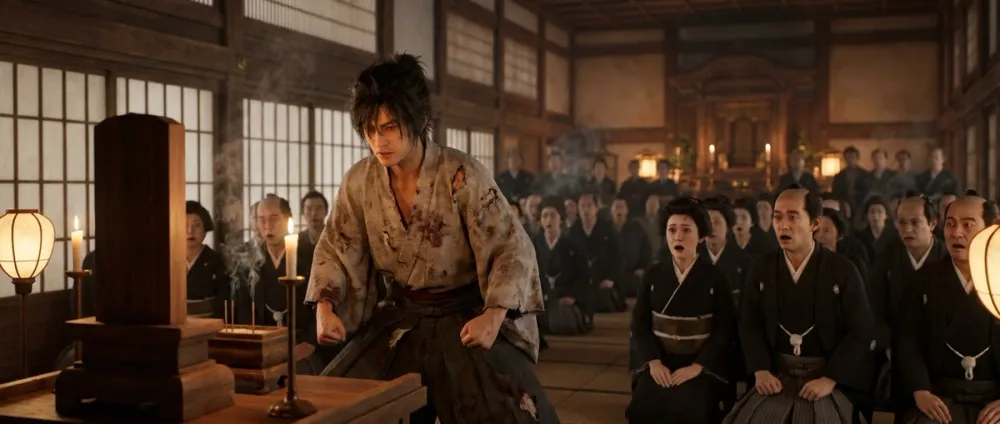
When Oda Nobunaga took over leadership of his clan in 1551 at just 17 years old, following his father's death, he already carried a nickname that still appears in every biography written about him: "the Fool of Owari" (Owari no Ōutsuke). He wandered the streets in torn clothing, chewed on raw fruit in public, and behaved so disrespectfully at formal occasions that even his own retainers doubted his fitness to lead. At his own father's funeral, he's said to have thrown incense powder onto the altar by the handful instead of following the prescribed formal ceremony.
Less than a decade later, that same man was on his way to becoming one of the most powerful and feared warlords in Japanese history — responsible for one of the most brilliant military victories of the Sengoku period, for revolutionary firearms tactics, and for a ruthlessness that earned him the exact opposite nickname: the "Demon King."
A war between brothers for control
Nobunaga's eccentric behavior wasn't consequence-free — it nearly cost him control of his own clan. His younger brother Nobuyuki, backed by several dissatisfied retainers, openly plotted a rebellion to seize leadership for himself. When the plan was discovered, Nobunaga initially showed surprising mercy, pardoning the retainers involved. But when Nobuyuki launched a second rebellion attempt shortly after, he was betrayed by his own relatives and ultimately executed on Nobunaga's orders — a clear message to anyone still questioning his authority.
By 1559, with the capture of Iwakura Castle, the last bastion of resistance, Nobunaga had brought all of Owari Province fully under his control. What looked like eccentric, unpredictable behavior was increasingly revealing itself as a calculated facade — a man who deliberately let opponents underestimate him, only to strike them down all the more decisively later.
Okehazama: 2,000 against 25,000
By 1560, Nobunaga's young rule seemed on the verge of collapse for good. Imagawa Yoshimoto, one of the most powerful daimyō in Japan, was marching on Kyoto with a massive force estimated at 25,000 men — directly through Nobunaga's territory. Nobunaga's own forces were vanishingly small by comparison, likely no more than 2,000 to 3,000 warriors.
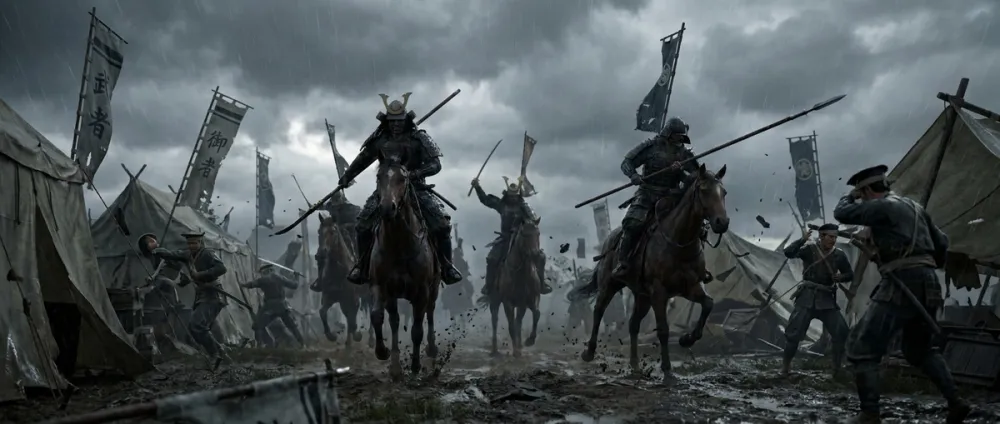
Instead of holing up behind fortress walls as most of his advisers recommended, Nobunaga made a risky call: he used a violent rainstorm to move his small force undetected near Imagawa's camp at Okehazama, where troops were relaxing and celebrating after a recent victory. The surprise attack caught the Imagawa army completely off guard — in the chaos that followed, Imagawa Yoshimoto himself was killed, his head triumphantly carried back to Kiyosu Castle.
The Battle of Okehazama remains one of the most famous surprise victories in Japanese military history to this day — a win against more than ten times his numbers that turned Nobunaga, overnight, into one of the most respected and feared warlords in Japan. Among the allies who subsequently joined him was a young warrior named Matsudaira Motoyasu — who would later become known as Tokugawa Ieyasu and go on to found Japan's final, centuries-long shogunate dynasty.
Free markets instead of centuries-old monopolies
What set Nobunaga apart from most other warlords of his era wasn't just military brilliance, but a remarkably modern economic mindset. With his rakuichi-rakuza policy ("free markets, free guilds"), he abolished the centuries-old trade monopolies held by guilds and temples across his territories, along with the countless toll barriers and checkpoints that had severely hampered trade between provinces up to that point. Merchants could suddenly trade freely, without paying guild fees or monopoly premiums — a reform that turned his territories into economic hubs while also generating the tax revenue that financed his military campaigns.
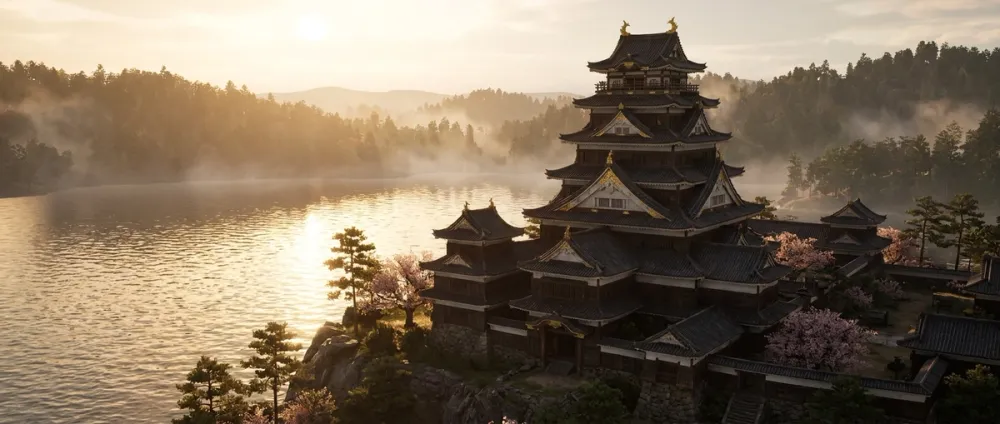
His most striking building project was Azuchi Castle, built between 1576 and 1579 on the shores of Lake Biwa. With a seven-story keep elaborately decorated with paintings by the famous artist Kanō Eitoku, it was unlike anything Japan had seen before — no longer a purely defensive structure, but a deliberate symbol of power that combined military strength with cultural grandeur. The castle became the model for practically every major castle built in the following decades.
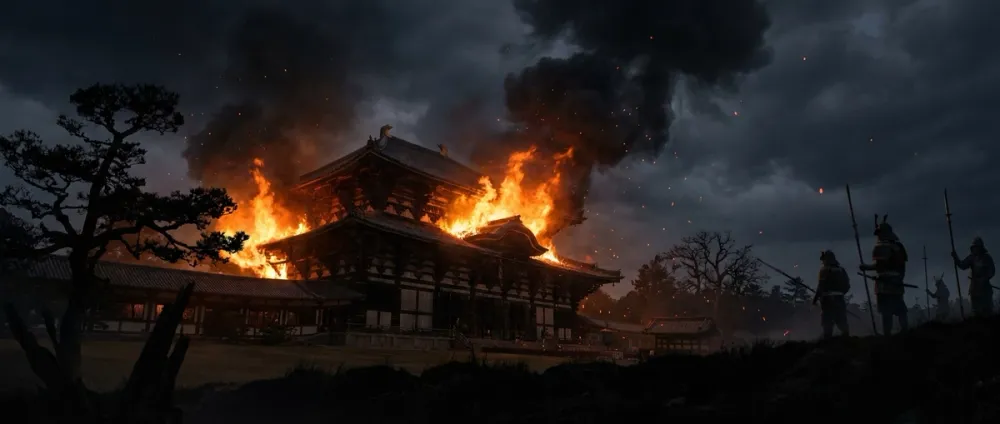
The irony: shortly after Nobunaga's death in 1582, Azuchi Castle burned completely to the ground under circumstances still unexplained today — a structure meant to symbolize his lasting power outlived its builder by only a few weeks.

This is HistoryBytes.
Short lessons, real duels, and immersive visuals from a world of history — download it now.
The conflict with the warrior monks
Nobunaga's rise wasn't defined by military skill alone — it was also marked by a brutality that stood out even by the already bloody standards of the Sengoku period. His most stubborn opponent wasn't another daimyō, but the Ikkō-Ikki, a movement of armed Buddhist followers who opposed samurai rule altogether and operated out of powerful fortified temple complexes.
In 1571, Nobunaga besieged and destroyed the temple complex on Mount Hiei near Kyoto, for centuries one of Japan's most important religious and political centers. The destruction was total — practically the entire population of the mountain temple was killed. The broader conflict with the Ikkō-Ikki dragged on for more than a decade, finally ending only in 1580 through mediation by the imperial court.
These events reveal an important side of Nobunaga: he saw religious and political power as a direct threat to his control and responded without hesitation, with overwhelming force — a strategy that won him territory and power, but also earned him the reputation many contemporaries summed up in a single word: "demon."
Nagashino: how Nobunaga tactically revolutionized firearms
As early as 1549 — years before he became a national figure — Nobunaga had 500 of the new tanegashima matchlock guns made for his army, weapons that had only reached Japan six years earlier via shipwrecked Portuguese traders. While other daimyō initially viewed firearms as little more than an exotic novelty, Nobunaga recognized their tactical potential early.
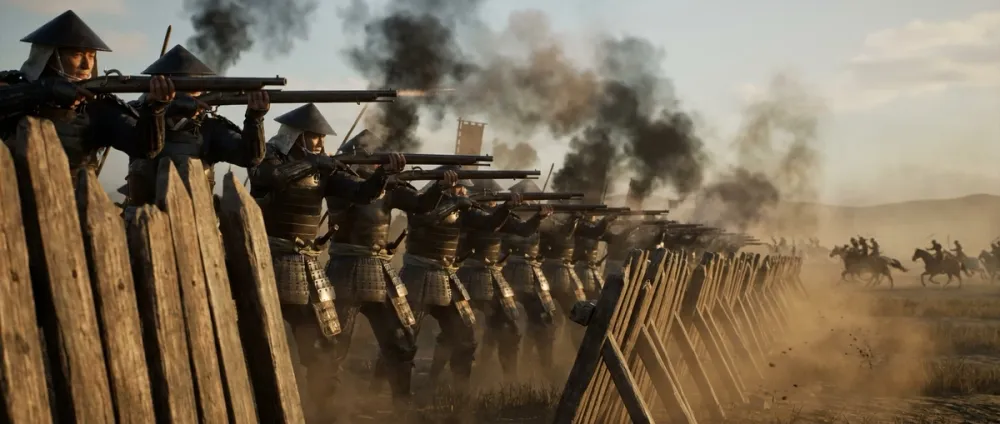
Proof followed in 1575 at the Battle of Nagashino: against the feared, traditionally dominant cavalry of the Takeda clan, Nobunaga positioned his gunners behind palisades in multiple rows that systematically rotated while reloading — one of the earliest documented uses of coordinated volley fire tactics in military history. The result was devastating for the Takeda cavalry, whose traditional charges were effectively shredded against the disciplined bursts of gunfire.
Nagashino marked a turning point: the battle proved that modernized firearms tactics could break traditional cavalry dominance — a lesson that shaped Japanese warfare for decades beyond Nobunaga's own campaigns.
A reputation that shaped friend and foe alike
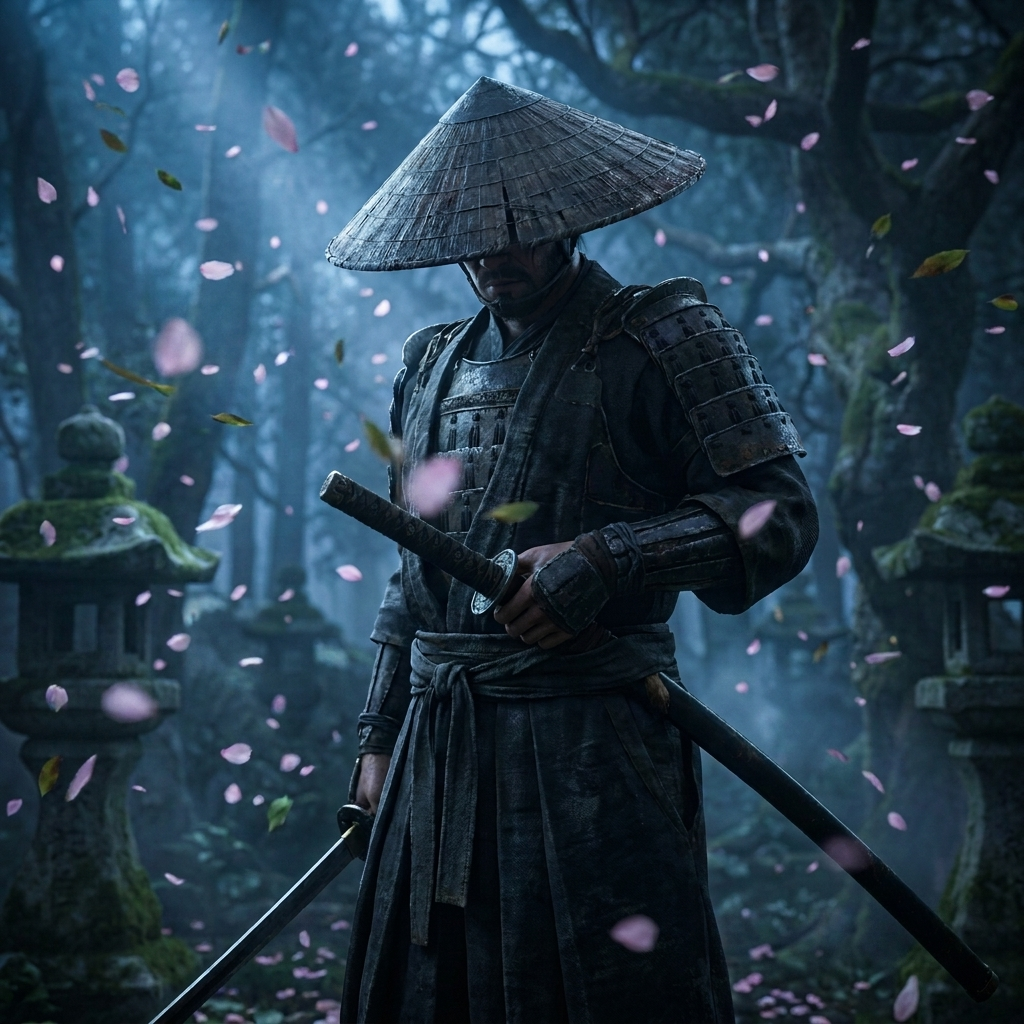
The nickname that stuck to Nobunaga in his final years — "Dai Maō," the Demon King — was, by most accounts, one he actively cultivated himself, to deepen the fear his enemies felt toward him. Going from the disrespectful "fool" of his youth to the most feared name in the country was a remarkable image transformation, one that shows just how deliberately Nobunaga managed his own public perception.
At the same time, he also showed a notably open attitude toward the unfamiliar: in 1581, through the mediation of a Jesuit missionary, he met an enslaved African man, to whom he gave the name Yasuke and — in the first documented case of its kind — granted the status of samurai. This episode reveals an unusually pragmatic, if historically complex, side of a man whose reputation was otherwise defined almost entirely by war and conquest.
Step into the world of the samurai in HistoryBytes
The Honnō-ji Incident
By spring 1582, Nobunaga controlled nearly half of Japan and was preparing to push his power further west. That June, en route, he stopped at Honnō-ji temple in Kyoto — accompanied only by a small escort, believing himself safe.
It was there that one of his own long-trusted vassals struck: Akechi Mitsuhide turned his troops against his own lord and surrounded the temple. Nobunaga, wounded and with no chance of escape or rescue, committed seppuku, ritual suicide, rather than fall into his betrayer's hands. Mitsuhide's exact motives for the betrayal remain disputed among historians to this day.
Nobunaga never fully achieved his stated goal of uniting all of Japan. But his closest general, Toyotomi Hideyoshi, avenged the betrayal shortly after and carried Nobunaga's unification work forward — a process that ultimately culminated in the centuries-long Tokugawa shogunate dynasty, co-founded by none other than that same young warrior who had joined Nobunaga's side after Okehazama.
From outsider to legend
HistoryBytes was never about memorizing dates — it's about understanding how people like Nobunaga actually lived: how they got underestimated, how they built power, how they dealt with betrayal and setbacks. In the Whispers of the Samurai season, you'll meet figures exactly like this — not as one-dimensional heroes or villains, but woven into the real, often contradictory stories behind them. Nobunaga's path from mocked "fool" to the most feared man in Japan shows just how far reputation and reality can drift apart.
A legacy caught between brilliance and brutality
Oda Nobunaga's story doesn't fit neatly into a simple hero narrative. He was simultaneously a military genius and a ruthless destroyer, a pragmatic reformer and a feared tyrant, a disrespectful outsider and a calculating strategist. It's exactly these contradictions that make him one of the most complex figures in Japanese history — a man whose work his own death couldn't stop, because he had already laid the groundwork for uniting an entire country, long before a traitor denied him the chance to finish it himself.