SPQR: What Those Four Letters All Over Rome Actually Mean
September 24, 2026 · HistoryBytes Team
Four letters that show up everywhere
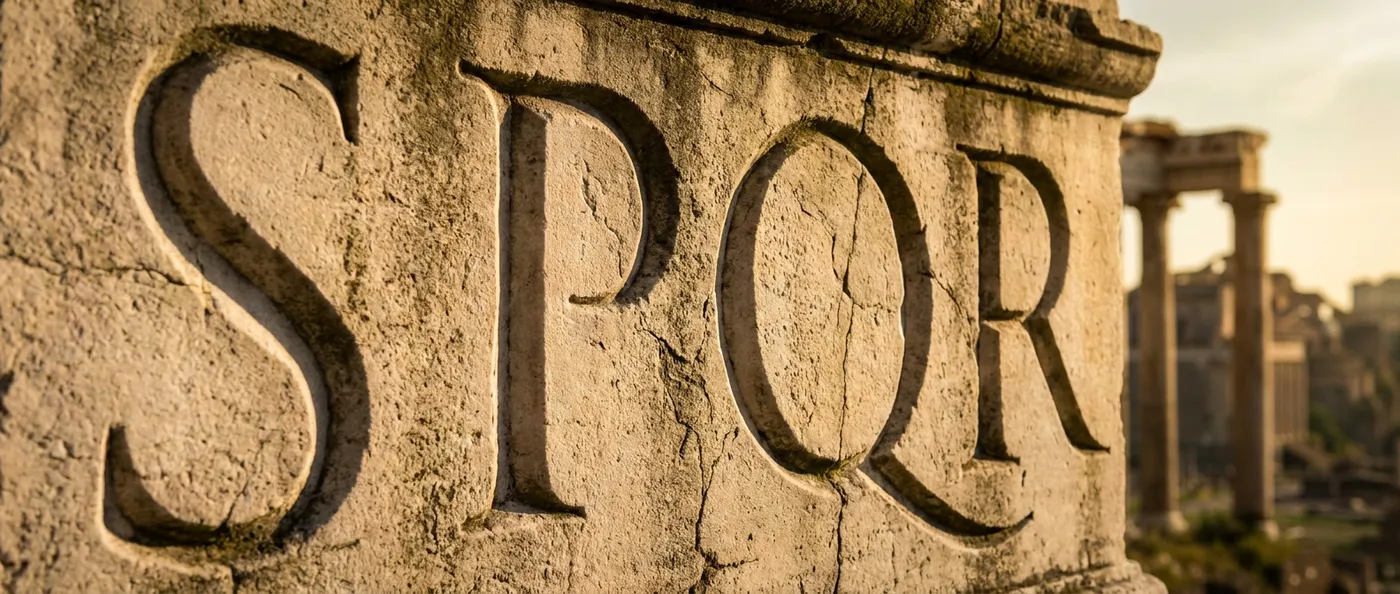
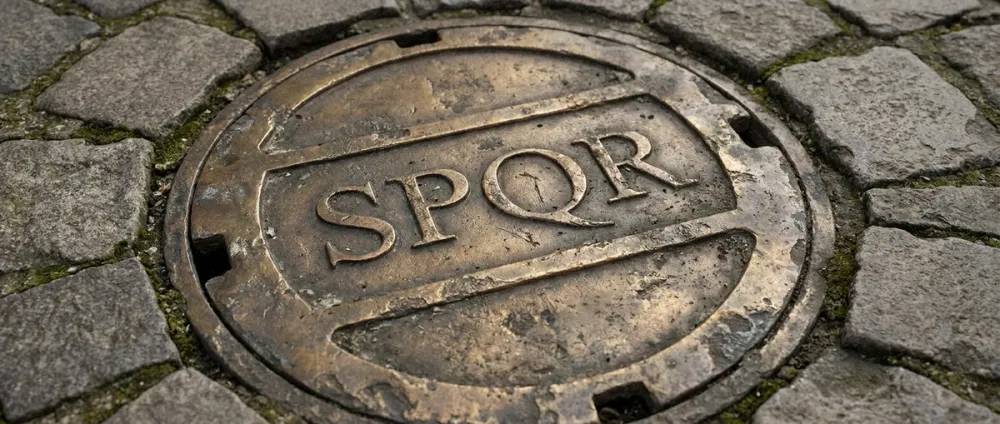
Walk through Rome and you'll see them everywhere: on manhole covers, on lampposts, carved into stone archways, even on the city's garbage trucks. Four letters — SPQR — turn up literally at every corner of the Italian capital, usually with no explanation beside them. For most tourists, it stays a pretty, mysterious detail — photographed and then forgotten. Yet behind this abbreviation lies one of the most remarkable survival stories in the entire history of symbols: SPQR is older than most countries that exist today, outlasted the fall of kings, republics, and empires, was revived by a fascist dictator — and still officially decorates Rome's city crest today. The story of these four letters is, in miniature, the story of Rome itself.
Senate and people, in four letters
SPQR stands for "Senatus Populusque Romanus" — literally "The Senate and the People of Rome," usually translated more loosely as "The Senate and People of Rome." The clever part lies in the deliberate two-part structure: the formula names not just the rulers (the Senate, dominated by the aristocratic patrician class), but explicitly includes the ordinary people (the plebeians) as an equal part of the state's identity. For its time, that was a remarkable political statement: Rome didn't see itself as the property of a single ruler, but as a shared project between two forces holding each other in balance.
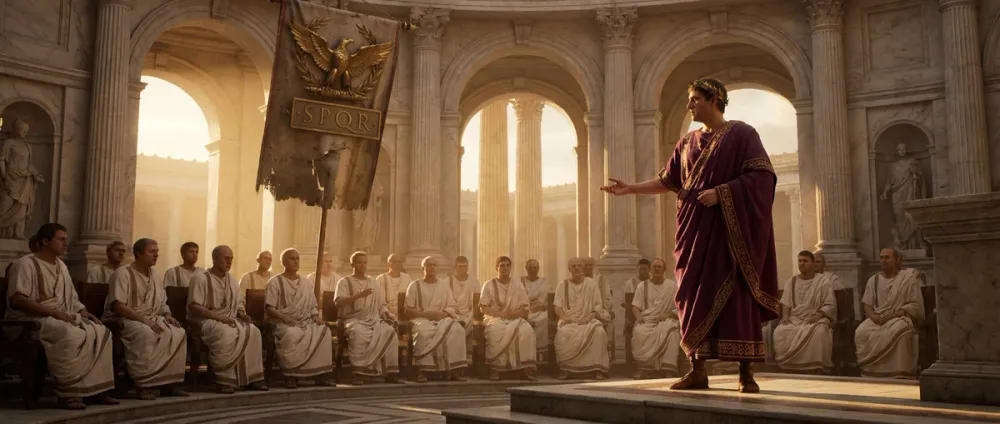
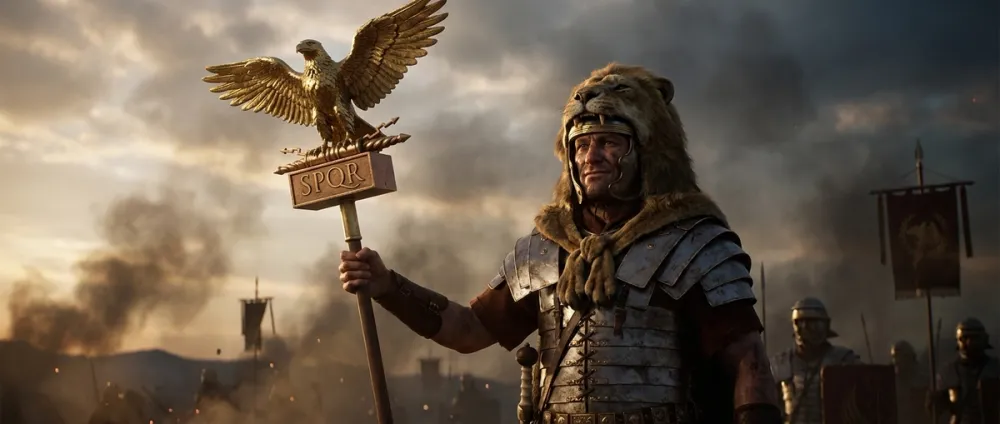
That exact formula went on to appear everywhere the Roman state wanted to make its authority visible: on coins, on official documents, and above all on the standards carried by the legions — every legionary marching under that symbol was officially fighting not for one man, but for the Senate and the People together. A clever move that anchored loyalty well beyond any single, often short-lived leader.
Why the formula is younger than you'd think
You'd be forgiven for assuming SPQR was as old as the Republic itself, founded in 509 BCE after the overthrow of the last king. In fact, the earliest concrete, archaeologically confirmed evidence of the formula dates only to around 80 BCE — during Sulla's dictatorship, nearly 430 years after the founding of the state. Whether the formula was already in informal use before that remains disputed among historians; hard evidence is lacking either way.
The timing is no coincidence: Sulla's rule was a period of bitter internal conflict between rival political factions in Rome. Some historians suspect the deliberate, visible spread of the SPQR formula at exactly this moment served as a kind of political unity signal — a reminder that, despite their internal power struggles, all factions ultimately remained bound to the same state, the same "Senate and People" idea.
This is HistoryBytes.
Short lessons, real duels, and immersive visuals from a world of history — download it now.
Emperors who used it to mask their own senate's powerlessness
Perhaps the most remarkable thing about SPQR isn't its origin, but its staying power. When the Republic officially gave way to the Empire under Augustus in 27 BCE, the formula should logically have lost its meaning — after all, the Senate under the emperors retained only a fraction of its former real power. Yet the exact opposite happened: emperors deliberately held onto SPQR, kept minting it on coins, carving it into buildings, carrying it on legionary standards.
The reason is a transparent but effective PR move: as long as SPQR stayed visible, emperors could present themselves officially as "representatives of the people's will," even while ruling as de facto absolute monarchs. Augustus himself was a master of this double game — he never called himself "king" (a title Romans despised), but "Princeps," "first citizen," and let SPQR stand as visible proof that the old Republic apparently lived on. The formula became a tool of political continuity fiction — power changed fundamentally, while the symbol stayed deliberately unchanged.
The legionary eagle as Rome's most sacred symbol
How seriously Rome took its SPQR symbol shows most clearly in the moments it was lost. Every legion carried an eagle (aquila) as its supreme field standard, often marked with SPQR directly or carried alongside it — losing that eagle in battle counted as one of the greatest disgraces a Roman unit could possibly suffer. In 9 CE, Rome lost three entire legions along with their eagles to Germanic tribes under Arminius at the Battle of the Teutoburg Forest — a catastrophe that reportedly drove the aging Emperor Augustus to beat his head against the palace walls, crying out, "Varus, give me back my legions!"
Rome spent years waging campaigns with the sole purpose of recovering the lost eagles — not out of strategic necessity, but out of pure symbolic pride. It actually worked: two of the three eagles were recaptured as early as 15-16 CE under General Germanicus, the third only 32 years after the defeat, in 41 CE. No detail shows more clearly how much SPQR and the symbols carrying it meant to Rome, far beyond mere administrative formality — even decades later, the state considered an entire military campaign worth the cost of recovering a single lost standard.
From pagan to Christian Rome, without interruption
How long did SPQR actually stay in active use? The last known coin minting bearing the formula dates to the reign of Constantine the Great, who ruled from 312 to 337 CE — and was the first Roman emperor to support Christianity. That means SPQR survived not just the transition from Republic to Empire, but the entire religious upheaval of Rome, from traditional pagan worship to Christianity as the new state religion. For nearly 400 years, the same four-letter formula remained a visible state symbol, across fundamentally different political and religious systems.
That extraordinary continuity shows just how deeply SPQR was embedded in Roman self-understanding — a symbol that apparently mattered more than whichever form of government or state religion happened to accompany it at the time.
From medieval uprising to fascism
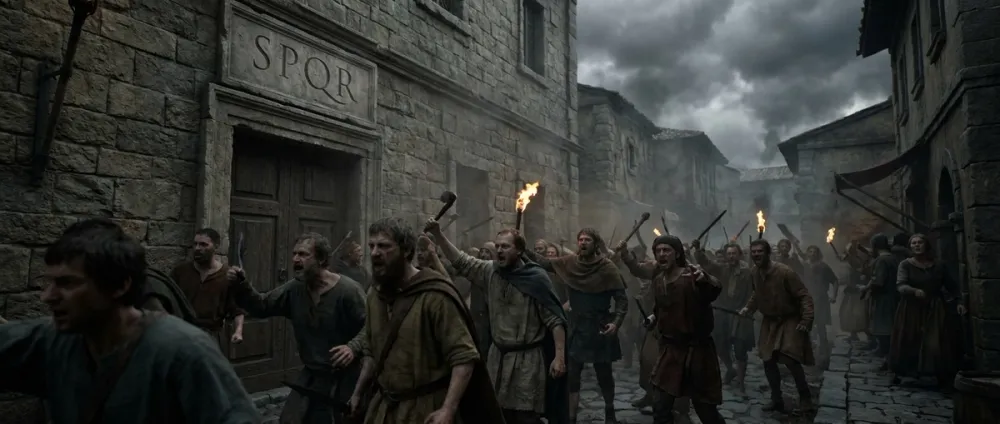
After the fall of the Western Roman Empire, SPQR was far from gone for good. In the Middle Ages, a movement known as the "Commune of Rome" deliberately took up the symbol again — as an act of resistance against papal rule over the city, tied to a dream of returning to Rome's old republican self-determination.
The most famous and consequential modern misuse of the formula, though, happened in the 20th century: Benito Mussolini, Italy's fascist dictator, systematically used SPQR to symbolically tie his regime to ancient Rome — part of his propaganda vision of a "New Roman Empire." To this day, buildings and monuments from the Mussolini era stand in Rome bearing SPQR carvings, right next to genuinely ancient inscriptions far older than them — a silent juxtaposition of real and appropriated history.
A 2,000-year-old abbreviation as a modern city brand
Today, SPQR is the official emblem of the city of Rome — it decorates the municipal crest, appears on official documents of the city government, and turns up, quite literally, on the manhole covers and garbage trucks tourists photograph every day. That makes SPQR arguably one of the longest continuously used political symbols in world history — spanning a crisis of the late Republic, an empire, the Middle Ages, fascism, and now the democratic present of Italy.
Not every modern use of SPQR is meant seriously, though: in the French comic "Asterix," the abbreviation gets a tongue-in-cheek reinterpretation as "Sono Pazzi, Questi Romani" — "These Romans are crazy."

A symbol that opens a window into all of Roman history
Details exactly like this sit behind every season in HistoryBytes — small, everyday traces that, looked at closely, tell the story of an entire civilization. In the Emperors of Rome season, you'll keep running into symbols, titles, and formulas like SPQR that reveal far more about power, legitimacy, and Roman self-identity than their simple outward form suggests. That's exactly what makes history exciting: realizing how much meaning can hide behind four seemingly simple letters.
Four letters, an entire empire
In the end, SPQR tells a story that reaches well beyond Rome itself: the story of how symbols can outlast power, how they get reclaimed and reinterpreted again and again by completely different political systems — Republic, Empire, medieval commune, fascist dictatorship, modern democracy. The four letters themselves haven't changed once since their first confirmed use around 80 BCE. What changed, every single time, was only what they were being claimed to mean — quiet proof that symbols rarely keep the meaning they started with, but instead become whatever each era decides to make of them.