Samurai vs Knight: Who Would Actually Win?
September 21, 2026 · HistoryBytes Team
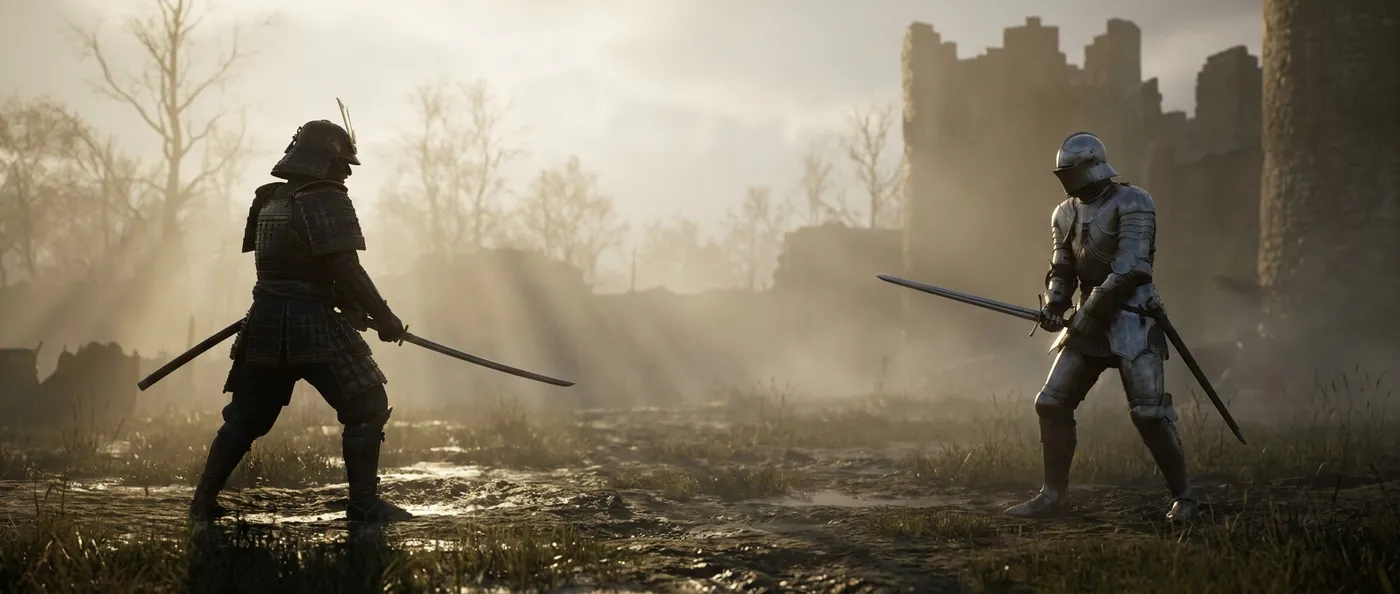
Two legends who never actually met
Few historical comparisons come up as often as this one: samurai versus knight — who would win? Both are treated as the ultimate warrior of their culture, both are wrapped in codes of honor, both keep showing up as a duel pairing in movies, video games, and internet debates. What almost always gets lost: these two warriors never actually met in real history. European knights dominated the battlefield from the 9th to the 15th century; samurai ruled Japan from the 12th to the 19th century — different continents, different centuries, not a single documented encounter. The question "who would win" is, at its core, a thought experiment, not a historical event. That's exactly what makes it interesting, though: it forces a genuine comparison of armor, weapons, and training — and quite a few pop-culture myths collapse along the way.
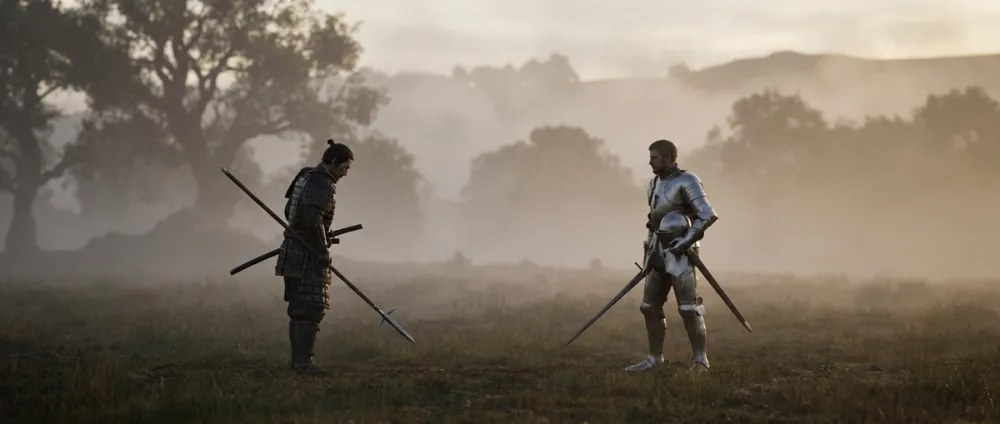
Different continents, different laws
To make the comparison fair, you first have to understand how different the systems these warriors came from actually were. European knights were part of a feudal system — they swore fealty to a lord in exchange for land, bound by a code of chivalry that emphasized bravery, piety, and protecting the weak, heavily shaped by the Church.
Samurai instead served a daimyō (feudal lord) within a strictly hierarchical system built on stipends rather than land grants, following bushido — a code of loyalty, discipline, and martial mastery. Worth noting, as we've covered in another article: the term "bushido" in its modern, codified form was actually coined around 1900 — during the actual age of the samurai, there was no single written rulebook by that name, more a loose collection of unwritten values.
Historians broadly agree: comparing knights and samurai directly means placing two entirely different societal systems side by side — not two variants of the same job.
How boys became warriors
Both traditions began training in childhood — but with different emphasis. Knights went through a strict tiered system: page first, then squire, serving an experienced knight, tending his horse, and learning swordsmanship, lance work, and shield use along the way. Tournaments — jousting and group melees — served as practical training under controlled, if still genuinely dangerous, conditions.
Young samurai learned kenjutsu (swordsmanship), kyujutsu (archery), and horsemanship — but just as much calligraphy, poetry, and Confucian ethics. This combination wasn't accidental: Zen Buddhist principles were meant to help control fear and distraction in battle, formalized in martial arts schools like Katori Shintō-ryū or Kashima Shintō-ryū.
The difference can be summed up like this: knightly training aimed more at physical dominance and formation combat, samurai training at precision, discipline, and mental control. Neither system was "better" — they prepared warriors for fundamentally different combat realities: massed cavalry battles in Europe, often smaller, more mobile engagements in feudal Japan.
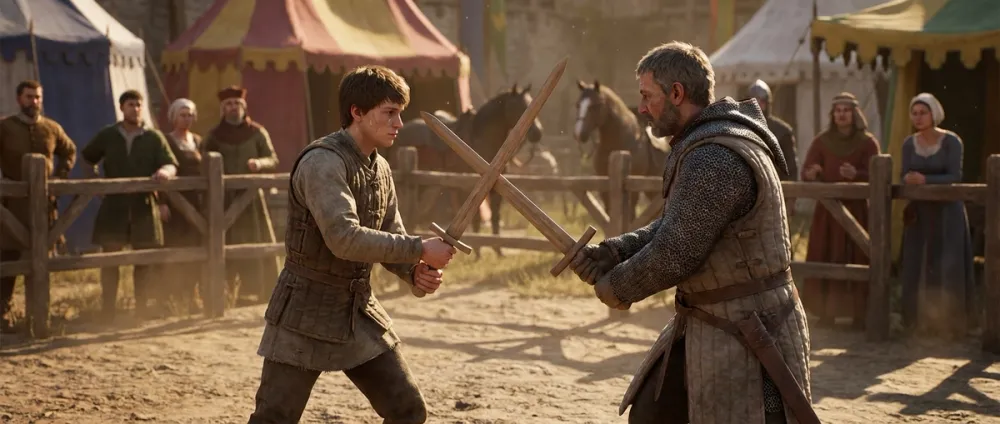
Two real men who show what these systems were capable of
Instead of talking about "training" in the abstract, it's worth looking at two real men who pushed these exact systems to their absolute limits. William Marshal, born around 1146 as the penniless younger son of a minor nobleman, was even held hostage as a child — his own father is said to have replied dryly that he still had "the hammer and the anvil to forge more and better sons." With no inheritance or fortune, William built his entire career on tournaments: according to tradition, he defeated roughly 500 opponents in one-on-one combat over his lifetime, including the future King Richard the Lionheart. He served five English kings, eventually became regent of England, and went down in history as "the greatest knight who ever lived" — a title his own contemporaries gave him.
On the other side of the world, roughly 450 years later, Miyamoto Musashi perfected a different system to the point of mastery: as a ronin — a masterless samurai with no fixed lord — tradition holds he fought over 60 duels without a single defeat. His most famous weapon in his most legendary duel wasn't even a real sword, but a wooden blade carved from an oar, which he used to defeat his armed rival Sasaki Kojirō.
Both men prove the exact same principle in completely different ways: elite training in either system could produce warriors who were practically unbeatable — just under entirely different rules.
Experience chivalry in HistoryBytes
This is HistoryBytes.
Short lessons, real duels, and immersive visuals from a world of history — download it now.
Why the "clumsy knight" is a pop-culture error
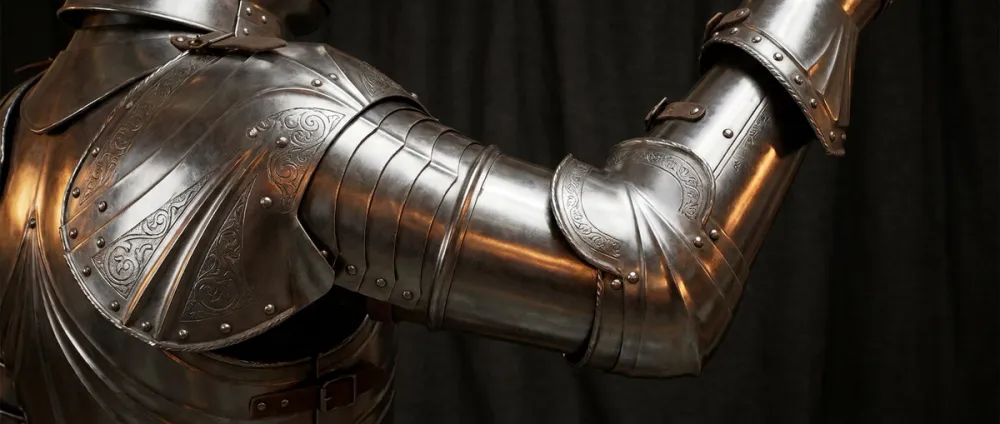
One of the most stubborn myths of all: knights in plate armor were slow and immobile, barely able to stand back up if they fell. That's simply false historically. A full suit of plate armor weighed between 27 and 36 kilograms — comparable to a modern infantry soldier's gear — and was so well balanced across the whole body that trained knights could run, climb, and even vault onto their horses in it. The weight was a factor, but not a crippling one.
Samurai armor (typically lamellar or plated construction using lacquered leather and metal) was generally lighter and prioritized freedom of movement over maximum protection. That made samurai warriors more agile and faster — but it came with a downside too: against the sheer force of a European longsword strike or hammer blow, this lighter armor was noticeably more vulnerable than a closed steel plate.
The fair comparison, then, isn't "one armor was better" — it's that each armor type was a deliberate answer to the combat situation it was expected to face: heavy plate for absorbing massed cavalry lance impacts and foot combat against other heavily armed opponents, lighter lamellar for fast, mobile individual engagements and mounted archery.
The second big myth: the "superior" sword
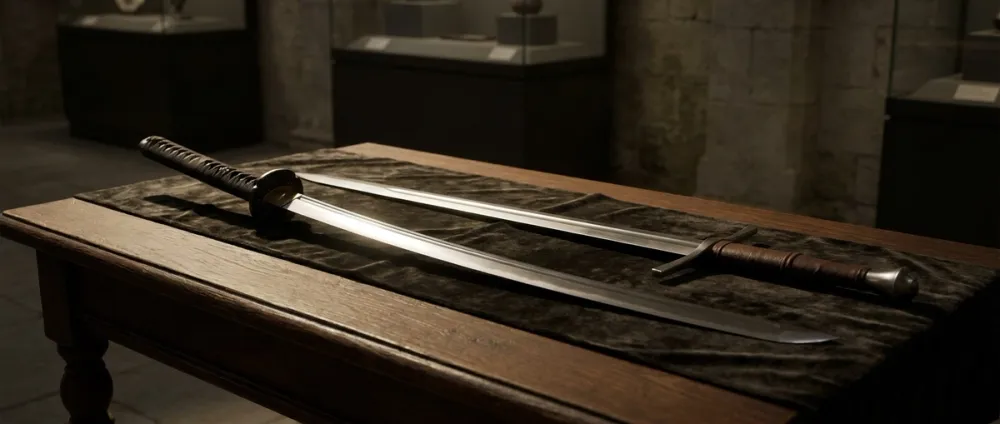
Pop culture loves to portray the katana as the ultimate blade, effortlessly cutting through anything. That doesn't fully hold up either: katanas weigh, on average, roughly the same as European longswords — the often-claimed speed advantage from lower weight is largely a myth. What actually sets the katana apart is its curved blade geometry, optimized for fast draw-cuts, while European longswords leaned more toward thrusting and heavy chopping strikes, often gripped two-handed for maximum power.
Also worth noting: the katana was only one of a samurai's main weapons, on equal footing with the yumi (longbow) and the yari (thrusting spear) — mounted archery was long considered the most prestigious skill of all, not swordsmanship. Knights, meanwhile, carried lances for cavalry charges alongside the longsword, plus maces and war hammers — the latter specifically designed to smash through plate armor by blunt force, where a blade would simply glance off.
Another structural difference: European knights relied heavily on shields as an active combat tool from early on, not just for cover. Japanese martial arts instead leaned more on armor, movement, and two-handed weapon use — a fundamentally different defensive philosophy, not a sign of being behind on either side.
The honest answer: it depends
After all the facts, the real question remains: who wins? The most honest answer, and the one historians and martial arts experts tend to lean toward, is that it depends almost entirely on the scenario, not on some built-in advantage for either side.
Mounted combat in an open field: Here the knight likely has the edge. The force of a massed lance charge, combined with heavy armor, is extremely hard to counter — a samurai would need to dodge the impact entirely rather than block it head-on.
Unarmored or lightly armored close combat with plenty of room to move: Here the picture shifts toward the samurai. Greater mobility, precise sword training, and a habit of fast, evasive movement could cause serious trouble for a more heavily laden knight before he even closes the distance.
A fully armored one-on-one duel in tight space: This is where it gets murkiest — the knight's plate armor offers massive protection against cutting attacks, while precisely aimed thrusts into joint gaps or heavy hammer blows could still get through. A stalemate is the most likely outcome here, decided more by individual skill than by equipment.
Ranged combat before melee even begins: An often-overlooked factor: samurai training in mounted archery (yabusame) meant they were trained to weaken or kill opponents before any physical contact at all — a combination of speed and precision that European knights largely didn't possess. In a scenario with open terrain and advance warning, this one skill alone could decide the whole outcome before sword or lance ever came into play.
The most serious summary from historians who study both traditions: samurai and knights never had a scheduled "world championship match" — they lived on different maps, in different centuries, under different legal systems. The fair comparison isn't "who wins," but "how differently did two cultures solve the same basic problem — training the perfect warrior?"
Step into the world of the samurai in HistoryBytes
Not a duel, but a trade deal — and Japan was clearly the stronger side
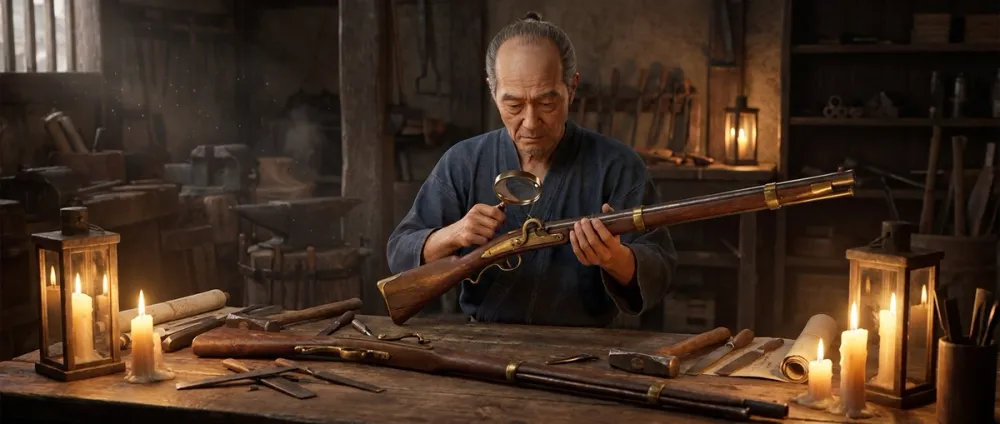
While samurai and knights never met, Japan and Europe did actually cross paths in real history — just in a completely different way than you'd imagine. In 1543, two Portuguese traders were shipwrecked aboard a Chinese junk on the Japanese island of Tanegashima. The local lord, Tanegashima Tokitaka, immediately bought two of the matchlock guns the strangers carried and commissioned a swordsmith to reproduce the mechanism — an effort that initially stalled on a detail Japan had never encountered before: the screw threading needed for the breech.
The problem got solved, and what happened next is remarkable: within just ten years, Japan produced an estimated 300,000-plus of these so-called tanegashima firearms — more than were in circulation in many European countries at the time. By 1549, the warlord Oda Nobunaga had already ordered 500 units for his own army, later deploying them in the famous Battle of Nagashino (1575) with such massed, tactically sophisticated volleys that they shattered traditional cavalry lines outright.
The real "encounter" between the two warrior cultures, then, wasn't a duel at all, but a technology exchange — and Japan was far from the lagging side. It adopted and perfected the new technology at a speed that would have astonished many European powers of the era.
Two traditions, one principle
HistoryBytes was never about memorizing dates — it's about understanding how people like these warriors actually lived: how they trained, what they fought for, what values guided their actions. In the Tales of Chivalry and Whispers of the Samurai seasons, you'll meet figures exactly like this — not as movie clichés, but woven into the real stories behind them. This exact comparison shows just how much nuance hides behind a seemingly simple "who would win" question, once you actually look closer.
Two answers to the same question
The truth behind "samurai versus knight" is, in the end, more interesting than any single answer: two cultures, separated by continents and centuries, independently developed remarkably thoughtful, internally consistent systems for training warriors — each with its own logic, its own strengths, its own blind spots. Maybe the real winner of this thought experiment isn't either warrior at all, but the realization of just how differently people around the world can solve the same problem — and how much is lost when that diversity gets reduced to a single "who's stronger" question.