Eric Bloodaxe: The Viking King Who Killed Four Brothers
September 23, 2026 · HistoryBytes Team

The son who loved his father most — and killed the most brothers
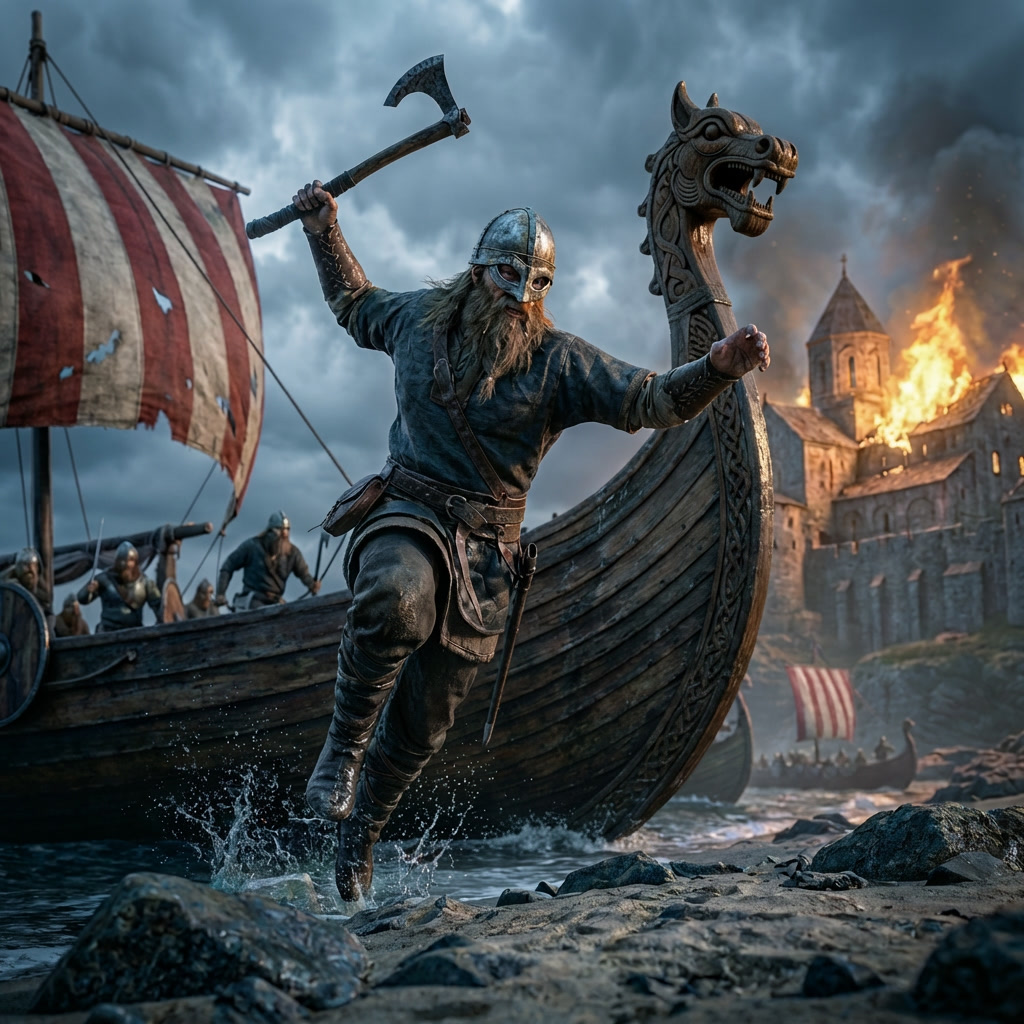
At twelve years old, Eric Haraldsson received five longships of his own from his father — a gift that kicked off his career as a raider before he'd even reached puberty. By twenty, he'd had four of his own brothers killed to secure the Norwegian throne. The nickname he's remembered by leaves little room for interpretation: Eric Bloodaxe.
As the favorite son of Harald Fairhair, the first king of a unified Norway, Eric should have had everything a Viking prince could want. Instead, his reign became one of the bloodiest and shortest in Norwegian royal history — before he, cast out of his own homeland, went on to become king twice over in England of all places. Fittingly, a new Amazon Prime series titled "Bloodaxe" is about to bring his story to screens — a good moment to know the real version behind it.

Seven years of raiding before he was even an adult
According to the Icelandic sagas, Eric's career as a Viking leader began at just twelve years old, and what followed reads like a deliberate apprenticeship in ruthlessness: for three years he raided the coasts of Denmark, Friesland, and Saxony, before spending four more years raiding Scotland and the area around the Irish Sea. He wasn't even twenty yet.
On one of these voyages, he met and married Gunnhild — described in the sagas as a powerful, feared figure, often associated with sorcery. Her exact origins remain disputed among historians: some sources name her the daughter of the Danish king Gorm the Old, others give her an entirely different lineage from northern Norway. One particularly colorful saga account claims Gunnhild once sought to apprentice herself in magic under two Finnish sorcerers, only to trick and have them killed at the end of her training so she wouldn't have to share their knowledge with anyone else — a story that's barely verifiable historically, but says a great deal about the reputation later storytellers gave her.
What's clear is that Gunnhild exerted considerable influence over Eric throughout their marriage, and later sources even portray her as the driving force behind some of his most ruthless decisions. After Eric's fall and death, she remained an influential figure acting on her own terms — raising their children in Scandinavia and later actively intervening in the Norwegian succession, well beyond Eric's own lifetime.
Four dead brothers, one throne
When Harald Fairhair died, exactly the chaos you'd expect from a polygamous marriage with numerous sons followed: multiple claimants to the same throne. Eric, as his father's declared favorite, acted decisively and brutally — he had four of his older half-brothers killed, including Bjørn Farmann, king of Vestfold, to eliminate any serious rival.
The nickname "Bloodaxe" is explained differently across different sources: some trace it to his early, especially brutal raiding campaigns, others directly to the fratricide itself. Some medieval sources even use the alternative title "Brother-Slayer" (fratrum interfector) — a nickname that leaves nothing to the imagination.
This ruthlessness secured him the crown in the short term, but it also cost him the support of large parts of the Norwegian nobility. A kingdom won through the murder of one's own family stood on decidedly shaky foundations from the start — a fact that would soon come back to bite him.

This is HistoryBytes.
Short lessons, real duels, and immersive visuals from a world of history — download it now.
The fifth one he couldn't kill in time
Fittingly, it was the one brother Eric hadn't eliminated in time who became his downfall: Haakon, raised at the court of English King Æthelstan (hence his later nickname "Haakon the Good"), returned to Norway and found broad support among nobles who had long since had enough of Eric's bloody rule.
Haakon prevailed, and Eric was forced to flee — a remarkable fall for a man who, just a few years earlier, had believed he'd secured his position permanently through systematic fratricide. Eric fled across the North Sea to England with Gunnhild and their children, where an entirely unexpected second chapter of his career awaited him.
From cast-out Norwegian to ruler of Northumbria
Once in England, Eric pulled off something that makes his story even more remarkable: he was named king of Northumbria not once, but twice (947-948 and again 952-954), ruling from York — then known as Jórvík, one of the most important power centers of Viking-age England. Archbishop Wulfstan of York, one of the most influential religious and political figures in northern England, actively backed Eric's claim, considerably strengthening his position.
Northumbria was hotly contested territory at the time, caught between Anglo-Saxon kings and various Viking and Hiberno-Norse power brokers — Eric's two separate appointments as king show just how unstable and shifting the balance of power there really was. Between Eric's two reigns, control of Northumbria changed hands multiple times, including a return to English king Eadred — a pattern that shows just how much the region functioned as its own political battleground, almost independent of whatever "official" crown claimed it from London. Archbishop Wulfstan himself later fell under suspicion of playing both sides and was temporarily imprisoned by King Eadred — a sign of just how risky and shifting political alliances in this border region really were.
Chronicles of the era, most notably the Anglo-Saxon Chronicle, describe his rule matter-of-factly, without the dramatizing language of the later Icelandic sagas — a hint that the "barbaric tyrant" portrayal of Eric was largely a later literary exaggeration, not necessarily how contemporaries actually saw him.
Around 954, Eric was killed in battle at Stainmore — his second and final kingdom ending just as violently as his entire career had begun.

Two source traditions, two completely different Erics
A central problem with Eric Bloodaxe: the main sources for his life come from strikingly different traditions with strikingly different reliability. The Icelandic sagas — chief among them later works like the Heimskringla — weren't written down until two to three centuries after the events they describe, by authors who clearly valued literary drama over sober fact. It's exactly this tradition that gives us the bloodiest details: the systematic fratricide, Gunnhild's sorcery, the nickname "Bloodaxe" itself.
English sources from Eric's own lifetime — above all the Anglo-Saxon Chronicle — paint a notably more sober picture. They mention him briefly as "Harold's son," without any of the dramatic embellishment found in the later sagas. That contrast isn't a coincidence: contemporary chroniclers rarely had much interest in dramatizing enemies or distant Norse kings, while Icelandic saga authors centuries later explicitly wanted to tell exciting, morally clear-cut stories.
For you as a reader, that means: the "Eric Bloodaxe" most people know — the ice-cold, calculating fratricide — is, to a significant degree, a later literary construction. The real, historical Eric was probably a fairly ordinary, ambitious power player of his era — just one whose story happened to land particularly good storytellers.
What remained of Eric
After Eric's death, Gunnhild fled back to Scandinavia with their children. Notably, one of Eric's sons, Harald Greycloak, would himself become king of Norway years later — the bloodline Eric had tried to secure through fratricide did, in fact, continue, just by a roundabout route and a generation later.
The historical assessment of Eric remains divided to this day: to some, a bloodthirsty tyrant whose nickname was rightfully earned; to others, a pragmatic ruler who operated successfully in a violent age, his reputation later sharpened by storytellers. Both readings rest on the same sparse, centuries-old sources — one reason his life still leaves so much room for reinterpretation, as the upcoming Amazon series will likely show.

A name that never lost its reputation
Eric Bloodaxe's story is, in the end, one about the cost of power: he won a crown by murdering his own family, and still lost it within a few short years. He found a second, even a twice-repeated, shot at kingship abroad — and yet ultimately died in battle, far from the homeland that had once cast him out. Tyrant or pragmatic survivor: his nickname has outlasted nine centuries, and with the upcoming series, his story is about to reach an entirely new audience — hopefully with a bit more nuance than the bloody shorthand version suggests.