Theobald of Provins: The Bones and Face of a Hermit Noble
 AI
A face after 950 years
In the Church of San Giovanni Battista in Badia Polesine, a small town in northern Italy, lie remains that have been venerated for centuries as those of Saint Theobald of Provins. In October 2026, a research team reported the first examination of these remains using five methods: anthropology, palaeopathology, genetics, radiocarbon dating, and the three-dimensional reconstruction of the face. The work appeared in the International Journal of Osteoarchaeology. The result is that the attribution is plausible, but not proven.
Theobald is an unusual figure for a chivalry season. According to the sources he came from the family of the counts of Champagne, was meant to become a warrior, and at 18 decided against it. He became a pilgrim, then a hermit, then a priest, and died, according to tradition at 33, of an illness that covered his skin. In short: the study says more about our methods than about the man. But it shows how much can be read from 950-year-old bones, and where the limit lies.
A count's son who didn't want to be a warrior
Theobald was born in Provins, a town in Champagne, southeast of Paris. The sources give his birth year differently: according to the study and Wikipedia he was born in 1033, the Heiligenlexikon, Encyclopedia.com, and the Wikipedia disambiguation page give 1017. He came from the family of the counts of Champagne, his father was called Arnulf according to the sources, his mother Willa or Gisela, and he was named after his uncle, Archbishop Theobald of Vienne, who is also regarded as a saint.
The name means, according to the Heiligenlexikon, "the one brave among the people." According to tradition he was raised as a future warrior, as befitted the son of a count. At about 18, says Catholic Online, he gave up the martial career of the men of his family, with his father's permission. The Oxford Reference entry puts it thus: he preferred a hermit's life to a military one. The Heiligenlexikon reports that he came to Reims in 1054 and met Walter there, who likewise lived as a knight. Images of the saint therefore show him both ways: as a hermit and as a rider or knight.
Even as a youth he admired the lives of hermits such as John the Baptist, Paul of Thebes, and Anthony the Great. He visited a hermit named Burchard who lived on an island in the Seine.
 AI
The Church and the violence of knights
Theobald grew up in a time when the Church tried to limit the violence of warriors. After the breakup of the Carolingian Empire in the 9th century, many small counties and lordships had formed in which lords and knights often fought each other. In the 11th century, private feuds increasingly threatened churches and monasteries. On 1 June 989, bishops at the Council of Charroux in Aquitaine proclaimed the "Peace of God," in the presence of large crowds who had gathered around the bones of saints: churches were to be inviolable, soldiers were not to plunder peasants and the poor, and whoever attacked unarmed clergy was excommunicated. Later merchants, pilgrims, and women were added.
The "Peace of God" led to the "Treuga Dei," the truce on certain days. It was first proclaimed in 1027 at Toulouges and prohibited violence on Sundays, holy days, and during Lent. A text from the diocese of Thérouanne said that from Wednesday evening to Monday morning nobody should attack, wound, or kill another. Whether the Peace of God worked is unclear, since there are no crime statistics, but the need for the truce shows that it did not end the violence.
The Peace of God is regarded as a forerunner of what was later called chivalry: the code by which a knight protects the weak, stays faithful to his lord, and keeps Christian virtue emerged, according to a widespread account, only in the 12th and 13th centuries. Theobald's decision thus fell in a time when people were still arguing about what a warrior was good for. That the Peace of God triggered it, the sources do not say, it is only the framework.
This is HistoryBytes.
Short lessons, real duels, and immersive visuals from a world of history — download it now.
From Reims to Compostela and Rome
Theobald and Walter went first to the abbey of Saint-Remi in Reims and then to Pettingen in present-day Luxembourg, where they built themselves two small cells. Because they had learned neither a craft nor farming, they hired themselves out as day laborers in the surrounding villages and earned their bread by simple work, many hours a day. At night they sang the Divine Office. That is one of the details that separates Theobald's life from a knight's: the son of a count hired himself out as an unskilled laborer.
Afterward the two set out on pilgrimage, barefoot, to Santiago de Compostela and to Rome. On the way back, according to Wikiwand, they planned to travel via Venice to the Holy Land. But Walter fell ill near Salanigo near Vicenza, and they stayed. After Walter's death, Theobald joined a group of hermits, and so many disciples gathered around him that the bishop of Vicenza ordained him a priest so he could look after them better.
His family followed him: his mother Gisela, with her husband's permission, settled nearby as a hermit, and his parents visited him. Shortly before his death he took vows among the Camaldolese, whose prior was summoned when it was realized how close Theobald was to death.
 AI
A saint of charcoal-burners and winegrowers
Theobald died on 30 June 1066 near Vicenza, of an illness in which the skin of all limbs was covered with blotches and ulcers, according to tradition probably leprosy. In 1073, only seven years later, Pope Alexander II canonized him.
The Catholic feast day is 30 June, in Badia Polesine he is celebrated on 1 July. He is patron saint of the town of Provins, of farmers, winegrowers, shoemakers, beltmakers, and charcoal-burners, and he was invoked against fever, eye ailments, dry cough, gout, infertility, and anxiety. Why precisely these trades, the sources don't say. That he worked as a day laborer may have played a role, but that is a conjecture.
His remains had an eventful history. He was buried near Vicenza, according to the Heiligenlexikon in the cathedral, according to another account in Sossano. Later the remains reached the abbey of Vangadizza in Badia Polesine. His brother Arnulf took relics to the abbey of Sainte-Colombe in Sens, and in 1705 relics came to Provins. In the hermitage of Saint-Thibaut in Marcourt-sur-Ourthe in Belgium, where a statue at the altar recalls him, a reliquary is said to contain his skull. How that relates to the remains in Italy is open.
 AI
What five methods show
Relics are a rare source for research: skeletons from the early Middle Ages are seldom found in excavations, while in the shrines of saints they often lie preserved for centuries. The research team around Nicola Carrara examined the remains with anthropology, palaeopathology, genetics, radiocarbon dating, and 3D reconstruction. The first result matched tradition remarkably well: the remains belong to an adult man who died at about 30 to 35 years of age, and according to tradition Theobald became 33. The second result came from radiocarbon dating: a tooth root gave a calibrated age of AD 988 to 1163 at 95 percent confidence. Theobald's lifetime, 1033 to 1066, lies comfortably in this range.
The team nevertheless does not write that the attribution is proven. It concludes instead that the anthropological findings, the historical sources, and the radiocarbon dating make the traditional attribution plausible. That is a careful and correct sentence: a span of 175 years cannot distinguish between Theobald and another man of the 11th century. It rules out that the remains are much older or much younger, no more.
The researchers also asked whether Theobald had leprosy. On the skull they found changes to the nose, palate, and jaw that can occur in a certain form of leprosy, the multibacillary one. But these changes are not typical of leprosy, and the hands and feet, which would clarify the finding, have not survived. The genetic examination also found no DNA of the pathogen Mycobacterium leprae. Leprosy thus remains a possibility and not a diagnosis, since other chronic infections can leave similar traces.
A face of bone and assumptions
The most striking result is the three-dimensional reconstruction of the face. The team created a high-resolution 3D model of the skull and used 52 markers for soft-tissue thickness to estimate the facial shape. The reconstruction deliberately follows the anatomy of the skull and does not try to reproduce the changes of a possible disease. It was first shown publicly in 2020 in Badia Polesine, after an examination of the relics in 2019. The basis was hundreds of digital photos of the skull.
The limits are clearly named. The genetic analysis did not provide enough information to determine features such as pigmentation. Skin tone, eye color, hair, and beard of the man are therefore hypothesis and not scientifically determined. The face thus shows a possible shape, no more.
 AI
Where the remains lie
Badia Polesine lies on the right bank of the Adige and owes its name to the Benedictine abbey of Santa Maria della Vangadizza, around which the town developed. The abbey arose, by one account, around the year 900 or in the middle of the 10th century, founded according to one account by the Este, and was for centuries an independent state answerable directly to the Holy See, until its secular power ended in the 14th century. In the first half of the 13th century the Camaldolese replaced the Benedictines, the same order to which Theobald belonged at the end.
In 1810 the abbey was suppressed by a decree of the Napoleonic period, and Theobald's remains came to the archpriest's church of San Giovanni Battista, where they lie to this day. It is the main church of the town and received its present form mainly in the 18th century, when it was expanded, parts date from the 12th century. Saint Teobaldo is patron saint of Badia Polesine. According to local accounts, a festival procession in medieval costume moves through the town every year, recalling the transfer of the relics to Saint-Thibault in 1075.
 AI
Open questions
Even after the study, questions remain. First, the birth year: the sources give 1017 or 1033. The skeleton's age, 30 to 35, fits 1033, because at 1017 Theobald would have died at about 49. That speaks for 1033 but is no proof, since the age estimate on a skeleton has its own uncertainty. Second, the place: where exactly he died and was buried, the sources give differently, near Vicenza, in Salanigo, or in Sossano.
Third, the relics: parts are said to lie in France, a skull in Belgium. The study examines only the remains in Badia Polesine. Fourth, the illness: leprosy is possible according to the bones and tradition, but not documented. Fifth, the face: it is a scientifically founded assumption of the shape, not a portrait. The study says so itself: it cannot show beyond doubt that the man whose face was reconstructed really is Theobald. And like any single publication, this one needs checking by other teams before it can be treated as established knowledge.
The overview at a glance
To wrap up, the short version, so fact and story don't blur.
| Category | What belongs here |
|---|---|
| Well documented | The 2026 study (Carrara et al., International Journal of Osteoarchaeology) with anthropology, palaeopathology, genetics, radiocarbon dating, and 3D reconstruction; remains of an adult man of 30 to 35 years; radiocarbon of a tooth root AD 988 to 1163 (95 percent); no DNA of Mycobacterium leprae found; reconstruction with 52 soft-tissue markers, first shown in 2020; abbey of Vangadizza suppressed in 1810, relics in San Giovanni Battista; canonization in 1073 |
| Handed down | That Theobald came from the family of the counts of Champagne; renunciation of the warrior career at 18; pilgrimage to Compostela and Rome; ordination in Vicenza; death on 30 June 1066; leprosy as cause of death; relics in Sens, Provins, and Belgium |
| Open | Whether the remains in Badia Polesine really belong to Theobald; birth year 1017 or 1033; place of death and burial; whether he had leprosy; how the reliquary in Belgium relates to the remains in Italy; skin, eye, and hair color of the man |
One picture from five angles
Theobald shows how much worldview lies in a single life decision. That's why every season in HistoryBytes is split into five categories, and this story touches all five: Theobald of Provins as a person, Badia Polesine as a place, the study of October 2026 as an event, the Peace of God and the renunciation of the warrior career as an idea, the remains with the facial reconstruction as an object. That's how the Tales of Chivalry season builds the whole picture of a world in which there were also very different answers to the question of what a nobleman should do with his life.
The man without a sword
The story of Agincourt or William Marshal tells of knights who fought. Theobald tells of one who didn't, and perhaps that is why his face interests us so much. He would have had wealth, horses, and a sword and earned his bread instead as a day laborer, sang the Divine Office at night, and died young. Whether the bones in Badia Polesine are his, we don't know for certain. We know that a research team examined them with modern methods and said honestly how far it got. That is, for all the technology, perhaps the most convincing trait of this story. And the question of what a nobleman lives for had more than one answer in the 11th century.
 AI
Experience chivalry in HistoryBytes
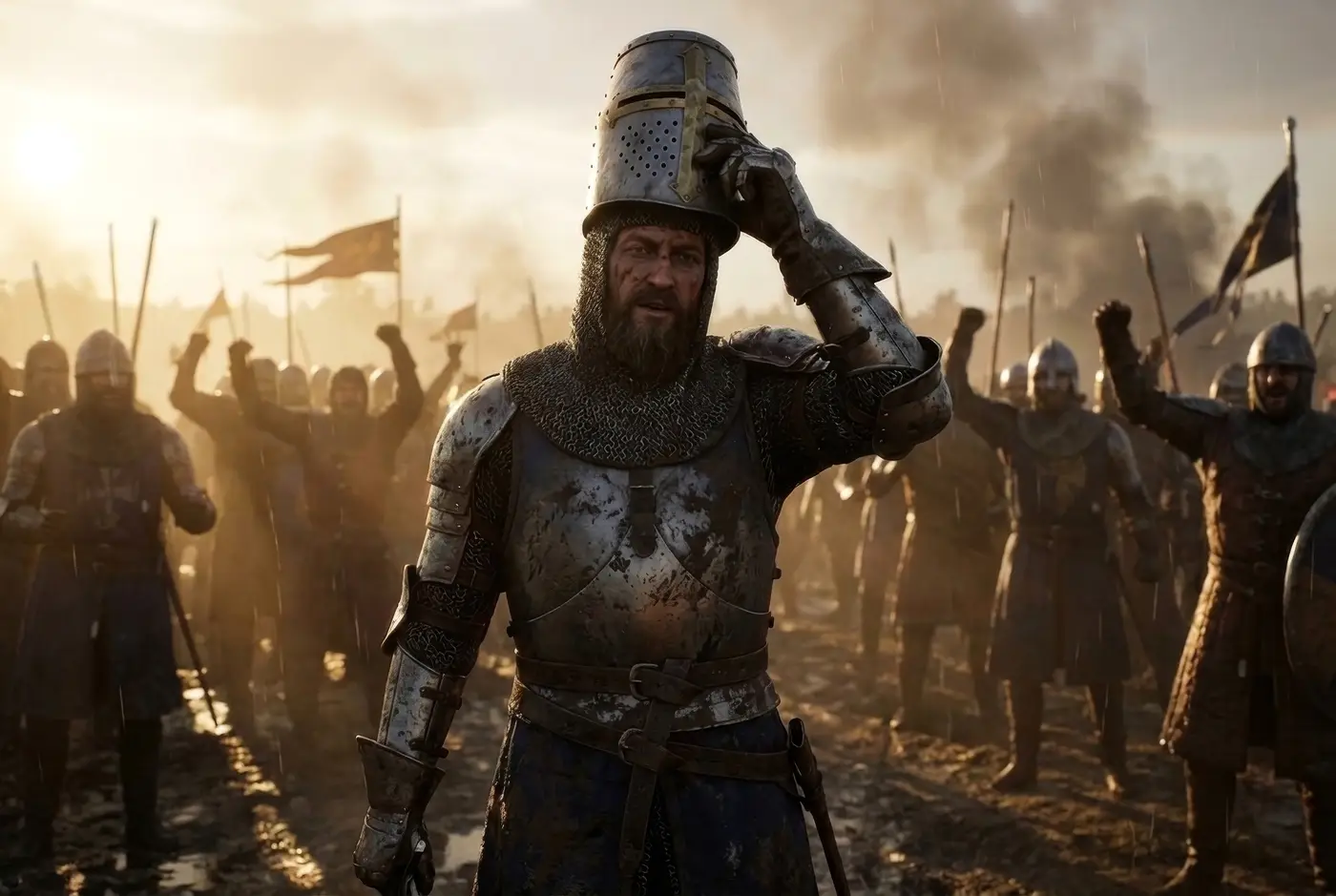
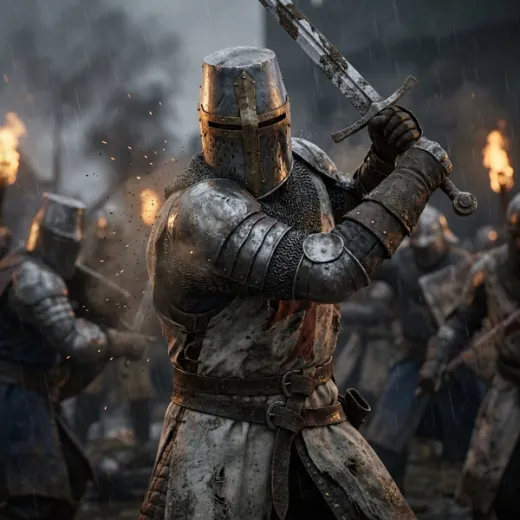
Tales of Chivalry
From squires to crusades — in the Tales of Chivalry season, the age of knights comes alive. Story campaigns, quizzes, and real immersion into a world of honor, castles, and battle.
5 episodes freeThe first 5 episodes are free, Premium unlocks the rest.