Was Cleopatra Egyptian? What the Sources Really Say
 AI
Was Cleopatra Egyptian?
Mostly not, according to most scholars. Cleopatra VII descended on her father's side from the Macedonian Greek Ptolemaic dynasty, and her first language was Greek. Her mother's identity is uncertain, and Egyptian ancestry can't be proven. What is documented: she was the only Ptolemaic ruler known to have learned Egyptian, and she presented herself as pharaoh and the "New Isis."
Test your knowledge
What you are reading is the short answer. If you want to check it, you can answer questions about Cleopatra and the Ptolemies in HistoryBytes, in the Pharaohs of Egypt season, with cards and a quiz, before or after you read the article.
This is HistoryBytes.
Short lessons, real duels, and immersive visuals from a world of history — download it now.
A question that comes back every year
Hardly any figure of antiquity is asked as often whether she was "Egyptian," "Greek," or something else as Cleopatra. The internet argues about it fiercely, films put her on screen with changing faces, and scholarship answers more soberly than you'd expect: the sources say little on the subject, and what they say stands in texts that Romans and Greeks wrote decades or a century after her death.
In short: there is no evidence that Cleopatra was Egyptian on her mother's side. There is a dynasty that for 300 years understood itself as Macedonian Greek, and there is a queen who, more than all her predecessors, made an effort for Egypt. Both are true at once, and that is why the question of ancestry is simpler than the question of identity. This article shows what the sources say, what experts suppose, and what cannot be settled at all.
Macedonian kings in Egypt
Cleopatra VII was born in early 69 or late 70 BC in Alexandria, the daughter of Ptolemy XII Auletes. She descended from Ptolemy I Soter, a Macedonian Greek, a general and companion of Alexander the Great, who got Egypt after Alexander's death and founded the dynasty that ruled there for some 300 years. The Ptolemies ruled as Hellenistic kings and at the same time as pharaohs, and their capital Alexandria was a Greek city on the Egyptian coast.
Her father named her his heir before his death in 51 BC. Then came the quarrel with her brother Ptolemy XIII; Caesar tried to reconcile the siblings and was besieged with Cleopatra in the palace of Alexandria. A little later, according to Plutarch, she had a son by him whom the Alexandrians called Caesarion.
The family often married among themselves, siblings too, as yesterday's article about Arsinoe II showed. They also married into other Hellenistic dynasties, especially the Seleucids. Because the Seleucids had ties to Persian and Bactrian nobility, it is considered likely that Cleopatra also had minor Iranian ancestry, Sogdian and Persian. In sum, scholars largely agree that she was predominantly of Macedonian Greek origin.
The Ptolemies spoke Greek and ruled Egypt, as the sources say, without learning the native language. Cleopatra was the exception.
 AI
The gap in the family story
The most important point of the whole debate is an absence: Cleopatra's mother is not securely known. The common assumption is that it was Cleopatra V Tryphaena, the wife of Ptolemy XII, who was also the mother of Cleopatra's older sister Berenice IV. If that were right, Cleopatra's mother too would be from the Ptolemaic family. It is not certain. Cleopatra V herself is also hard to pin down in the sources, her identity and that of a "Cleopatra VI" are disputed among historians.
Conjectures arise from this gap. The historian Duane Roller has speculated that Cleopatra could have been the daughter of a woman who was half Macedonian Greek and half Egyptian and belonged to a priestly family of the god Ptah in Memphis, in which case she would have been "only technically illegitimate." In scholarship this hypothesis is not generally accepted, and Roller himself stresses that Cleopatra, whatever her ancestry, valued her Greek Ptolemaic heritage most. The historian Adrian Goldsworthy calls the idea of an Egyptian priestly mother "pure conjecture" and considers either Cleopatra V or a concubine, "probably of Greek origin," to be the mother. Stacy Schiff writes that Cleopatra was a Macedonian Greek with some Persian ancestry and that an Egyptian mistress was rare among the Ptolemies.
There is, moreover, no DNA study of Cleopatra, because her tomb is unknown. Every statement about her ancestors therefore rests on written sources and on the dynasty's family history.
The only Ptolemy who learned Egyptian
Here lies the strongest evidence for Cleopatra's relationship to Egypt, and it comes from Plutarch, who described her time around AD 100, about 150 years after the events. In his Life of Antony (chapter 27) it says she knew the speech of many peoples, "although the kings of Egypt before her had not even made an effort to learn the native language, and some actually gave up their Macedonian dialect." Her tongue, he writes, she could turn like an instrument of many strings, and in talks with "barbarians" she seldom needed an interpreter, whether they were Ethiopians, Troglodytes, Hebrews, Arabians, Syrians, Medes, or Parthians.
Current research sums it up this way: her first language was Koine Greek, and she is the only Ptolemaic ruler known to have learned Egyptian. Plutarch also describes how she presented herself: at a public appearance she wore a robe sacred to Isis and was addressed as the "New Isis" (Antony 54). That was probably politics, and a wise kind: whoever ruled Egypt as pharaoh needed the priesthood and the people on their side, and a ruler who spoke their language and embodied their goddess had both more easily.
You shouldn't conclude too much from it. That she learned Egyptian doesn't make her Egyptian, and Plutarch's list of peoples says something about her gift for languages, not about her origin. It shows a Greek who made more effort in Egypt than all her predecessors.
 AI
What Plutarch, Cassius Dio, and coins say
Her appearance is a question of its own, and the sources are surprisingly reserved. Plutarch writes: "Her beauty, as we are told, was in itself not altogether incomparable, nor such as to strike those who saw her, but converse with her had an irresistible charm." He emphasizes her voice, her persuasiveness, and her presence. The Roman historian Cassius Dio, by contrast, calls her "a woman of surpassing beauty." Both wrote long after her death, and both come from the world of Rome, which was her opponent and often drew her in its tradition as a dangerous seductress.
Pictorial evidence consists of coins and a few busts. The known likenesses show a ruler with a prominent nose, a hairstyle of curls in the "melon style" gathered into a knot at the nape, and almond-shaped eyes. But they are ruler portraits meant to show an image of power, not portraits in the modern sense. Neither skin color nor ancestry can be read from them. Skin and hair color are not recorded.
 AI
The boy from the Octagon of Ephesus
In the debate on Cleopatra's origin a skeleton plays a part that was never hers. In Ephesus, the city in present-day Turkey, a skeleton was discovered in 1929 in a tomb building, the Octagon. The archaeologist Josef Keil took the skull to Vienna. In the 1990s the archaeologist Hilke Thür put forward the hypothesis that the tomb was that of Arsinoe IV, Cleopatra's younger sister or half-sister, who is said to have been killed in Ephesus in 41 BC at Antony's instigation. The grounds were the shape of the building, said to recall the lighthouse of Alexandria, the age of the bones, and the finding that it was a young woman.
A second claim followed: from old measurements and photos of the skull, "African" features of the mother were derived. That was rejected by experts, because skull measurements are not a reliable indicator of origin, because the remains could not be unambiguously assigned to Arsinoe, and because Arsinoe and Cleopatra had the same father but possibly different mothers.
In January 2025 a team at the University of Vienna around Gerhard Weber published in Scientific Reports the examination of the skull, which lay in the university's collection. Result: it is a boy between 11 and 14 years old with pathological developmental disorders. The skull's DNA matches the femur from the tomb, and radiocarbon dating fits Arsinoe's lifetime, but the skeleton is male. The team concludes: "What we can now say with certainty is that the person buried in the Octagon was not Arsinoe IV." The boy may have belonged to a rich or high-ranking Roman family, his identity remains unknown. The search for Arsinoe's remains continues.
Where does Cleopatra lie?
Cleopatra's tomb has not been found. The ancient sources say she withdrew into a mausoleum near Alexandria, which according to Plutarch lay near a temple of Isis, and died there when Octavian conquered Egypt. The underwater archaeologist Franck Goddio suspects the mausoleum on the submerged island of Antirhodos between the palace and the temple of Isis in the harbor of Alexandria.
The archaeologist Kathleen Martínez, a Dominican lawyer and diplomat, by contrast has been digging since 2004 in the temple of Taposiris Magna, about 48 kilometers west of Alexandria. She suspects the priests secretly buried Cleopatra and Antony there. Her team found in 2022 a tunnel about 1,300 meters long at a depth of 13 meters, plus coins with Cleopatra's image (according to the ministry 337 in the campaigns), and in 2025, with a team around the ocean explorer Robert Ballard, a submerged harbor that fits the tunnel.
Experts are skeptical. In an email to CNN, Draycott writes that Cleopatra had her own harbor in Alexandria next to her palace and that the literary sources agree her tomb was in Alexandria. Zahi Hawass says the Egyptians never buried in temples. Even if the tomb is never found, Martínez's work has confirmed the temple's connection to Isis. But it is no proof of Cleopatra's tomb.
 AI
Five things we don't know
First, the mother: who she was is not documented. Second, the ancestors: predominantly Macedonian Greek is the majority view of scholarship, minor Iranian shares are considered likely, Egyptian ones are neither documented nor excluded. Third, the appearance: skin and hair color are not recorded, coins and busts are ruler images. Fourth, the tomb: it is unknown, so there is no DNA.
Fifth, the sources themselves. Plutarch wrote around AD 100, Cassius Dio later, both from Rome's point of view. What they say about Cleopatra's languages or her appearance as Isis is plausible but not independently confirmed. That is worth bearing in mind for every claim that goes beyond these texts, from both sides of the debate.
The evidence at a glance, what a short answer doesn't show
To wrap up, everything at a glance, with fact and story kept apart.
| Category | What belongs here |
|---|---|
| Well documented | Born 69 or 70 BC in Alexandria, daughter of Ptolemy XII; descended from Ptolemy I Soter (Macedonian Greek); first language Koine Greek; the only Ptolemaic ruler known to have learned Egyptian; majority scholarly view: predominantly Macedonian Greek, with minor Iranian share; University of Vienna study (2025): skull from the Octagon of Ephesus is that of a boy of 11 to 14, not Arsinoe IV; tomb not found |
| Handed down | Plutarch's statements about her languages and her charm (Antony 27); her appearance as the "New Isis" (Antony 54); Cassius Dio's "surpassing beauty"; coin images as ruler image |
| Disputed or open | Who her mother was (Cleopatra V or a concubine); whether she had Egyptian ancestors (Roller's hypothesis not generally accepted); her appearance; where her tomb lies (Alexandria according to the sources, Taposiris Magna according to Martínez) |
One picture from five angles
Cleopatra shows how many questions lie in a single figure. That's why every season in HistoryBytes is split into five categories, and this story touches all five: Cleopatra VII as a person, Alexandria as a place, the skull study of 2025 or the search at Taposiris Magna as an event, the question of what "Egyptian" and "Greek" mean in a dynasty as an idea, the coin with her profile as an object. That's how the Pharaohs of Egypt season builds the whole picture of a world in which languages, gods, and ruling houses interlocked.
A Greek who learned Egypt
Cleopatra was, by all we know, a Greek who learned Egypt. That is less than the legend and more than the legend's opponents admit. She spoke the language her predecessors did not speak, she wore the robes of the goddess Egypt loved, and she ruled there to the end. Where she is buried we don't know, and how she looked, equally not. That the question of her origin nonetheless occupies so many people perhaps says more about us than about her: we like to make figures of the past our own. The sources are more honest about it.
 AI
Sources and date: 4 November 2026
Plutarch, Life of Antony, chapters 27 and 54 (around AD 100); Cassius Dio, Roman History; Duane W. Roller, "Cleopatra: A Biography" (2010); Adrian Goldsworthy, "Antony and Cleopatra" (2010); Stacy Schiff, "Cleopatra: A Life" (2010); Gerhard W. Weber et al., "The cranium from the Octagon in Ephesos," Scientific Reports (January 2025), with the University of Vienna press release (12 January 2025); CNN on the tomb search at Taposiris Magna (26 September 2025). This page is updated when new finds are published.
Experience ancient Egypt in HistoryBytes
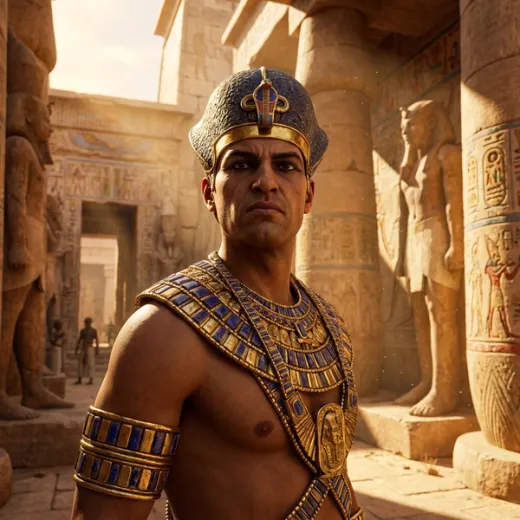
Pharaohs of Egypt
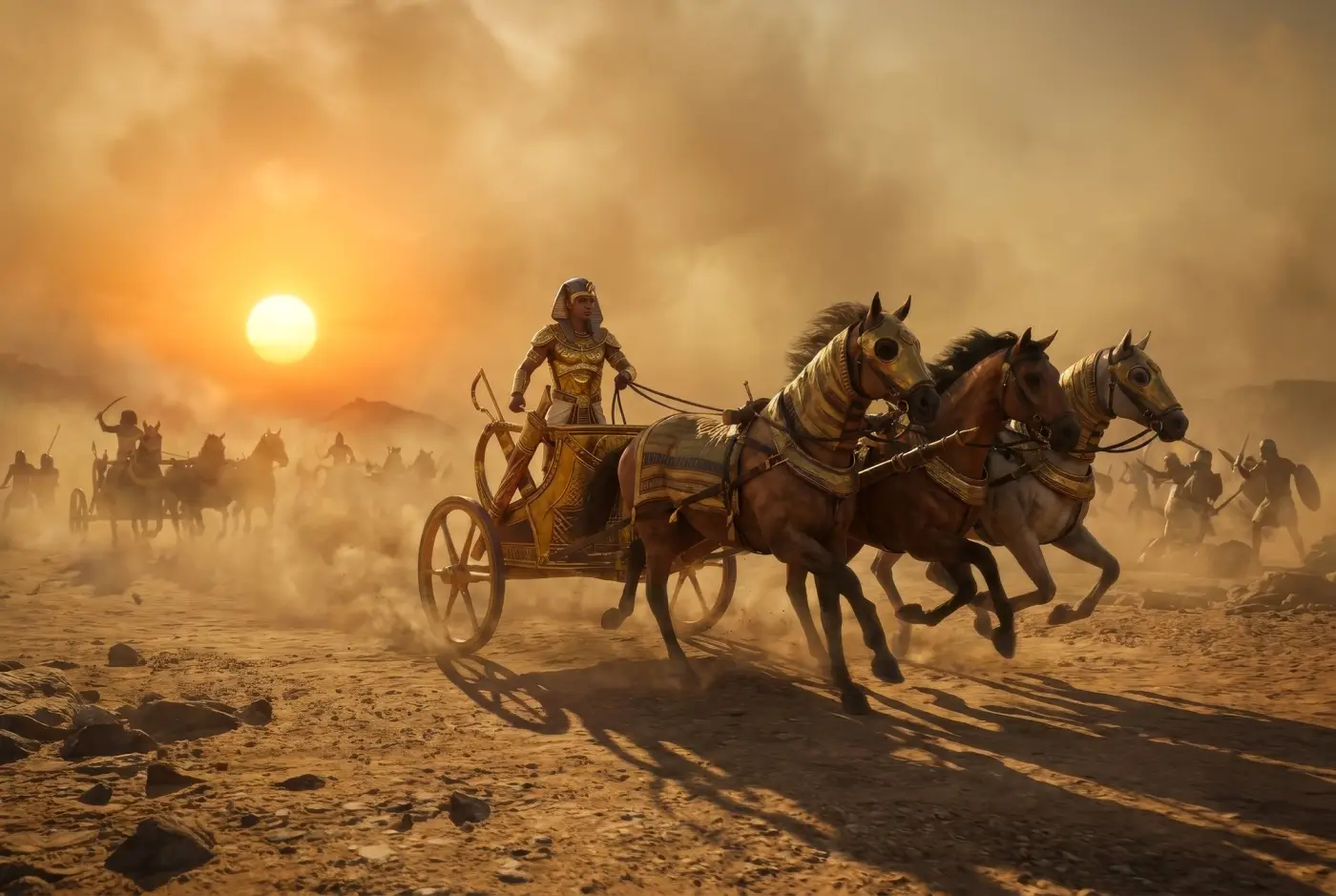
From pharaohs and pyramids to the secrets of the Nile — in the Pharaos of Egypt season, ancient Egypt comes alive. Story campaigns, quizzes, and real immersion into a world of power, belief, and mystery.
5 episodes freeThe first 5 episodes are free, Premium unlocks the rest.