Agincourt 1415: How Many Fought and Where Was the Battle?
 AI
The most famous battle of the Hundred Years' War, and what we don't know
On 25 October 1415, Saint Crispin's Day, an exhausted English army under Henry V defeated a considerably larger French knightly army in northern France. Yesterday was the 611th anniversary. The battle is documented by at least seven contemporary accounts, three of them from eyewitnesses. Even so, historians still argue over two basic questions: how many men fought on each side, and where exactly did the battle take place?
In short: that the English won is certain, as is the role of the longbow, the mud, and the narrow front. Open are the numbers, which range, depending on the historian, from a ratio of 4 to 3 to more than 4 to 1, the exact site, for which there is no archaeological evidence at the traditional field, and the question of how many prisoners Henry had killed.
From Harfleur to Calais, and an army that shrank
Henry's army landed in northern France on 13 August 1415. According to the sources it consisted of about 12,000 men and up to 20,000 horses and besieged the port of Harfleur. The town surrendered on 22 September, but the siege took longer than planned, and many soldiers died of disease. Instead of sailing back to England, Henry marched with about 9,000 men through Normandy to Calais, to show that his claim to the duchy was more than a legal assertion.
The march did not go smoothly: the French blocked the Somme, so the English had to turn south to find a ford. In the end they had covered 260 miles (420 kilometers) in two and a half weeks, had little food, and suffered from dysentery. The French army, led by the Constable Charles d'Albret because King Charles VI couldn't rule due to mental illness, blocked their way to Calais.
 AI
Mud, woods, and stakes
The battle took place on freshly ploughed land, hemmed in by dense woods, which favored the English: because of the narrowness and because of the deep mud through which the French knights had to walk. Henry drew up his men in three groups over a front of about 690 meters, with the men in plate and mail in the center and the longbow archers on the flanks. About 80 percent of his army were English and Welsh archers.
The archers drove pointed wooden stakes at an angle into the ground to make cavalry veer off. That was new for the English and may have been inspired by the Battle of Nicopolis in 1396, where the Ottomans used the tactic against French cavalry. The French knights, by contrast, wore armor of 23 to 27 kilograms, had to keep their heads lowered to avoid being hit in the face, and walked several hundred meters through sticky clay. According to Barker, some knights even drowned in their helmets in the mud, d'Albret among them.
This is HistoryBytes.
Short lessons, real duels, and immersive visuals from a world of history — download it now.
Whoever waited, won
For three hours after sunrise nothing happened. The textbooks of the time said that whoever marches against a standing enemy loses. The French waited for reinforcements, Henry, by contrast, had to attack because his army was growing weaker. He had the stakes pulled up, carried forward, and driven in again, and the archers shot from extreme range, about 270 meters. The French cavalry, which could have disrupted the shooting, attacked only after the first volley, and then not with the planned numbers.
The French knights advancing on foot reached the English line despite the hail of arrows and pushed it back. But they stood so densely that the men in the third rank could hardly use their swords. When the archers ran out of arrows, they put down their bows and fell on the exhausted knights with hatchets, swords, and wooden mallets. The English were lighter and more mobile in the mud, the fallen knights hardly got back up. Henry himself fought hand to hand, an axe blow knocked a piece of the crown off his helmet.
 AI
Chivalry and ransom
After the victory, Henry had most of the French prisoners killed, possibly thousands. Only the highest-ranking were spared because under the rules of chivalry they brought high ransom. Most chroniclers write that Henry feared the prisoners, who outnumbered their guards, could take the weapons lying about and overwhelm the exhausted English army as French reserves regrouped. The chroniclers did not criticize the order.
The English knights refused to take part because they considered it unchivalrous. The historian John Keegan suspects it wasn't about killing as many as possible but about intimidating the prisoners. He estimates that only about 200 archers were involved and relatively few prisoners died before the French reserves fled and Henry withdrew the order. How many were actually killed, we don't know. Shakespeare later portrayed the scene in "Henry V" as a break with chivalry.
 AI
A dispute since 2005
Most contemporary accounts have the English outnumbered several times over. The historian Anne Curry came to a different result in 2005 based on administrative records: the French numbered 12,000, the English 9,000, a ratio of 4 to 3. Juliet Barker, Jonathan Sumption, and Clifford Rogers disagreed: the records were incomplete, the English probably had about 6,000 men, of whom 5,000 archers and 900 to 1,000 men in armor, according to the two eyewitnesses from the English camp.
On the French side, researchers agree more: they count about 10,000 knights and men-at-arms, plus 4,000 to 5,000 archers and crossbowmen, together 14,000 to 15,000, according to Rogers up to 24,000 if armed servants are counted. Ian Mortimer considers a ratio of 15,000 to 8,000 or 9,000 at most to be the extreme that is credible. Barker says a ratio of only 4 to 3 would make a "nonsense" of the course of the battle described by eyewitnesses. The numbers remain a range, not a result.
A field without finds
The exact site is not known. It probably lies on the narrow strip of open land between the woods of Tramecourt and Azincourt, near the modern village. But on this traditional ground archaeological finds are missing, and in excavations in 2015 nothing was found that could be attributed to the battle. That is why it has been suggested that the battle took place west of Azincourt.
The historian Michael Livingston studied sources and early maps and in 2019 made the case for a site west of Azincourt. On old maps he also found the field name "Anglais," which he reads as Henry's camp on the night before the battle. The village itself remembers the battle in the museum Centre Azincourt 1415 and lists there the names of the fallen on both sides. Where they actually lay, nobody knows for certain.
 AI
A generation of nobility lost the battle
Around 6,000 French fighters fell, among them 90 to 120 great lords and bannerets, three dukes (Alençon, Bar, and Brabant), nine counts, an archbishop, and the Constable d'Albret. The heralds counted 3,069 fallen knights and squires, plus at least 2,600 more corpses without coats of arms. Entire noble families died out in the male line. Between 700 and 2,200 men were captured, among them the dukes of Orléans and Bourbon. For the English, at least 112 fallen are documented by name, the chronicler Monstrelet gives 600, Wavrin 1,600.
Henry returned to England on 16 November and entered London in triumph on the 23rd. The victory secured the rule of the House of Lancaster. In France, the truce between Armagnacs and Burgundians broke down, the Burgundians marched on Paris within ten days. That gave Henry 18 months to prepare the next campaign, and English dominance lasted 14 years, until the siege of Orléans in 1429.
The overview at a glance
To wrap up, the short version, so fact and story don't blur.
| Category | What belongs here |
|---|---|
| Well documented | Battle on 25 October 1415 at Azincourt; at least seven accounts, three from eyewitnesses; English victory; archers' share of about 80 percent; mud and narrow front; French losses of about 6,000, among them three dukes and the Constable; Henry's return to England on 16 November; breakdown of the truce between Armagnacs and Burgundians |
| Handed down | Henry's speech and order to kill the prisoners (chroniclers, number unknown); knights who drowned in their helmets in the mud; the French plan to cut off two fingers of the archers; the number of English dead (112 to 1,600) |
| Disputed | How many fought on each side (4 to 3 according to Curry, 4 to 1 and more according to Barker, Sumption, Rogers); how many prisoners were killed; where exactly the battle took place (traditional site or west of Azincourt); whether the attack on the baggage train came at the start or the end of the battle |
One picture from five angles
Agincourt shows how much remains open about a famous battle. That's why every season in HistoryBytes is split into five categories, and this story touches all five: Henry V as a person, Azincourt as a place, the battle of 25 October 1415 as an event, chivalry and ransom as an idea, the longbow as an object. That's how the Tales of Chivalry season builds the whole picture of a time in which chivalry was put to the test on the battlefield.
The names of the fallen
After the battle, Henry gathered the heralds of both armies, who had watched the battle together, and they agreed on the name: Azincourt, after the nearest fortified place. The heralds counted the fallen knights and squires, and the museum in Azincourt still lists the names of the fallen on both sides today. The battle is regarded as a victory of the archers over a knightly army. Whether it was won on this field or on that one is, after more than 600 years, still open.
 AI
Experience chivalry in HistoryBytes
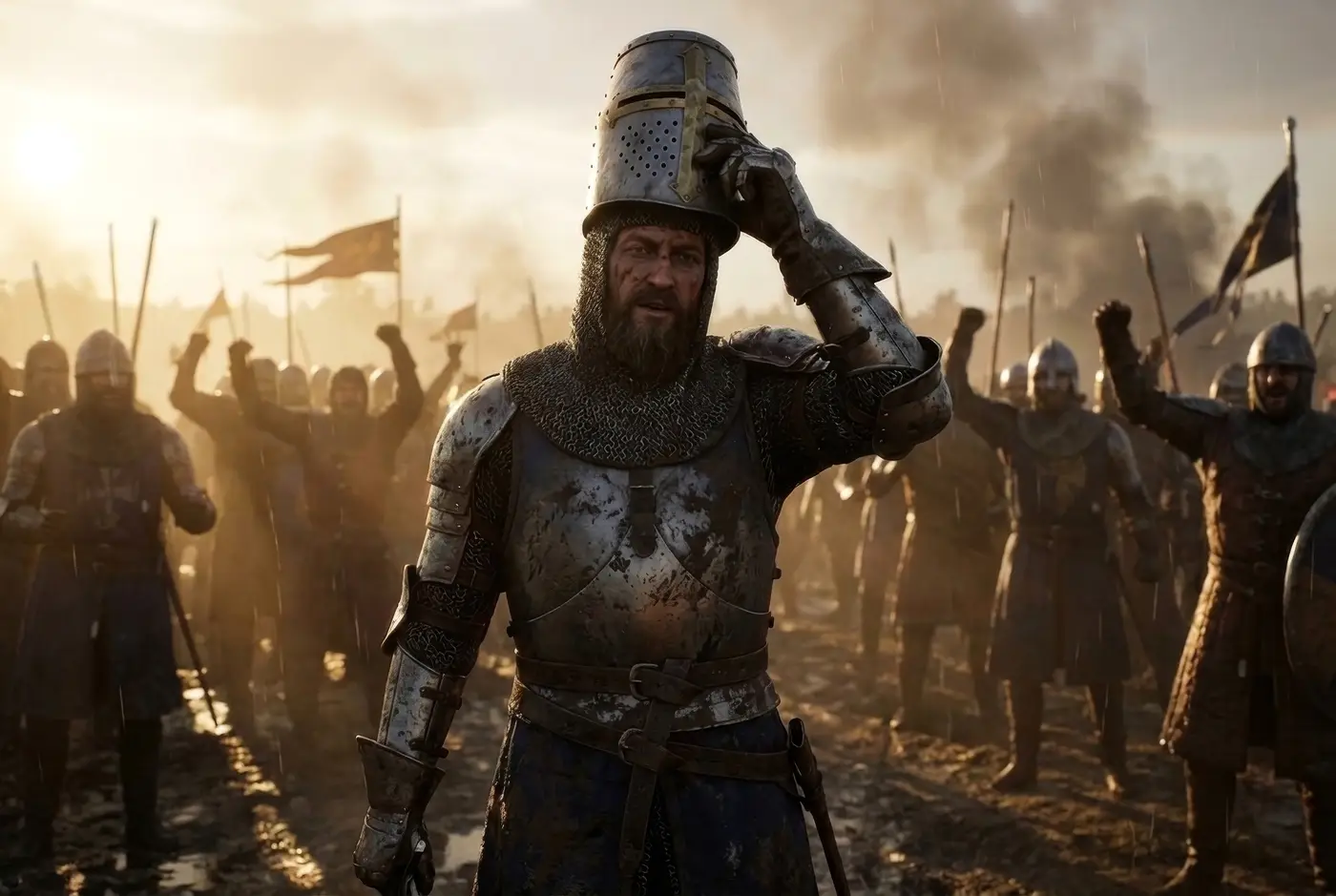
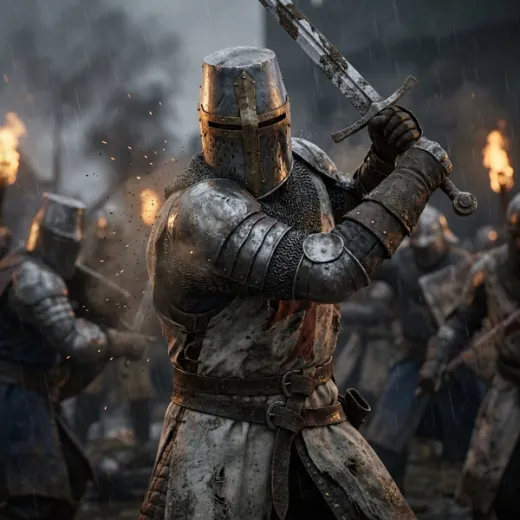
Tales of Chivalry
From squires to crusades — in the Tales of Chivalry season, the age of knights comes alive. Story campaigns, quizzes, and real immersion into a world of honor, castles, and battle.
5 episodes freeThe first 5 episodes are free, Premium unlocks the rest.