The Hanseatic League: The Trade Empire With No King, No Army, No State
 AI
AIAn empire that officially never existed
For four centuries, one power controlled trade across a stretch of nearly 3,000 kilometers between London and Novgorod, binding together over 200 cities across seven modern-day countries. It could economically strangle entire regions, waged its own wars, maintained its own courts in foreign capitals. And yet this power never had a king, never had a true capital city, never had a standing army, never even had an official founding date.
This is the Hanseatic League, a loose alliance of North German merchants and towns that became the most powerful economic network of medieval Europe, without ever being a state in the conventional sense. Historians occasionally even compare its loose but effective structure to modern forms of cross-border cooperation, an early blueprint for how cities could organize themselves across national boundaries without any overarching central authority at all.
 AI
AIThe cog as a technical edge
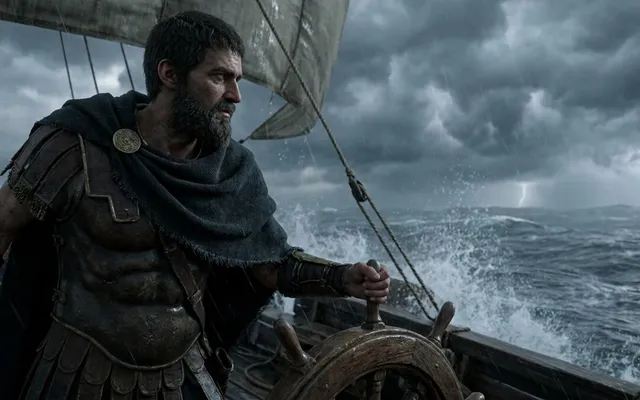
One key, often overlooked building block of Hanseatic success was a single ship type: the cog. Its sturdy, round-bellied hull with comparatively large cargo capacity was ideally suited to the demands of Baltic trade, more cargo per voyage, more stable in rough seas than many competing ship designs of the time. That technical edge gave the League a solid advantage over competitors still relying on older, less efficient ship construction, for decades.
In 2002, archaeologists discovered the wreck of a roughly 700-year-old cog off the Baltic coast near the Darß peninsula, the so-called "Darßer Kogge." The cargo found on board gave researchers unexpected evidence that the League's sphere of influence reached even further than previously assumed, a single wreck retroactively correcting the picture of an entire trading era.
No grand vision, just a security problem
The Hanseatic League's origins lie in the late 12th century, when North German merchants loosely banded together to protect their shared trading interests. The trigger was decidedly unglamorous: the territorial rulers of the time simply couldn't reliably secure trade routes against pirates and robber barons. Towns drew closer together to secure mutual safety, exclusive trading rights, and, where possible, outright trade monopolies.
Lübeck, rebuilt in 1159 under Henry the Lion, became the de facto starting point of this development. In 1241, Lübeck and Hamburg formed a partnership to jointly control the salt and herring trade, two of the most important goods in the medieval north, salt for preservation, herring as a dietary staple. The League wasn't officially founded until 1356, at the first Hanseatic Diet in Lübeck, nearly two centuries after its actual beginnings, an alliance that had long existed before it gave itself a name and a formal structure.
The Steelyard: 300 years of German law on English soil
Perhaps the most striking example of how the Hanseatic League actually functioned was its trading post in London, known as the Steelyard, located on the north bank of the Thames. Within this compound, it wasn't English law that applied, but Hanseatic law, German merchants maintained their own courts to settle disputes, effectively living under their own legal system, in the heart of a foreign capital.
The Steelyard lasted over 300 years, until Queen Elizabeth I finally expelled the Hanseatic merchants in 1598 after decades of trade disputes. The League maintained similar self-governing trading posts, known as kontors, in Bruges, Bergen, and Novgorod as well, each one a kind of extraterritorial German enclave on foreign soil, tolerated for centuries because the economic benefit to the host countries was simply too great to give up.
 AI
AI
This is HistoryBytes.
Short lessons, real duels, and immersive visuals from a world of history — download it now.
The League's real weapon was the boycott
What made the Hanseatic League especially unusual: it held no standing army and claimed no territory of its own, yet it wielded considerable political power. Its most effective tool was economic, the threat of a complete trade boycott could bring individual cities, or even entire kingdoms, to their knees, because the League simply controlled the flow of essential goods like salt, grain, timber, wax, and furs.
In extreme cases, though, the League didn't shy away from open military force either, even if the path there was rarely straightforward. When Danish King Valdemar IV pushed his expansion against Hanseatic interests in the Baltic, the League declared war in 1361. The start could hardly have gone worse: in 1362, the Hanseatic fleet under its commander Johann Wittenborg suffered a serious defeat, and for a moment the entire alliance stood on the brink of falling apart, several member cities didn't even seriously commit to the war effort.
But the League recovered. Over several years, it held its coalition together until it forced Denmark into sweeping concessions at the Treaty of Stralsund in 1370, including control over several strategically important fortresses in Scania. That exact ability, to weather an initial military disaster and still come out ahead politically, shows the League was far more than just a trade association, it could, when needed, fight wars and win them, even against an actual king.
An early form of democracy, without ever using the word
Without a king or central government, the obvious question is how the League made decisions at all. The answer was the Hansetag, an irregularly held assembly in Lübeck of representatives from member cities. Decisions followed a principle called "Einung," no decision counted as made as long as even a single city raised serious objection, which by modern standards made these sessions into drawn-out, often weeks-long negotiating marathons, where people even argued over seating order, who got to sit at the front and speak first.
The harshest punishment the Hansetag could hand out was expelling a defiant city from the alliance, called being "verhanst." From 1518 onward, verhanst cities officially even lost the right to attend future Hansetage at all, a de facto economic exclusion from Northern Europe's most powerful trade network, achieved entirely without war or violence, purely through loss of access.
 AI
AIAn entire continent, dependent on a single fish
Just how far this economic control reached shows up especially clearly in the autumn herring markets in Scania, southern Sweden, which the League dominated for a long stretch of time. Herring was a staple food across medieval Europe, especially because of numerous church fasting days, and the League effectively controlled its entire trade across the continent, from the catch itself through preservation with Lübeck salt to final distribution. Anyone trying to bypass Hanseatic trade routes simply had no reliable access to one of the continent's most important food sources.
The Teutonic Order, the League's only territorial member
One of the Hanseatic League's most unusual memberships was the Teutonic Order, the knightly order best known for its military crusades in the Baltic region. As the only League member that actually held its own territory, the Order was closely interwoven with the alliance economically and militarily, many important Hanseatic trading ports sat directly within the Order's own lands, and the Order itself helped protect the Baltic trade routes.
This connection shows just how pragmatic the League actually was in practice: ideological or political differences mattered little as long as trade flourished, even a knightly order with its own sovereign territory found its place in an alliance officially made up only of merchants and towns.
 AI
AIDefeated not by an enemy, but by new kinds of states
The Hanseatic League's decline was gradual, not the result of a single defeat but of a fundamental shift in Europe's political landscape. From the late 15th century onward, nation-states like England and the rising Dutch Republic grew stronger, powers with their own fleets, their own trade policy, and increasingly their own economic leverage, advantages the loosely organized League simply couldn't match.
The last official Hanseatic Diet took place in 1669, with no dramatic final moment, more a quiet winding-down of an alliance whose individual member cities increasingly folded into other, stronger political structures or simply stopped participating in the shared project.
A name still carved into city crests today
The Hanseatic League itself has long since ceased to exist, but its name hasn't. Cities like Hamburg and Bremen still officially carry the title "Free and Hanseatic City" as part of their full legal name, a direct, formal reference to a membership that's been history for over 350 years. Even their license plates still carry an "H" as a visible relic, HH for Hansestadt Hamburg, HB for Hansestadt Bremen.
In 1980, a modern successor organization was even founded, the City League THE HANSA, with the stated goal of reviving the historic League's cross-border tradition for shared tourism and European cooperation, an alliance with none of the original economic power this time, but the same name and the same idea of city cooperation across borders.
 AI
AIBryggen in Bergen, a UNESCO World Heritage Site to this day
Of the League's four great kontors, London, Bruges, Bergen, and Novgorod, only one survives physically today: Bryggen in Bergen, also called "Tyskebryggen," the German Wharf. Founded around 1350, the wooden trading settlement survived centuries of major fires, most recently in 1702 and 1955, but was faithfully rebuilt to the same historic layout after every one. Around 62 of its characteristic narrow wooden buildings still stand today, protected as a UNESCO World Heritage Site since 1979.
One small but telling detail captures the former Hanseatic way of life particularly well: open fire was completely banned inside the actual merchant houses for fire-safety reasons, cooking happened exclusively in separate stone communal buildings called Schøtstuen. Just days ago, on 26 September 2026, Bergen celebrated its 750th city anniversary, with Bryggen as the historic centerpiece of the celebrations, a legacy the city still actively marks as part of its identity today.
 AI
AIPower that didn't come from crowns
Stories exactly like this sit behind every season in HistoryBytes, not just kings and battles, but the quieter forms of power, trade, contracts, economic pressure, that often outlasted any military conquest. In the Tales of Chivalry season, alongside knights and castles like Eltz, you'll keep encountering structures exactly like this, alliances that show the Middle Ages were about far more than just the sword and the crown.
An empire built on contracts, not conquest
In the end, the Hanseatic League leaves behind an unusual lesson about power: for four centuries, it dominated one of Europe's most important trading regions, not through conquest, not through a ruler, not even through a formal founding of state, but through the simple, effective principle that shared economic benefit could hold cities together across borders and languages. When the world changed and nation-states found their own ways to achieve the same advantage, the League quietly disappeared, but its name remained, carved into city crests that still remind us today that power doesn't always need a crown.
Experience chivalry in HistoryBytes
 Season 6
Tales of Chivalry
1050 - 1485 ADFrom squires to crusades — in the Tales of Chivalry season, the age of knights comes alive. Story campaigns, quizzes, and real immersion into a world of honor, castles, and battle.
Start the seasonTales of Chivalry is a Premium season. The first 5 episodes are free, Premium unlocks the rest.