Why Did the Greenland Vikings Vanish? New Norse Church Found
 AI
A skeleton looking east
In August 2026, archaeologists at Qinngua in southern Greenland came across a skeleton buried with its arms at its sides and its head pointing east. That is the typical position of a Christian grave. It proved what had been suspected for over twenty years: the wall remains at this spot belonged to a Norse church. "This is the smoking gun," said the archaeologist Christian Edelfelt Koch Madsen, adding that there was now no doubt a church had stood here.
In short: it is the first Norse church discovered in Greenland in more than 60 years, and it lies only a few kilometers from Erik the Red's estate. It says a lot about power and competition in the Viking colony, but it doesn't answer why the Norse disappeared in the 15th century. The researchers themselves speak only of another piece of the puzzle.
From the wall to the grave
The church lies at Qinngua near the modern town of Narsarsuaq in southern Greenland, about five kilometers from Brattahlíð, Erik the Red's estate and the main hub of the whole Norse colony. As early as the early 2000s, researchers discovered there a rectangular stone wall with the remains of a stone building in the middle, a layout that suggested a church. A cemetery was missing for confirmation.
In 2025, a team returned and found charcoal and a decomposed bone on the last day of excavation. In August 2026, it uncovered a whole skeleton, on the second-to-last day of the dig. Based on size and hewn stones, the researchers suspect a construction date between 1100 and 1300. Involved were the National Museum of Denmark, the Greenland National Museum, the University Museum of Bergen, and UNESCO Kujataa. The site may correspond to the "Church under the Sunny Mountains" mentioned in the medieval Icelandic codex Flateyjarbók, but there are many mountains in Greenland that look alike.
 AI
Who ran the show
The church at Qinngua is the sixth that researchers have found around Brattahlíð. They were probably built by rich farmers or landlords. The researchers suspect that these families competed for the religious power and revenue that came with a church. Madsen reads the churches as showing that in the early Middle Ages the settlers began to compete over who would run the show.
That is the real news: the Viking colony in Greenland was not a uniform village but a society with competition and power struggles. According to Madsen, the whole colony numbered about 3,000 people at its peak. Earlier estimates were about 5,000, later calculations have nearly halved that number.
A bishop at a farmer's request
That rich farmers in Greenland bought churches and influence is also shown by a larger story the sagas tell. According to them, Sokki Þórisson, a wealthy farmer from the Brattahlíð area, had the idea of a separate bishop for Greenland in the early 12th century and got the approval of the Norwegian King Sigurd I Magnusson. In 1124 the Archbishop of Lund ordained Arnaldur as the first bishop of Garðar, in 1126 he arrived in Greenland and founded the episcopal seat with the Cathedral of Saint Nicholas, the patron saint of sailors.
The cathedral was built of red sandstone, in the shape of a cross, the only known building of that form in Greenland, and had a bell tower and greenish glass windows. Excavation began in 1926. In the grave of a bishop in the north chapel lay a crosier of ashwood with walrus ivory and a gold ring. The diocese was, by one account, allowed to pay its tithe to Rome in goods, mainly walrus tusks and furs, which tied the Church to the ivory trade. The last bishop who actually lived at Garðar died in 1378, until 1537 bishops continued to be appointed, but none ever came to Greenland. To date, researchers have found more than a dozen churches.
 AI
This is HistoryBytes.
Short lessons, real duels, and immersive visuals from a world of history — download it now.
985 to 1300: a colony that flourished
Norse settlers from Iceland settled in Greenland around 985, led by Erik the Red. He had come to Iceland from Norway after his father was banished for manslaughter, was banished himself there, and reached Greenland around 982 with a few men, three years later he returned to start a settlement. The colony consisted of the Eastern Settlement and the smaller Western Settlement.
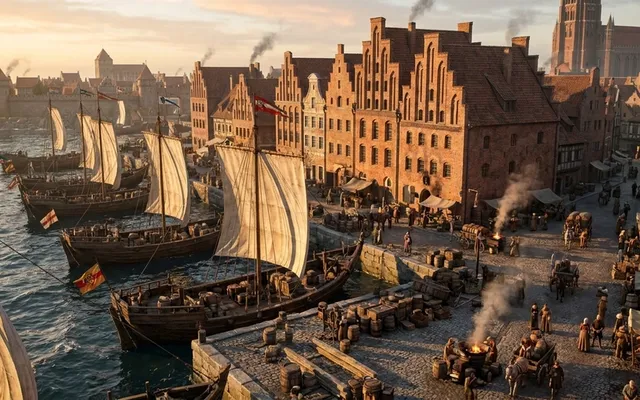
They did not just get by: they built manor houses and hundreds of farms, imported stained glass, kept sheep, goats, and cattle, and traded furs, walrus ivory, live polar bears, and other Arctic goods with Europe. That success is what makes the disappearance so puzzling. Walrus ivory was the main export.
 AI
Chronology of the vanishing
The end is better documented than you might think, but the sources only reach to 1408. After 1300, no more churches were built. By about 1350, the Western Settlement was abandoned. From 1369 there were only four known sailings to Greenland, and the economy suffered when walrus ivory lost value. In addition, Norway made trade with Greenland illegal without royal permission. The clergyman Ívar Bárðarson, who represented the Church in Greenland from 1341 to 1366, described the fjords, church property, and a trip to the Western Settlement in a report.
The last written news from the Eastern Settlement comes from a ship of Icelanders that was there between 1406 and 1410. In 1408, two of them married at Hvalsey Church, whose ruins are still visible today, near present-day Qaqortoq. A letter from 1424 in which a Greenlandic priest testifies to having been present at this wedding is the last known written evidence of the Norse Greenlanders. After that, the sources are silent. When exactly the Eastern Settlement became empty, we don't know.
Climate, trade, isolation, and the Inuit
There is no single cause, and research is divided. The Little Ice Age, which lowered temperatures from about 1300, shortened the growing season and the hay harvest, and more summer drift ice affected the Eastern Settlement but not the Western one, and could explain the decline of seals in the finds. Trade collapsed: African elephant ivory displaced walrus ivory on the European market, and new hemp ropes possibly replaced cables of walrus hide, as Andrew Dugmore and colleagues write. Isolation was added to that.
The Inuit are also considered a factor, but evidence is lacking: they arrived in the course of the 13th century, and there are traces of trade between the two groups, but by the current state of archaeology no evidence for violent conflict. An Inuit legend does tell that their warriors burned the Norse at Hvalsey, but that is oral tradition. That the Norse did not learn kayaks and ring-seal hunting from the Inuit is often said, but Dugmore and Konrad Smiarowski also write that there is evidence of successful adaptation and sustainable practice by the Norse. And some may simply have sailed to Iceland or Europe without anyone recording it.
 AI
A piece of the puzzle, not a solution
The church at Qinngua doesn't explain why the Vikings vanished. It shows something else: that the colony in the early Middle Ages was a society with competition and power struggles, able to afford churches and to buy influence with them. Konrad Smiarowski, an environmental archaeologist at the University Museum of Bergen and co-leader of the project, calls the find "another piece of the puzzle" that may bring us closer to understanding what happened to the colony.
When the church was built is not yet settled. The team wants to study the finds of the dig and, if funding allows, return to narrow down the construction date. Until then it stays with the suspected time between 1100 and 1300, the phase in which the settlers in Greenland were converting to Christianity.
The overview at a glance
To wrap up, the short version, so fact and story don't blur.
| Category | What belongs here |
|---|---|
| Well documented | Settlement around 985 under Erik the Red; the church at Qinngua with a skeleton (August 2026), about five kilometers from Brattahlíð; six churches around Brattahlíð; no more churches after 1300; the Western Settlement abandoned around 1350; the wedding at Hvalsey in 1408 as the last news, the letter of 1424; the collapse of the ivory trade |
| Handed down | The site as the "Church under the Sunny Mountains" of the Flateyjarbók; a population of 3,000 (Madsen) to 5,000 people; the Inuit legend of Hvalsey |
| Open | When the church was built (suspected 1100 to 1300); why the Norse vanished; what role climate, trade, the Inuit, and adaptation played; whether some returned to Iceland or Europe; when exactly the Eastern Settlement ended |
One picture from five angles
The new church shows that a vanished world leaves many traces. That's why every season in HistoryBytes is split into five categories, and this story touches all five: Erik the Red as a person, Brattahlíð and Qinngua as places, the wedding at Hvalsey in 1408 as an event, the church as an instrument of power as an idea, the codex Flateyjarbók as an object. That's how the Viking Sagas season builds the whole picture of a time in which the Norse settled far beyond Scandinavia.
The last wedding
That the last news from Greenland comes from a wedding is a strangely quiet end for five centuries. The colony began with an exile and ended, as far as we know, with two Icelanders marrying in a stone church. In between lay a society that imported glass, built churches, and fought over power. The new church at Qinngua is a piece of it, and the riddle remains: we know when it fell silent, but not why.
 AI
Experience the world of the Vikings in HistoryBytes
Viking Sagas
From power struggles to voyages of discovery — in the Viking Sagas season, the age of the Norsemen comes alive. Story campaigns, quizzes, and real immersion into a world of conquest, betrayal, and new horizons.
5 episodes freeThe first 5 episodes are free, Premium unlocks the rest.