How Were the Pyramids Built? What the Evidence Really Shows
 AI
A tomb, a famous name, and the question of all questions
On 26 October 2026, the Egyptian Minister of Tourism and Antiquities climbed down a burial shaft at Saqqara. An Egyptian excavation there had uncovered the chamber of an official named Weni, about 4,300 years old, with bronze instruments that may have been medical and two wooden figures in a worshipping pose. The name Weni makes Egyptologists listen, because a man of that name described in the longest autobiography of the Old Kingdom how he had stone brought for a pyramid. But the man of Saqqara is not that Weni, and that is a good occasion for the question asked for millennia: how were the pyramids actually built?
In short: the finds of the past 40 years have changed the picture. According to them, the pyramids were not built by slaves but by fed workers in organized crews. A diary from 2013 shows how stones were transported on boats. A Nile branch unknown until 2024 lay right by the pyramids. A ramp from 2018 shows how stones were hauled on steep ground. But open remains precisely the most important thing: how the blocks got into the upper courses.
A famous name and a translation error
The tomb lies northwest of the pyramid of King Merenre, who ruled around 2280 BC in the 6th Dynasty. It is a mudbrick mastaba, a flat-roofed tomb house, with several shafts, one of which leads to Weni's inscribed burial chamber. His inscriptions list a series of titles: mayor, sem priest, treasurer of the king of Lower Egypt, sole companion, lord of the city of El-Kab, and "director of every kilt." That was a common court title, often paired with the title of sem priest, who in funerary rituals restored the senses of the dead.
Some English reports translated the last title as "overseer of every royal expedition." According to the dictionary of the ancient Egyptian language, that is wrong. It matters because the famous Weni the Elder really did lead expeditions. He served three kings, among them Merenre, left the longest autobiographical inscription of the Old Kingdom, and described in it how he had stone fetched from the quarries for Merenre's pyramid, including for the king's sarcophagus. But his tomb lies at Abydos in Upper Egypt, found in 1999 by Janet Richards. The ministry presents the Weni of Saqqara as a different official, the name was common at the time.
 AI
What was built
For scale: the Great Pyramid of Khufu (Cheops) at Giza was originally 146.6 meters high, today it is about 138.5 meters, and the sides are about 230 meters long. It consists of an estimated 2.3 million blocks and was the tallest structure on Earth for almost 3,800 years. The precision is surprising: the longest and shortest side differ by only 4.4 centimeters, the base is level to 2.1 centimeters, and the pyramid is aligned to north within about 3.6 arcminutes, one fifteenth of a degree.
By today's estimates it was built in somewhat more than 20 years, during the reign of Khufu, dated to about 2589 to 2566 BC. Counting around the clock, that works out to a block about every five minutes over two decades. Originally it was also clad in smooth white limestone slabs from Tura, almost all of which are missing today, so it shone bright instead of, as now, appearing as a rough stepped structure. And it was not the only one: along an ancient Nile branch stand 31 pyramids from the 3rd to the 13th Dynasty, and the Great Pyramid is only the most famous.
This is HistoryBytes.
Short lessons, real duels, and immersive visuals from a world of history — download it now.
The workers' town of Giza
The image of slaves under the whip comes from films. Since 1988, the team of Ancient Egypt Research Associates under Mark Lehner has been excavating a large settlement southeast of the pyramids, Heit el-Ghurab, "Wall of the Crow," named after a massive limestone wall south of which it lies, also called "the lost city of the pyramid builders." It found long buildings with sleeping places for work gangs, bakeries with bread molds, breweries, storehouses, administrative buildings, and large amounts of cattle, sheep, and goat bones. The workers thus received bread, beer, and meat.
About 500 meters to the west, Zahi Hawass discovered from 1990 the workers' cemetery, with tombs of mudbrick lying close to the king's pyramid, an honor that wouldn't have been given to slaves. The skeletons show healed bone fractures, that is, medical care, but also the danger of the work. In 1997 Hawass and Lehner also described work gangs with names of their own such as "Friends of Khufu." Lehner says there were slaves in Egypt but the pyramid workers were not slaves in the modern sense, and from the finds it looks more like a temporary service obligation of simple farmers alongside a permanent core of specialists.
How many there were is disputed. Herodotus named 100,000 men 2,000 years later. Lehner and his colleagues reckon 20,000 to 30,000 at the peak, Hawass named about 10,000 in 2010, and newer studies that allow for decades of construction come to only a few thousand.
 AI
A logbook from year 26 of Khufu
In 2013 the archaeologists Pierre Tallet and Gregory Marouard found rolls of papyrus on the Red Sea, in an ancient harbor at Wadi al-Jarf. The team found the first rolls on 24 March 2013 at the entrance to a storage cave. They are the oldest inscribed papyri known. The best preserved, Papyrus Jarf A and B, are the logbook of a man named Merer, a middle-ranking official with the title inspector. They date from year 26 or 27 of the reign of Khufu, so probably from the end of his rule, and describe several months of work.
Merer and his crew, according to Tallet about 40 men, transported white limestone from the quarries of Tura North and Tura South by boat to Giza, "Akhet-Khufu," the "Horizon of Khufu," as the pyramid was called. The logbook notes day by day where they spent the night, where they hauled stones, and when they cast off. On average they made two or three round trips every ten days. On the way they put in at a basin, "She-Khufu," overseen by an official named Ankhhaf, a half-brother of the king. Tallet suspects the stones were the casing stones, which today are almost all missing.
How sober the logbook is shows in an excerpt. On one day Merer hauls stones with his crew at Tura South and spends the night there. The next day he casts off loaded with stone toward Akhet-Khufu and spends the night at She-Khufu. The day after, he sails from She-Khufu on to Akhet-Khufu. Then the cycle begins again: unload, return, reload. The basin She-Khufu was, according to one account, probably an artificial lake that served as a staging post on the northbound journey. The logbook shows an administration that planned work by days and stations.
Merer is not the only writer. Tallet published further logbooks in 2021, among them the diary of a man named Dedi, and in 2022 an overall account under the title "The Red Sea Scrolls." The harbor at Wadi al-Jarf, where the papyri lay, was a Red Sea harbor from Khufu's time, and boats were stored in its artificial caves. That the rolls were kept in caves there preserved them for more than 4,500 years.
Some websites give a crew of 200 men. That is not from the original publication, in which Tallet speaks of a group of about 40 men.
 AI
Why the pyramids stand at the desert's edge
That the Nile was a transport route fits with a discovery of 2024. The geoscientist Eman Ghoneim and her team mapped, with satellite radar images, geophysical measurements, and sediment cores, a forgotten Nile branch about 64 kilometers long, 200 to 700 meters wide, and 2 to 8 meters deep. They named it Ahramat, Arabic for "pyramids," and published the work on 16 May 2024 in Communications Earth & Environment.
The branch runs at the foot of the desert plateau and borders 31 pyramids from the 3rd to the 13th Dynasty. It could explain why they stand in a narrow, now dry strip: they lay on the water. The researchers write that the branch was an important transport route for workers and building material. That is a reasoned interpretation but not yet proof that it carried water in Khufu's time. Lehner has also proposed that the site of Heit el-Ghurab was a harbor.
How stones were moved
A wall painting in the tomb of Djehutihotep at Deir el-Bersha, around 1900 BC, shows a figure pouring water onto the ground in front of a sledge carrying a huge statue. A physics study of 2014 (Fall and colleagues, Physical Review Letters) investigated this: if you moisten the sand in front of the sledge in the right amount, the necessary pulling force drops by up to half. The picture could thus show a practical procedure and not a mere ceremony.
For steep paths there has been a find since 2018. At Hatnub, an alabaster quarry in the Eastern Desert, French and British archaeologists found a ramp with two staircases lined with postholes. Ropes were tied to the sledge and around wooden posts, and that worked, according to Roland Enmarch, as a force multiplier. So alabaster blocks could be hauled out of the quarry on slopes of 20 percent and more. Tool marks and two inscriptions of Khufu date the system at least to his reign. Yannis Gourdon suggests the system could also have served in building his pyramid.
That is a possibility and not an answer. Critics consider the ramp no solution for the pyramid, because it shows how to lift stones out of a quarry, not how to get them to 140 meters of height. For that, research knows several models: straight ramps, spiral ramps, an internal ramp, and newer computer models with several ramps along the edge. Which is right, or whether it was a mix, we don't know.
 AI
The autobiography that describes a pyramid
Back to Weni: the famous Weni, called Weni the Elder, served under three kings. His autobiography is the longest preserved from the Old Kingdom, and it shows what the organization behind pyramids looked like: he led expeditions to the quarries to fetch stone for the pyramid of his king Merenre, also for the king's sarcophagus.
So they built not only with rope and muscle but with administration: officials who planned expeditions, inspectors like Merer who commanded boats, bakers and brewers who fed thousands. The tomb at Saqqara that has now been found belongs to a man of this class of officials. His bones tell of a life with more than desk work: he died at over 50, had severe dental disease, and bones with traces of repeated physical strain.
 AI
The open questions
For all the research, questions remain. How the blocks got into the upper courses is not settled, despite Hatnub and several models. How many workers were at the construction at the same time varies between a few thousand and 30,000. Whether the Ahramat branch carried water in Khufu's time is still being studied. And how the pyramid is built inside is still being checked: non-destructive measurements have shown cavities inside, among them a corridor behind the entrance on the north side, which a later study confirmed with three measuring methods.
It's also honest to say: much of what the internet says about the pyramids is assertion. That applies to the supposedly "impossible" techniques as well as to numbers that are passed along in books and blogs until nobody knows where they come from. The figure of 200 men for Merer is an example.
The overview at a glance
To wrap up, the short version, so fact and story don't blur.
| Category | What belongs here |
|---|---|
| Well documented | Workers' town Heit el-Ghurab with bakeries, breweries, dormitories (since 1988); workers' cemetery (since 1990) with healed fractures showing care; Merer's diary (found 2013, year 26 or 27 of Khufu): limestone transport by boat from Tura to Giza; Ahramat Nile branch (2024, 64 km, 31 pyramids); Hatnub ramp (2018, at least from Khufu's time, slope 20 percent and more); wet sand halves the pulling force (2014); dimensions of the Great Pyramid; Weni's tomb at Saqqara (26 October 2026) with bronze instruments and wooden figures |
| Handed down | Herodotus's 100,000 men; Weni's title "director of every kilt" (not "overseer of every expedition"); that Weni of Saqqara is not Weni the Elder (the ministry's presentation) |
| Open | How the blocks got into the upper courses; how many workers there were (10,000 to 30,000 or fewer); whether the Ahramat branch carried water in Khufu's time; what Weni's instruments were used for; whether Hatnub-type ramps were also used at the pyramid |
One picture from five angles
Pyramid building shows how much stands behind a famous monument. That's why every season in HistoryBytes is split into five categories, and this story touches all five: Merer as a person, Giza as a place, the building of the Great Pyramid as an event, state-organized labor as an idea, the papyrus from Wadi al-Jarf as an object. That's how the Pharaos of Egypt season builds the whole picture of a world in which administration, belief, and craft were closely intertwined.
People, not myths
The pyramids are structures of stone, rope, water, and organization. Whoever wants to explain them needs neither aliens nor armies of slaves but bakers, boatmen, officials, and farmers who worked for a time on the construction. The diary of Merer is the loveliest example: it tells nothing of gods or miracles but notes where the night was spent. Perhaps that is the greatest discovery of recent years. We now know the names of men who worked on the pyramid, and we know that they got their bread.
 AI
Experience ancient Egypt in HistoryBytes
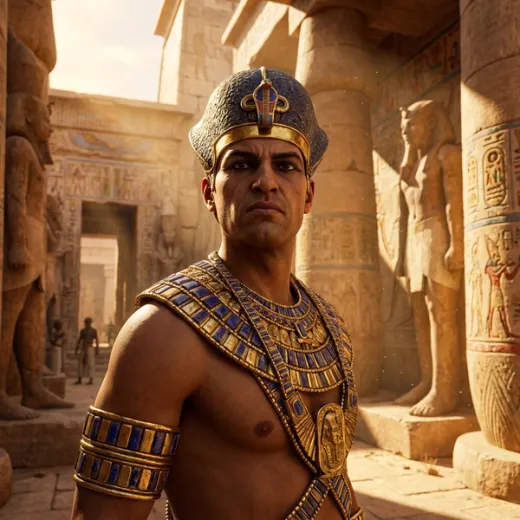
Pharaohs of Egypt
From pharaohs and pyramids to the secrets of the Nile — in the Pharaos of Egypt season, ancient Egypt comes alive. Story campaigns, quizzes, and real immersion into a world of power, belief, and mystery.
5 episodes freeThe first 5 episodes are free, Premium unlocks the rest.