Ramses II: New Colossal Statue Found, What We Really Know
 AI
AIA villager, an inscribed stone, and a pharaoh still making headlines after 3,200 years
A man was working on a plot of land in front of his house in Behbeit el-Hagar, a village in Gharbia Governorate in the Nile Delta, when he came across a block covered in carvings. He reported it to the local authorities. What came out of the ground afterward, according to a statement from the Ministry of Tourism and Antiquities, were the remains of two enormous royal statues, at least one of which shows Ramses II. The Minister of Tourism and Antiquities, Sherif Fathy, praised the man: his quick report showed how much the public can contribute to protecting heritage.
In short: in mid-October 2026, Egypt announced finds of two colossal statues in the Nile Delta, one certainly Ramses II, the other probably. The first head is 1.60 meters tall, and with its base the statue is said to have stood about 8.5 meters. It remains unclear why they stood in a village whose famous temple was built almost 900 years after Ramses.
 AI
AIHead, torso, and a block of pink granite
The most impressive piece is a head about 1.60 meters tall, as big as a small adult. The king wears the double crown, which unites the white crown of the south and the red crown of the north and expresses the unity of the two halves of the country. Next to the head lay the upper part of the back pillar, the stone strip that supports many statues at the back. It bears the king's Horus name, Kanakht Mery-Maat, "Strong Bull, Beloved of Maat," one of the five official names of every pharaoh. According to Hisham El-Leithy, Secretary-General of the Supreme Council of Antiquities, the complete statue with base may have stood about 8.5 meters high, an estimate based on proportions.
Granite is very hard and difficult to carve, and Egypt's pink granite was quarried mostly at Aswan, hundreds of kilometers to the south. Added to this is most of a second royal statue, about 2.40 meters long, without legs and base, with the striped headcloth, the nemes. Its facial features are well preserved and resemble those of the first head, which is why the ministry also considers it to be Ramses II. The statement mentions no inscription with his name for this statue. Third, a block of pink granite was found, about 1.30 meters long, a meter north of the second statue, with two of Ramses II's titles: "King of Upper and Lower Egypt" and "Son of Ra."
 AI
AIA lesson from Cairo, 2017
How careful one should be with attribution is shown by a case from 2017. In March, an Egyptian-German team in Matariya, a district of Cairo over the ruins of Heliopolis, found fragments of a colossal statue of quartzite, about eight meters tall, on the site of an old temple of Ramses II. It was first presented as Ramses himself. A few days later, an inscription on its back showed a name of Psamtik I, who ruled from 664 to 610 BC, about six centuries after Ramses. The then antiquities minister left a small possibility open: that Psamtik had reused an older statue of Ramses.
At Behbeit, the first head does carry Ramses II's Horus name on its back pillar. For the second statue, the ministry mentions no text. Whether this attribution holds will be shown by excavation and study.
 AI
AI
This is HistoryBytes.
Short lessons, real duels, and immersive visuals from a world of history — download it now.
Behbeit el-Hagar and the temple that collapsed
The place name already offers a clue: "El-Hagar" means "the stones" in Arabic, and "Behbeit" comes from the ancient Egyptian "Per-Hebyt," roughly "house of the festival." The village lies on the Damietta branch of the Nile, about eight kilometers west of Mansura. The stones are granite blocks from one of the strangest temples of the Delta: the Iseum, the great temple of Isis. Most Egyptian temples were built of limestone or sandstone, with granite reserved for individual pieces such as statues, obelisks, or doors. At Behbeit the whole building was granite. Nectanebo II (360 to 342 BC), the last native-born pharaoh of Egypt, built most of it, the Ptolemies completed it, and Ptolemy III (246 to 222 BC) added the last major parts. The location was no accident: Nectanebo's dynasty, the 30th, came from nearby Sebennytos, today's Samanud, and the temple was the northern counterpart of the great sanctuary of Isis at Philae in the south.
The building did not last. According to the Metropolitan Museum of Art in New York, it had problems with its foundations soon after construction, and perhaps around 24 BC an earthquake brought it down completely. Its stones were scattered to museums around the world, and the Montreal Museum of Fine Arts notes that a slab from one of its chapels even turned up in the great temple of Isis in Rome. Between Ramses (around 1279 to 1213 BC) and the start of construction lie almost nine centuries, so two Ramses colossi in the village of the Nectanebo temple are not what one would expect.
 AI
AIThree possibilities the statement leaves open
The statement doesn't say whether the statues were raised on this very spot, brought from elsewhere, or reused centuries later. Egyptian texts mention Behbeit from the New Kingdom onward, the era of Ramses himself, although it may have been little more than a dependency of Sebennytos. Reuse wouldn't be unusual: in April 2026, the ministry announced another statue of Ramses II at Tell el-Faraun in Sharqia Governorate, a massive limestone statue that had apparently been moved in antiquity from the royal capital, Pi-Ramesses, to be repurposed within a religious complex. It went to a storage facility in San el-Hagar for restoration. That doesn't settle the Behbeit case, however.
The excavation continues. El-Leithy said the aim is to understand how the pieces relate to one another and to the site. Until then, the statement says nothing about when the statues fell and where they originally stood. Another Ramses colossus has an eventful history of its own: the statue from Mit Rahina was found in 1820 in six pieces and moved as a single piece on 25 August 2006, a ten-hour transport wrapped in foam rubber.
2026 brings more Egypt into the news: only a few days earlier, on 11 October, the tomb of Amenhotep III reopened to visitors after 20 years, 14 meters underground. It was found empty, looted, and the pharaoh's mummy now lies with 16 other royal mummies in the National Museum of Egyptian Civilization in Cairo. Egyptian tourism is growing by about 20 percent a year according to the ministry, and finds like these are part of it.
66 years on the throne
Ramses II ruled from about 1279 to 1213 BC, around 66 years, and died at about 90. He belonged to the 19th Dynasty, his father was Seti I, and his capital was Pi-Ramesses (today Qantir). His chief wife Nefertari received her own temple next to Abu Simbel, other wives included Isetnofret and the Hittite princess Maathorneferure, and he is said to have had over a hundred children. His throne name Usermaatre-Setepenre means roughly "The justice of Ra is powerful, chosen of Ra." How we know his regnal dates so precisely: a new-moon date in his 52nd year corresponds, by most Egyptologists, to 20 December 1228 BC, and from that come his accession on 31 May 1279 BC and his death in July or August 1213 BC.
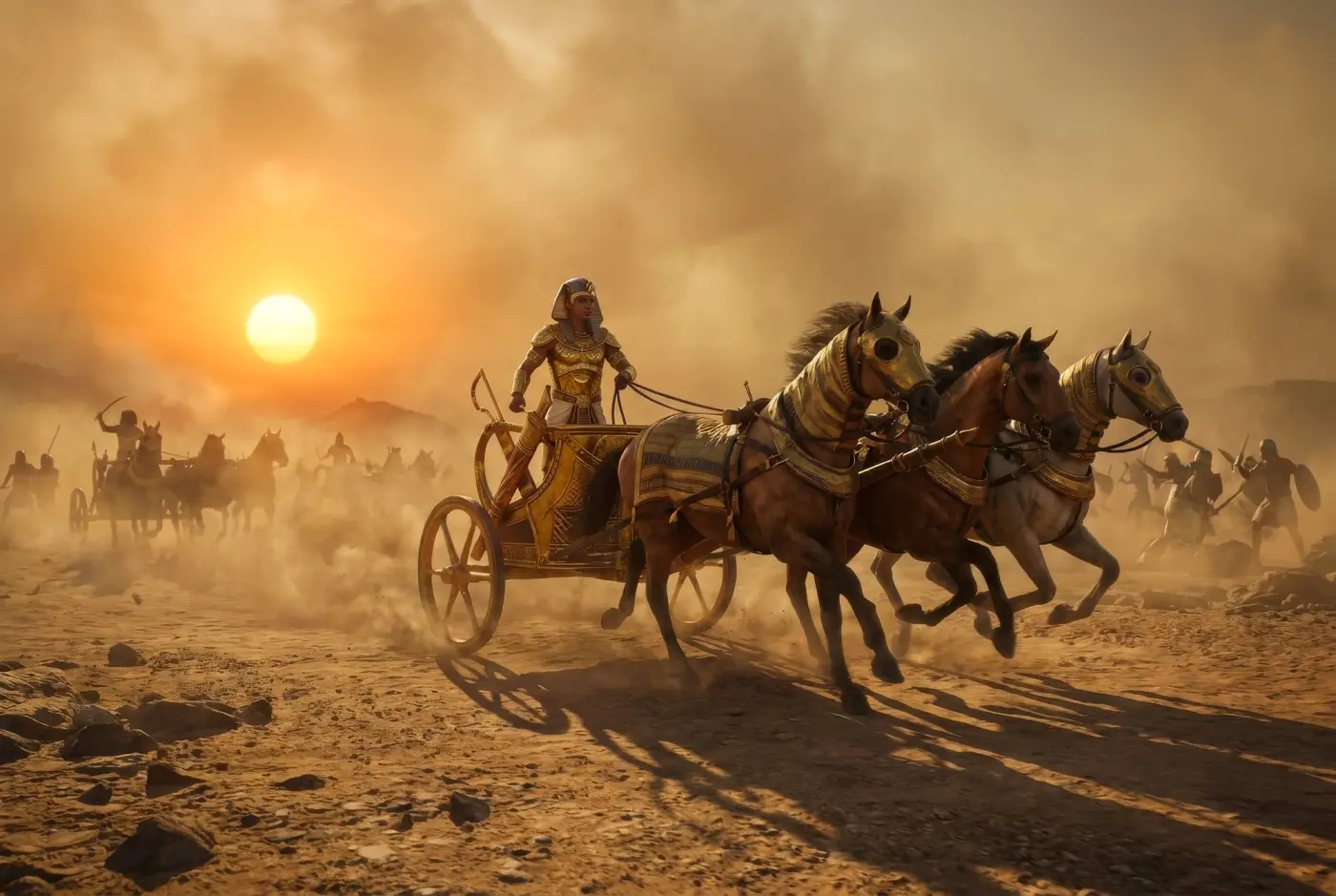
The most famous event of his reign is the Battle of Kadesh in May 1274 BC, in the fifth year of his reign, against the Hittites under Muwatalli II. Ramses was outmaneuvered in an ambush and nearly surrounded, and he personally led a charge with his bodyguard. The battle is counted among the largest chariot battles in history and, by one account, as the first recorded military ambush. Ramses himself lists 19 Hittite allies that Muwatalli brought to Kadesh. The battle is regarded as more of a draw. In Egypt, Ramses nonetheless had it depicted as a victory.
 AI
AIFrom the battlefield to the treaty
About 15 years after Kadesh, Ramses and the Hittite king Hattusili III concluded a treaty, the oldest surviving peace treaty in the world. It dates from around 1259 or 1258 BC, the 21st year of Ramses's reign, and is the only treaty of the ancient Near East of which the versions of both sides survive. It is often called the "Treaty of Kadesh," although it doesn't mention the battle, and also the "Silver Treaty" or "Eternal Treaty." It held until the Hittite Empire collapsed about 80 years later. The Hittite version was found in the Hittite capital, and a copy hangs at the UN headquarters in New York.
Marriage politics followed: Ramses married two Hittite princesses, the first after his second Sed festival. And the buildings are politics too: Abu Simbel arose probably between about 1264 and 1244 BC, along with the Ramesseum, parts of Karnak and Luxor, and the capital Pi-Ramesses. The facade of the Great Temple is about 33 meters high and 38 meters wide, four seated colossi of about 20 meters each, wearing the double crown, guard the single entrance, and smaller figures of the royal family stand at their feet. Above the door, in a niche, sits the falcon-headed Ra-Horakhty, and a frieze of 22 baboons crowns the top edge. Today the left figure is missing its head and torso, which fell in antiquity, probably in an earthquake, and lie at its feet.
 AI
AITwo late stories
The Greeks turned Ramses's throne name into "Ozymandias," and Shelley wrote a poem about it in 1818 in which a traveler describes the ruins of a statue in the desert whose inscription tells of the ruler's greatness while around it there is nothing but sand. A broken head of Ramses in a Nile Delta field fits it surprisingly well.
The mummy has a story of its own. In 1974, Egyptologists in Cairo noticed that its condition was deteriorating rapidly and decided to fly it to Paris for examination. Because French law required a passport for anyone entering, living or dead, the Egyptian authorities issued Ramses a passport listing his occupation as "King (deceased)." In September 1976, the mummy was received at Paris-Le Bourget Airport with full military honors and taken to a laboratory at the Musée de l'Homme.
 AI
AIThe overview at a glance
To wrap up, the short version, so fact and story don't blur.
| Category | What belongs here |
|---|---|
| Well documented | Ramses II ruled about 1279 to 1213 BC; Kadesh in May 1274 BC as a draw; the peace treaty of 1259/58 BC; Abu Simbel arose about 1264 to 1244 BC; the head at Behbeit bears Ramses II's Horus name; the granite block bears two of his titles; the passport of 1976 |
| Handed down | The hundred children; the height of 8.5 meters (an estimate based on proportions); the copy of the treaty at the UN headquarters; that Ramses personally charged at Kadesh |
| Open | Whether the second statue shows Ramses II; when and how the statues came to Behbeit; whether they originally stood there or were reused; whether there is a connection with the Nectanebo temple |
One picture from five angles
The find shows how much lies behind a name. That's why every season in HistoryBytes is split into five categories, and this story touches all five: Ramses II as a person, Pi-Ramesses and Behbeit el-Hagar as places, the Battle of Kadesh in 1274 BC as an event, self-presentation and propaganda as an idea, the colossal statue as an object. That's how the Pharaos of Egypt season builds the whole picture of a time in which pharaohs set their power in stone.
A king who set himself in stone
In the end there is a pharaoh who outlived himself. He had himself immortalized on statues, temple walls, and in treaties, and 3,200 years later a villager digging finds his name. That the statues lie in the Delta, at a place Ramses himself hardly had in view, is the most interesting thing about the report: the stones have a history of their own, longer than that of the king they depict. How they got there, we don't know yet.
 AI
AIExperience ancient Egypt in HistoryBytes
Pharaohs of Egypt
From pharaohs and pyramids to the secrets of the Nile — in the Pharaos of Egypt season, ancient Egypt comes alive. Story campaigns, quizzes, and real immersion into a world of power, belief, and mystery.
5 episodes freeThe first 5 episodes are free, Premium unlocks the rest.