Toyotomi Hideyoshi: The Peasant Who United Japan, Then Wanted China
 AI
AIThe man his own lord called "Monkey"
He was small and gaunt, with a face that reminded his lord Oda Nobunaga of a monkey. Nobunaga called him "Saru," monkey, and sometimes "bald rat." He had no ancestors to point to, no family name of any weight, no castle. His father was an ordinary foot soldier, an ashigaru, a peasant who served the samurai in wartime.
A few decades later, this same man ruled all of Japan. He had a castle built larger than anything the country had seen until then, disarmed the peasants of the entire country by decree, and sent armies of well over a hundred thousand men across the sea to Korea. Toyotomi Hideyoshi is the second of Japan's three great unifiers, and probably the one who shows most clearly how quickly a rise with no safety net can succeed, and how hard it is to keep what you have won.
 AI
AIWhy Nobunaga bet on him
According to tradition, Hideyoshi came from the village of Nakamura in Owari province, the same region Nobunaga came from. He entered Nobunaga's service and rose, step by step, to become one of his most capable generals, first under the name Kinoshita, later as Hashiba Hideyoshi. In an age when rank depended almost entirely on birth, that was an exception only the Sengoku era can explain: the country had been in civil war for roughly a century, and anyone who got results was needed, no matter where he came from.
Nobunaga handled that talent ruthlessly and practically. He mocked Hideyoshi in public for his looks and still put him at the head of campaigns. Hideyoshi accepted the nicknames pragmatically. Later, as ruler, he avoided them, but they stuck in the chronicles and still shape the image of "the monkey" today, a quick, clever, constantly surprising climber who outwitted opponents more often than he overran them.
His private life began at the bottom too. His wife Nene married him when he was still known as Kinoshita Tōkichirō and anything but famous, against the resistance of her own mother, who objected to the vast difference in social standing. Nene stayed at his side until his death.
1582: Honnō-ji and the race for Nobunaga's legacy
In the summer of 1582, everything Nobunaga's realm was built on collapsed. His vassal Akechi Mitsuhide turned on him at the Honnō-ji temple, and Nobunaga and his eldest son Nobutada were killed. Suddenly the most powerful figure in Japan was dead, and dozens of generals faced the same question: who carries on?
Hideyoshi reacted faster than anyone else. He made peace with the Mōri clan, whom he was fighting in the west at the time, turned around, and met Akechi Mitsuhide at the Battle of Yamazaki. Akechi was defeated and was killed shortly afterward, and Hideyoshi had achieved what no other Nobunaga general managed: he had beaten his lord's killer and, in doing so, secured the moral lead. That is the real core of his rise. Not birth, not wealth, but speed and a clearly recognizable cause that others could rally behind.
 AI
AI
This is HistoryBytes.
Short lessons, real duels, and immersive visuals from a world of history — download it now.
Japan's largest castle, built on the ruins of a temple fortress
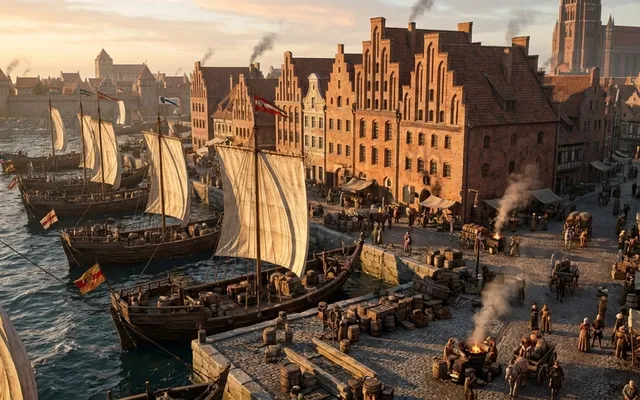
Just a year after Yamazaki, in 1583, Hideyoshi began building Osaka Castle, on the site of the Ishiyama Hongan-ji, a temple fortress Nobunaga had destroyed. It became the largest and most formidable castle in Japan, built to guard the western approaches to Kyoto, an unmissable signal to any rival about who was in charge from now on.
 AI
AIKomaki and Nagakute: a draw with consequences
In 1584, a man stood up against him who would one day inherit everything: Tokugawa Ieyasu. Together with Oda Nobukatsu, Nobunaga's second son, he faced Hideyoshi, and at Komaki and Nagakute the contest ended inconclusively. Hideyoshi's forces even took a heavy blow. It was no clear victory for the man claiming Nobunaga's succession.
Hideyoshi responded the way he always did: he switched from force to diplomacy. He made peace with Nobukatsu and Ieyasu, but Ieyasu still refused to become his vassal. So Hideyoshi sent him his younger half-sister Asahi, whom Ieyasu married in 1586, along with Hideyoshi's own mother as hostages, and Ieyasu eventually acknowledged Hideyoshi as his overlord. The man who would later inherit it all bowed to him for now. He waited.
Kampaku, a new name, and never a shōgun
In 1585, Hideyoshi was appointed Kampaku, imperial regent, an office that had until then been reserved for the court nobility. He was the first man in Japanese history without court-noble birth to hold it. He covered his origins with the tools of the court: he sought descent from the Fujiwara family and was adopted by the court noble Konoe Sakihisa. In 1586, the court granted him the family name Toyotomi, and Hashiba Hideyoshi became the man we know today.
He never received the title of shōgun, just like Nobunaga before him. Instead, he secured a chain of high court titles. On 9 May 1588, he received Emperor Go-Yōzei at the Jurakutei palace, an elaborately staged visit that is considered the high point of his career. A peasant's son hosted the emperor.
Sword hunt, land survey, and the end of social mobility
Hideyoshi remade a country in a form he himself would never have known. Between 1582 and 1598, he had all of Japan surveyed, the so-called Taikō Land Survey: every rice field was recorded, assessed, and assigned to a taxpayer. That took control of land ownership and tax revenue out of the hands of local elites.
In 1588 came the second, even more consequential step, the "sword hunt" (Katanagari). The decree forbade farmers in all provinces from owning swords, short swords, bows, spears, firearms, or other weapons. Officially, the collected metal was meant to be cast into a giant Buddha. In reality, Hideyoshi removed the peasants' ability to rebel, and at the same time closed the door behind himself: if you were born a peasant, you stayed a peasant; if you were born a samurai, you stayed a samurai. The principle of separating warriors from farmers, "Heinō Bunri," became law. The man whose own rise had only been possible because of chaos made sure there would never be another like him.
 AI
AIOdawara 1590: how Japan was united without a great battle
Before Odawara, Hideyoshi had put the country together piece by piece: in 1585 he subdued the island of Shikoku, and in 1587 Kyūshū in the southwest followed.
The last big obstacle on the path to unification was the Hōjō clan in the east, the last independent power in the country, entrenched behind the walls of Odawara Castle. Hideyoshi didn't storm it. He besieged the fortress with patience, and with theater: before the gates, he had a tea festival staged, invited traveling merchants, and set up a provisional town, as if to show the besieged that he had all the time in the world.
After about three months, the Hōjō surrendered. In 1590, for the first time in more than a century, Japan was united under a single rule, eight years after Nobunaga's death. In 1591 he also crushed the Kunohe rebellion in the north. The unification hung very heavily on a single person, however, and that was about to become clear.
 AI
AIKorea, 1592: where Hideyoshi miscalculated
With Japan united, Hideyoshi reached for more. He wanted to conquer China, an idea Nobunaga had already considered, and demanded that Korea let his troops march through. A Korean delegation traveled to Kyoto in 1590 but came back with conflicting impressions: Kim Sŏngil thought Hideyoshi's intentions were peaceful, Hwang Yun-gil saw a threat, and as a result little was prepared at the court in Seoul. When Korea refused, an army of around 150,000 men landed at Busan in spring 1592. The start was impressive: cities like Seoul and Pyongyang fell, and the troops advanced quickly.
Then it turned. Admiral Yi Sun-sin destroyed Japanese supply lines with armored "turtle ships," a large army from Ming China entered the war, and local rebels made life hard for the occupiers. After failed peace talks, Hideyoshi sent a second, more limited invasion of around 140,000 men in 1597, but it too achieved nothing. The costs were enormous, in people and in money, and they weakened Toyotomi rule at home. In Korea, Hideyoshi is remembered to this day as a brutal invader, one of the most defining enemies in Korean history.
 AI
AIThe final years, a five-year-old, and five regents
Things at home went worse in Hideyoshi's last years too, and much of it began with the year 1591. In February his half-brother Hidenaga died, who had accompanied him on many campaigns, in the same year the tea master Sen no Rikyū, and in September his only son Tsurumatsu. Some historians see this as a turning point: with Hidenaga and Rikyū gone, two people who might still have influenced his decisions were missing, and the Korean campaign and the purge around his nephew followed.
With no son of his own, Hideyoshi adopted his nephew Hidetsugu as heir in January 1592 and handed him the office of Kampaku shortly afterward, while he himself took the title Taikō, that of a retired regent. Then, in 1593, a biological son was born after all, Hideyori, and the successor became a problem. In 1595, Hideyoshi forced Hidetsugu to take his own life, and Hidetsugu's family was wiped out as well. A common interpretation sees this as a sign that his political judgment declined with age. In between, he indulged in some curious forays into the arts: in 1594 he had plays written about his own life and starred in them on stage himself, before a select audience of nobles and lords.
On 18 September 1598, Hideyoshi died at Fushimi Castle. His son Hideyori was only five years old. To secure his succession, Hideyoshi had set up a council of five powerful lords, among them Tokugawa Ieyasu. His final instructions were to protect Hideyori, withdraw the troops from Korea, and keep the lords together. His death was initially kept secret so the withdrawal could be organized in an orderly way, and during that withdrawal Admiral Yi Sun-sin, the man who had saved Korea, was killed by a stray bullet. Within the realm itself, the balance began to wobble as soon as Hideyoshi's death became known. In 1600, Ieyasu prevailed at the Battle of Sekigahara, and in 1615, after the siege of Osaka, Hideyori fell as well. The realm Hideyoshi had united in only eight years outlived him by barely two decades.
 AI
AIThree men, one proverb
In Japan there's a well-known proverb that sums up the three great unifiers in a single image: Nobunaga kneaded the rice cake, Hideyoshi baked it, and Tokugawa Ieyasu ate it. It's unfair, and still hits a core truth. Nobunaga broke the old order, Hideyoshi built a united country out of it, and Ieyasu took over the result and turned it into an order that lasted over 250 years. Hideyoshi was thus the middle leg of a relay, and also the one without whom the handover to Ieyasu would not have been possible.
 AI
AIOne picture from five angles
A single person doesn't explain an era on their own. That's why every season in HistoryBytes is split into five categories, and Hideyoshi's story fits into all five: he himself as a person, Osaka Castle as a place, the Battle of Yamazaki as an event, the separation of warriors and farmers as an idea, the confiscated swords as an object. That's how the Whispers of the Samurai season builds the whole picture of an era, how people lived, fought, and thought, not just a list of famous names.
From monkey to Taikō
Hideyoshi's story is that of a man who could do everything needed to rise, and almost nothing needed to hold on to what he'd reached. He was faster, smarter, and more flexible than everyone around him, and he understood how to run a country. But he knew no limits, and in the end the entire structure hung on his life. That Japan then stayed stable for centuries it owes to the man who took over his work. The foundations for that had been laid by "the monkey."
Step into the world of the samurai in HistoryBytes
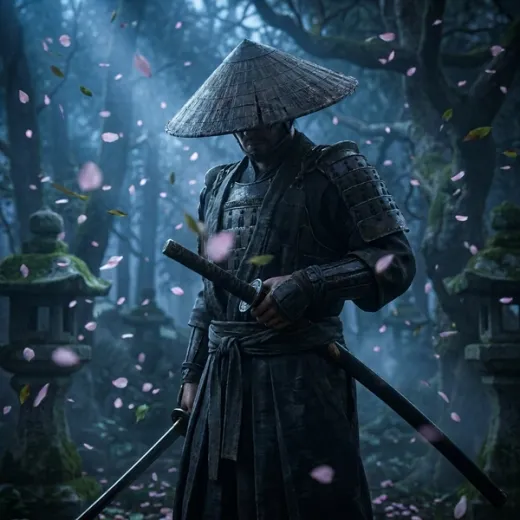
Whispers of the Samurai
From rising warlords to the battles that united a country — in the Whispers of the Samurai season, the age of the samurai comes alive. Story campaigns, quizzes, and real immersion into a world of power, betrayal, and change.
5 episodes freeThe first 5 episodes are free, Premium unlocks the rest.