Viking Horned Helmets: The Myth and Where It Came From
 AI
AIThe most famous helmet that never existed
A Viking without a horned helmet looks, to many, like a Viking without a ship. On postcards, in comics, in films, and on football pitches, the horns are as much a given as the beard. The odd thing is that in the graves, picture stones, and written sources of the Viking Age, there is no trace of them.
The Viking Age runs roughly from the 8th to the 11th century, and its end is often set at 1066, the Battle of Hastings and the destruction of Hedeby. In short: no Viking helmet with horns has ever been found. The Vikings wore simple helmets of iron or leather, or none at all. Real horned helmets existed in the north, but more than a thousand years before the Vikings, as ritual objects. The image of the horned-helmet Viking comes from the 19th century, from Romanticism and the opera stage.
 AI
AIThe Gjermundbu helmet
The most important piece comes from Norway. In March 1943, Gunnar Gjermundbo came across a rich grave while clearing a field on the Gjermundbu farm near Haugsbygd in Ringerike. It contained, among other things, a helmet and a mail shirt, and the find is regarded as unique: no other grave in Scandinavia and Western Europe contained both. The helmet is a round iron cap of four segments joined by iron strips, with a guard around the eyes and nose, a "spectacle," and a mail curtain for the neck. It is dated to the 10th century, probably around 970, and has no trace of horns.
It also doesn't stand alone: only five Viking helmets are known at all, besides Gjermundbu those from Tjele, Yarm, Lokrume, and a fragment from Kyiv, and only two could be reconstructed, Gjermundbu and the Yarm helmet in England, whose dating by some accounts even reaches before the Viking Age. In depictions of the Viking Age, warriors appear bareheaded or in plain helmets of iron or leather.
 AI
AIMostly no helmet at all
Most Vikings probably had no helmet at all. The ordinary warrior fought with spear and shield, while armor and helmets were worn rather by nobles and their bravest men. By one assessment, helmets have been found so rarely because they were very expensive and worn only by nobles and their retinues. There are traces nonetheless: the helmet fragment from Lokrume on Gotland, from the second half of the 10th century, protected the eyebrows and nose and bears silver inlay, which fits a high-ranking owner. On the picture stone of Stora Hammars one sees men with pointed heads that many take for helmets, and on the Middleton Cross in England from the 10th century stands a Scandinavian warrior with a conical helmet and an integral nose guard.
Helmet shapes changed: spectacle helmets like the one from Gjermundbu were in use until about 1000, and in the 11th century conical helmets with nasals became widespread. These are also shown by the Bayeux Tapestry, which shows the Normans of 1066, descendants of the Vikings, and the moment when William the Conqueror lifted his helmet to show his troops he was still alive is an indication of how anonymous such helmets made their wearers. In everyday life, people wore caps of wool, leather, or fur.
The real horned helmets of the north
The north wasn't entirely without horns. In 1942, two bronze helmets with curved horns were found in a bog at Veksø in Denmark, made around 900 BC, about 1,700 years before the Viking Age. They are regarded as ritual objects, not military equipment, and such helmets were probably not rare in Scandinavia between 3,700 and 2,500 years ago. One study traces the metal to Sardinia. Horns appear later too: as headgear of dancing figures on stamped panels of the Vendel period (Torslunda, Sutton Hoo, 6th and 7th centuries) and on a few pictures such as the Oseberg tapestry (before 834), each in a ritual context. More on the Torslunda panels can be found in the article on the berserkers.
Add to this ancient writers who described northern European peoples with helmets decorated with horns, wings, and antlers. Together with finds that were taken in the 19th century to be from the Viking Age and later proved older, it created a breeding ground for the image.
 AI
AI
This is HistoryBytes.
Short lessons, real duels, and immersive visuals from a world of history — download it now.
From Malmström to Wagner
The trail leads to the 19th century. The Swedish artist Gustav Malmström drew Viking warriors in the 1820s, by some accounts as early as 1820, with horned helmets for a book on Norse legend. The breakthrough came in 1876: at the first complete performance of Richard Wagner's "Der Ring des Nibelungen" in Bayreuth, the costume designer Carl Emil Doepler designed helmets with horns for the Germanic figures. The Ring is about gods and heroes of Germanic legend, not the Vikings, but the pictures migrated there. Later editions of Frithiof's Saga and legend books from 1878 also gave the hero horns.
From there it went on into posters, comics, films, and fan merchandise. A myth from 1876, still put on the head of every second Viking today.
 AI
AIThe overview at a glance
To wrap up, the short version, so fact and story don't blur.
| Category | What belongs here |
|---|---|
| Well documented | The Gjermundbu helmet (found 1943, dated around 970) has no horns; only five Viking helmets are known; the Veksø helmets (around 900 BC) are horned and much older; Doepler designed horned helmets in 1876 for Wagner's "Ring" in Bayreuth |
| Handed down | That Malmström drew horned warriors as early as 1820 (1820s depending on the source); horned figures on the Oseberg tapestry (before 834); ancient descriptions of horned helmets among northern peoples |
| Myth | "Vikings wore horned helmets"; that horns were useful in battle; that Wagner's figures are Vikings |
One picture from five angles
The horned helmet shows how an image can be stronger than the finds. That's why every season in HistoryBytes is split into five categories, and this story touches all five: the farmer Gunnar Gjermundbo as a person, Ringerike as a place, the Bayreuth performance of the Ring in 1876 as an event, the invented Viking image as an idea, the Gjermundbu helmet as an object. That's how the Viking Sagas season builds the whole picture of a time in which myth and reality are often confused.
A helmet without horns, a myth with wings
The real Viking helmet is unremarkable: round, iron, with a guard around the eyes and nose. It looks less impressive than the one from the stage, and that is exactly why it is convincing. The image with the horns remains because it is more striking than reality. Whoever looks closely finds a different picture in the finds: warriors who were practically equipped, with helmets that stopped blows, and with horns at most in ritual, long before them.
 AI
AIExperience the world of the Vikings in HistoryBytes

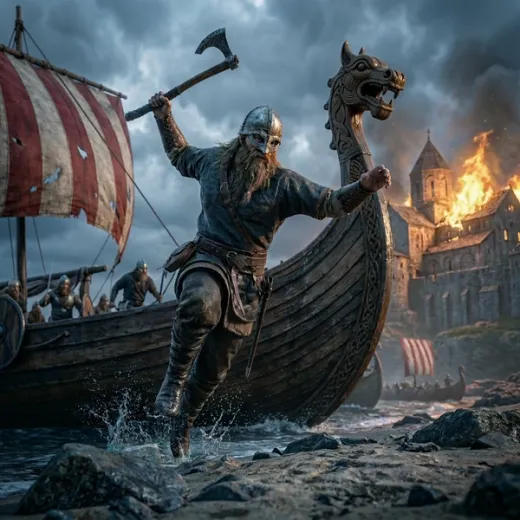
Viking Sagas
From power struggles to voyages of discovery — in the Viking Sagas season, the age of the Norsemen comes alive. Story campaigns, quizzes, and real immersion into a world of conquest, betrayal, and new horizons.
5 episodes freeThe first 5 episodes are free, Premium unlocks the rest.