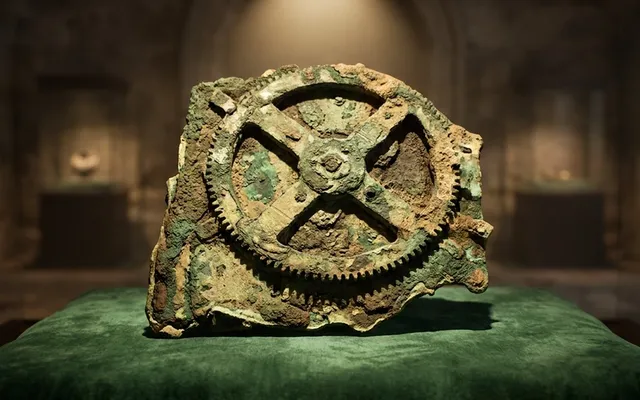
Why Has Roman Concrete Lasted 2,000 Years?
 AI
Why has Roman concrete lasted 2,000 years?
Probably because of a mixing technique, not just the volcanic ash. The Romans dry-mixed quicklime with ash and added water only afterward. That left small lime inclusions behind that can fill cracks. A building site in Pompeii confirmed it in 2025. Whether that alone explains everything is not settled.
Test your knowledge
That is the answer in brief. If you want to check it, you can answer questions about ancient Rome, emperors, and buildings in HistoryBytes, in the Emperors of Rome season, with cards and a quiz, before or after you read the article.

This is HistoryBytes.
Short lessons, real duels, and immersive visuals from a world of history — download it now.
A roof that has stood for about 1,900 years
The Pantheon in Rome, completed under Emperor Hadrian in the AD 120s, still carries the world's largest unreinforced concrete dome. Several Roman aqueducts still deliver water to Rome, and harbor basins, sewers, and seawalls survived centuries in salt water. Modern concrete structures, by contrast, often crumble after a few decades.
In short: for a long time volcanic ash was held to be the secret. Two studies by a team at MIT, in 2023 and in December 2025, shift the picture. They see the key in the mixing method and in tiny lumps of lime that dissolve when cracks form and close them again. This article shows what is established, what the researchers themselves call open, and what all this has to do with a sentence by the architect Vitruvius.
Volcanic ash and Roman cement
Roman concrete was widely used from about 150 BC. It consisted of lime, water, volcanic ash, and coarse rock. For decades it was assumed that the key to its durability was a single ingredient: volcanic ash, a so-called pozzolan, especially the ash from the area of Pozzuoli on the Bay of Naples. This ash was shipped across the whole empire and described by architects and historians of the time as an important ingredient.
That fit what the architect Vitruvius wrote in the 1st century BC in his work "De architectura," the first known book on architectural theory. According to it, lime was slaked with water into a paste and then mixed with the other ingredients. The concrete brought the Romans a building revolution: domes and vaults, bridges, harbor works, and water supply on a scale not seen before. But why did it last so much longer than today's?
 AI
How to build a dome out of concrete
Concrete was more than glue. In "De architectura" Vitruvius even gives mixing ratios: for buildings one part lime to three parts pozzolana, for work under water one part lime to two. Added to that were coarse aggregates such as rock pieces, ceramic fragments, and brick rubble from demolished buildings, in Rome often tuff. Because these chunks were so large, Roman concrete was not poured but rather laid in place. It was often faced with brick, and inside, stucco, frescoes, or colored marble covered the grey material.
The Pantheon shows what that meant. The dome measures about 43 meters across on the inside, and the height up to the round opening in the middle, the oculus, is the same. The oculus itself is a little over 9 meters wide. At the base the dome is about 6.4 meters thick, at the rim of the oculus only about 1.2 meters. The aggregates change toward the top, too: heavy travertine at the bottom, terracotta pieces above it, light tuff and pumice at the very top. According to Wikipedia the concrete of the upper layers weighs about 1,350 kilograms per cubic meter, clearly less than the travertine in the foundation at around 2,200. If you build a dome against its own weight, you have to get lighter toward the top. According to Wikipedia, interruptions and internal constructions in walls and domes also created joints that allowed parts of a building to shift slightly during earthquakes. That, too, belongs to durability: a building that is allowed to give way does not break as easily.
When the Pantheon was finished is, by the way, not entirely settled. Hadrian completed the building and probably dedicated it around AD 126, MIT gives 128. The scholar Lise Hetland even considers a start of construction under Trajan in 114 possible. This article therefore speaks of the AD 120s.
Lime inclusions mistaken for sloppy work
In samples of Roman concrete, small, bright white inclusions the size of millimeters stand out, the so-called lime clasts. They had long been known and were taken as a sign of sloppy mixing or poor raw material. What bothered the materials scientist Admir Masic of MIT was exactly that: why would the Romans put so much effort into an outstanding building material and then so little care into mixing it?
In January 2023 Masic, then doctoral student Linda Seymour, and four other researchers from the US, Italy, and Switzerland published their answer in the journal Science Advances. The samples came from the city wall of Priverno in southern Italy, which the Romans conquered in the 4th century BC. The white inclusions consisted of calcium carbonate, and the analysis suggested they had formed at extremely high temperatures, such as the reaction of quicklime with water produces. The Romans would thus have used quicklime instead of, or in addition to, slaked lime. This "hot mixing," the team concluded, was the real key.
A short look at the chemistry helps. Limestone is burned and becomes quicklime. Add water and it reacts with strong heat to slaked lime, which is called slaking. Vitruvius describes, as far as we know, the sequence: slake first, then mix. In hot mixing, by contrast, the reaction runs in the middle of the mixture, among ash and rock pieces. This very heat, the thesis goes, left the white inclusions behind.
 AI
How cracks are supposed to close themselves
Masic names two advantages of hot mixing. First, at high temperature chemical compounds form that would not be possible with slaked lime alone. Second, the heat greatly shortens setting, so building goes faster. Then there is self-healing: in hot mixing the lime clasts become brittle and reactive. If a fine crack forms in the concrete, it runs preferentially through these inclusions. If water gets in, calcium dissolves and precipitates again as calcium carbonate and fills the crack, or it reacts with the volcanic ash and strengthens the composite.
The team tested this in the lab: they made samples by hot mixing, in ancient and modern formulations, deliberately cracked them, and ran water through the cracks. Within two weeks the cracks had healed completely and no more water flowed. An identical block of concrete made without quicklime never healed, the water simply kept flowing through. Older samples from real Roman buildings had already shown cracks filled with calcite, which supports the idea.
The building site that Vesuvius froze
It remained open whether the city wall of Priverno was typical for the whole empire. The answer came in 2025 from Pompeii. Archaeologists had uncovered there an active building site that the eruption of Vesuvius in AD 79 had frozen as the workers had left it, with raw-material piles and tools. The researchers studied samples from the dry pre-mixed piles, from a wall under construction, from finished buttresses and structural walls, and from mortar repairs on an existing wall.
The result, published on 9 December 2025 in Nature Communications under the title "An unfinished Pompeian construction site reveals ancient Roman building technology": the concrete samples contained the lime inclusions, and in a pile of dry material lay intact pieces of quicklime, already mixed with the other ingredients, the first step of hot mixing. With isotope analyses, for which Kristin Bergmann had developed tools, the researchers could tell hot-mixed lime from the slaked lime that Vitruvius describes. The Romans, Masic says, burned limestone, ground the quicklime to a certain size, mixed it dry with volcanic ash, and added water only at the end.
 AI
Was Vitruvius wrong?
For Masic it was by his own account not easy to contradict Vitruvius, whose writings had sparked his interest in Roman architecture. He now suspects that Vitruvius was misread: the architect also mentions heat during the mixing of concrete, which could point to hot mixing. In addition, the 2025 study shows that the Romans did not know only one method. The structural concrete was hot mixed, but some fine renders show chemical traces of slaked lime.
That makes sense: hot mixing yields a durable, self-healing material for load-bearing walls but sets quickly and creates heat that would damage fine, decorative surfaces. The Romans thus chose the method according to purpose. At the site the researchers also found weights and measuring tools which, according to reports on the study, were possibly used to keep mixing ratios and build straight, even walls.
Concrete in the harbor: crystals instead of cracks
Concrete that sets under water was, according to Wikipedia, first used in coastal structures, probably at Baiae before the end of the 2nd century BC. One large example is the harbor of Caesarea, built between 22 and 15 BC: enormous quantities of pozzolana from Puteoli, today's Pozzuoli, were brought there across the Mediterranean. Anyone who shipped that much ash evidently knew it worked well under water.
Another finding concerns the harbor works. Roman concrete mixed with seawater, volcanic ash, and quicklime forms, according to studies, a rare crystal mineral called tobermorite that might give the concrete extra fracture resistance. When seawater penetrates fine cracks, it reacts with a mineral of the volcanic rock, phillipsite, and gives rise to aluminous tobermorite. The salt water that attacks modern concrete structures apparently contributes here to strengthening.
Added to that is a finding from Pompeii: the pumice particles of the volcanic ash reacted over time with the pore solution and formed new mineral deposits that strengthened the concrete further. Masic's team also found in the ash a surprisingly large variety of reactive minerals. All of that fits the picture of a material that does not simply freeze after hardening but keeps reacting over centuries.
 AI
What the studies do not show
As clear as the results seem, they have limits. First, "self-healing" does not mean every crack heals: in the lab fine cracks closed, how large the effect is in 2,000-year-old buildings is another matter. Researchers concede that it still has to be examined how widespread lime inclusions in Roman concrete actually are and where it demonstrably repaired itself. Second, the number of samples is limited: Priverno and the building site in Pompeii are two places in an empire.
Third, there are alternatives to self-healing that older research supports: the volcanic ash could have prevented cracks from spreading. According to the summary at Wikipedia, self-healing through the lime inclusions is now considered the more likely explanation, but not the only one. Fourth, we see only buildings that survived: what collapsed we hardly know, that is an obvious caveat, not a number. Fifth, Masic himself says the ancient process is not a direct replacement for modern standards, but the principles could inspire more durable, lower-carbon concretes.
 AI
Five open questions
First, how widespread hot mixing was across the empire: two sites are a beginning, but no proof for all building sites. Second, how large the contribution of self-healing is compared with the ash: the lab shows that hot-mixed concrete heals, not what share that has in the durability of the Pantheon. Third, whether Vitruvius wrote imprecisely or was misunderstood: that is Masic's suspicion. Fourth, where Roman concrete demonstrably closed cracks by itself: that has to be examined first, according to the researchers.
Fifth, transferability: according to MIT cement causes about 8 percent of global greenhouse gas emissions, and Masic hopes lessons from Roman concrete can make buildings last longer. Worth knowing here: Masic has founded a company, Dmat, that uses such lessons for modern building materials. That does not make his results wrong, but it is an interest one should know about.
One last note on reading such reports: the MIT release on the 2023 study was titled "Riddle solved." Headlines are short, the studies themselves more careful. Only two years later the Pompeii study showed that the Romans did not commit to a single method, and the researchers themselves say much remains to be examined. Anyone who reads "solved" should therefore ask what exactly was solved and what it rests on.
The evidence at a glance, what a short answer doesn't show
To wrap up, everything at a glance, with fact and interpretation kept apart.
| Category | What belongs here |
|---|---|
| Well documented | Roman concrete widely used from about 150 BC; Pantheon completed under Hadrian in the AD 120s (MIT gives AD 128, the dating is not entirely settled), largest unreinforced concrete dome; lime inclusions in Roman concrete, long read as sloppy work; 2023 study (Science Advances): lime inclusions from hot mixing with quicklime, lab test with healing within two weeks, control sample without quicklime never healed; 2025 study (Nature Communications, 9 Dec 2025): AD 79 building site in Pompeii with dry pre-mixed quicklime, isotope analysis distinguishes hot-mixed from slaked lime; Romans used both kinds of lime depending on purpose |
| Handed down | Vitruvius's description (1st century BC): lime is slaked with water into a paste; the ash of Pozzuoli as the key ingredient |
| Disputed or open | How widespread hot mixing was; how large the share of self-healing in the durability of old buildings is; whether Vitruvius was imprecise or misunderstood (Masic's suspicion); where Roman concrete demonstrably closed cracks by itself; contribution of seawater crystals (tobermorite) in harbor concrete; interest (company Dmat) |
One picture from five angles
Roman concrete shows how an everyday building material can become a riddle. That's why every season in HistoryBytes is split into five categories, and this story touches all five: Vitruvius as a person, Pompeii as a place, the eruption of AD 79 with its frozen building site as an event, the question of how building makes power possible as an idea, the dome of the Pantheon as an object. That's how the Emperors of Rome season builds the whole picture of an empire that was built with mortar and ash too.
What keeps working inside the wall
Roman concrete was probably never just stone. It was a material that kept working after construction: cracks that close, crystals in harbor water, ash that reacts over centuries. That we understand this only now, with isotope analyses and the help of a building site buried under ash, shows how much lies in seemingly ordinary things. It remains a riddle all the same. But it is a riddle with a trail, and the trail leads to a heap of white powder that a volcanic eruption left forgotten almost 2,000 years ago.
 AI
Sources and date: 15 November 2026
Admir Masic et al., "Hot mixing: Mechanistic insights into the durability of ancient Roman concrete," Science Advances (6 January 2023), and the MIT news release "Riddle solved: Why was Roman concrete so durable?"; Ellie Vaserman, James Weaver, Kristin Bergmann, Admir Masic et al., "An unfinished Pompeian construction site reveals ancient Roman building technology," Nature Communications 16 (9 December 2025), and the MIT news release "Pompeii offers insights into ancient Roman building technology"; Vitruvius, "De architectura" (1st century BC); summaries at Wikipedia ("Roman concrete," "Pantheon, Rome"), Phys.org (December 2025), and StudyFinds. This page is updated when new research is published.
Experience the Roman Empire in HistoryBytes
Emperors of Rome
From Caesar to Constantine — in the Emperors of Rome season, the age of the Roman emperors comes alive. Story campaigns, quizzes, and real immersion into a world of power, intrigue, and legions.
Completely freeEmperors of Rome is completely free and ad-free.