Did Atlantis Really Exist?
 AI
Did Atlantis really exist?
Very probably not. Everything we know about Atlantis comes from two texts by the philosopher Plato, written around 360 BC. Most scholars regard the island as his invention, a moral tale about power and arrogance. Real events such as the volcanic eruption on Santorini may have inspired Plato, but they do not prove a sunken empire.
A priest in Egypt and a congressman from Minnesota
Plato claims the story came from Egyptian priests and that "every word of it is true." Some 2,200 years later, an American politician turned it into a bestseller that still shapes almost every Atlantis documentary. And a volcano in the Aegean offers perhaps the best explanation for why the story sounds so convincing.
"Every word of it is true"
Around 360 BC, the philosopher Plato wrote a dialogue in Athens called the "Timaeus." In it, a man named Critias tells a story he claims to have heard from his great-grandfather. He in turn had it from Solon, the famous Athenian lawgiver, and Solon had learned it from priests in the city of Sais on a journey to Egypt. Critias stresses that the story is very strange, but every word of it is true.
The priests told Solon about a vast island beyond the "Pillars of Heracles," that is, beyond the Strait of Gibraltar. It was larger than Libya and Asia combined, and its kings ruled over large parts of the world of the time. When Atlantis tried to subjugate Greece and Egypt as well, the Athens of primeval times stood against it and won. Then came earthquakes and floods, and in a single terrible day and night Atlantis sank into the sea. All of this supposedly happened 9,000 years before Solon. That is how the world's most famous lost civilization begins, and it begins in a work of philosophy.
 AI
This is HistoryBytes.
Short lessons, real duels, and immersive visuals from a world of history — download it now.
Rings of land and water
In the second dialogue, the "Critias," Plato describes Atlantis in more detail, with a surprising number of specifics. When the gods divided the earth among themselves, the island fell to Poseidon. He fell in love with a mortal woman named Cleito and surrounded her hill with rings of land and water, two of land and three of sea, so that no one could reach her. Cleito bore him five pairs of twin sons, the first ten kings of the island. The eldest was called Atlas, and the island and the ocean were named after him.
Later kings expanded the site: bridges and canals linked the rings, the walls were clad in metal, and at the center stood a temple of Poseidon surrounded by golden statues of the kings and their wives. There were hot and cold springs, baths, harbors full of ships, and even a racecourse. Plato also gives measurements: the central island was five stadia across, the rings one to three stadia wide. Added up, his ring-shaped capital was about 27 stadia across, roughly five kilometers (three miles). And then, mid-sentence, as Zeus gathers the gods to punish the Atlanteans for their arrogance, the "Critias" breaks off. Plato never finished it.
 AI
A moral tale, not a chronicle
Why do most scholars consider Atlantis an invention? First, there is only a single source: Plato's two dialogues. Every later mention goes back to them. No Egyptian text, no older Greek source, and no archaeological find knows of Atlantis. Second, the date doesn't fit. Nine thousand years before Solon means around 9600 BC, the end of the last Ice Age. At that time there was no Athens and no Egypt, no cities, no writing, and no fleets that could cross the seas.
Third, the story fits Plato's thinking too neatly. The "Timaeus" opens with Socrates recapping the ideal state from the previous day's conversation and wishing to see it in action, in a war. That is exactly what Critias delivers: an ideal primeval Athens holding its own against a rich, overpowering sea power grown arrogant. The archaeologist Nicholas Hartmann of the Penn Museum saw a parallel to the Persian Wars, when Athens stood firm against a vast empire. Others are reminded of the proud sea power of Plato's own Athens. Atlantis is punished for its arrogance and sinks. That is the moral of a parable, not the report of a historian.
How Plato describes the primeval Athens that defeats Atlantis is revealing too. It looks exactly like the ideal state from his famous "Republic": the warriors live together on the Acropolis, own no gold or silver, and serve only the community. The land of Attica, he says, was fertile then, with dense forests and deep soils. Since then, floods had washed the earth away, leaving only the "bones of a wasted body." Plato combines observations his readers knew, bare and eroded hills, with an invented prehistory. It is precisely this mix of the familiar and the invented that makes his story so convincing. And it shows that Atlantis is unthinkable without the ideal Athens: the island is the counter-image against which Plato demonstrates his ideas.
Disputed even in antiquity
Interestingly, readers in antiquity already disagreed. The philosopher Crantor, one of the first commentators on Plato's works around 300 BC, considered the story plain history, according to a later report by the Neoplatonist Proclus. Some scholars today doubt whether Crantor really meant it as literally as Proclus presents it. Other ancient authors, such as the geographer Strabo, saw Atlantis rather as an invention.
You often read that even Plato's student Aristotle scoffed that whoever invented Atlantis also made it sink again. The line appears in Strabo, who does not explicitly name Aristotle as its author. The classicist Alan Cameron already considered the attribution to Aristotle "far from certain" in 1983. That, too, is part of the Atlantis story: even the evidence against it is sometimes just retold.
 AI
The volcano in the Aegean
If Atlantis is an invention, did Plato have a model? The best-known answer leads to the island of Santorini, called Thera in antiquity. In the Bronze Age it experienced one of the largest volcanic eruptions of the last 10,000 years. The eruption buried the town of Akrotiri under a layer of ash and pumice, in places more than 40 meters (130 feet) thick, and tore a large part of the island into the sea. What remained was a ring of island fragments around a flooded caldera. No skeletons have been found in the excavations at Akrotiri. The inhabitants were evidently warned and able to flee. They left behind multi-story houses, furniture, storage jars, and splendid wall paintings, remarkably well preserved under the ash. Akrotiri is therefore often called the "Pompeii of the Bronze Age," except that it is some 1,600 years older.
As early as 1939, the Greek archaeologist Spyridon Marinatos, who later excavated Akrotiri, suggested that the eruption destroyed the Minoan culture on Crete. From this came the theory that memories of the catastrophe might have found their way into the Atlantis story. Exactly when the volcano erupted was long one of archaeology's fiercest disputes. In 2018 the tree-ring researcher Charlotte Pearson of the University of Arizona found evidence pointing to a date around 1560 BC. In 2022 the archaeologist Sturt Manning of Cornell University narrowed the window statistically to about 1609 to 1560 BC. He dates the destructions on Crete, however, more than a century later. So the volcano alone did not wipe out the Minoans.
 AI
An inspiration, not a solution
As appealing as the Santorini theory is, it has limits. Thera lies in the Aegean, not beyond the Pillars of Heracles. The island was small, not a landmass larger than Libya and Asia combined. The eruption happened a good thousand years before Plato, not 9,000 years before Solon. And Plato's Atlantis is a great power that attacks Athens, whereas the Minoans are known above all as traders and seafarers. Hartmann therefore wrote that Thera could at most have contributed one element to the legend, through a distorted Greek memory.
What's more, Plato needed no real model to invent a sunken island. Earthquakes and floods were familiar to the Greeks. In the winter of 373 BC, a few years before Plato wrote the "Timaeus," the city of Helike on the Gulf of Corinth was, according to ancient accounts, swallowed by the sea in an earthquake. Plato therefore knew of cities that really did sink, without anyone having to invoke a Bronze Age catastrophe. The most careful answer is thus: Plato built a new story out of many pieces, and Santorini may be one of them.
How Atlantis resurfaced
For many centuries, Atlantis was read mainly as a parable. In the Renaissance, writers used the idea for their own thought experiments about the ideal state; Francis Bacon even called his utopia "New Atlantis" in 1626. That so many people today believe Atlantis really existed goes back above all to one man: Ignatius Donnelly, a congressman and politician from Minnesota. In 1882 he published the book "Atlantis: The Antediluvian World," which became a great success.
Donnelly took Plato's text literally and set out thirteen theses right at the start of his book. He claimed that all the early civilizations of the world, from Egypt to the Maya, descended from Atlantis. Even the Phoenician alphabet, he said, originated there. He explained the similarities between cultures on both sides of the Atlantic through this shared origin. His ideas spread widely: they influenced esotericists, novelists, comics, and films. Unfortunately, racists too. Donnelly described Atlantis as ruled by "white" kings, and similar notions later surfaced in the German völkisch movement. The Atlantis theorist Herman Wirth was among the founders in 1935 of the "Ahnenerbe," a pseudoscientific research institute of the SS under Heinrich Himmler.
 AI
Atlantis in the desert?
Today Atlantis turns up mostly in videos and social media posts. A particular favorite is the Richat Structure in Mauritania, the so-called "Eye of the Sahara." From space it looks like concentric rings, which is supposed to match Plato's rings of land and water. Geologists explain the structure quite differently: it is a deeply eroded dome in the rock, about 40 kilometers (25 miles) across, where erosion has exposed the layers as rings. It formed over millions of years, not by human hands. For a long time it was actually thought to be a meteorite crater, until studies showed it formed when rock layers were pushed up and then worn away. Supporters of the Atlantis theory like to point out that Mauritania does lie beyond the Pillars of Heracles on the Atlantic, and that the Sahara once had wetter periods. Both are true, but neither turns a geological formation into a city.
Plato's own figures don't fit either. By his measurements, his ring-shaped capital was about five kilometers across; the Richat Structure is eight times as large. It lies in the middle of the Sahara, hundreds of kilometers from the sea and on a plateau, not on an island that sank beneath the waves. And there are no traces of a city there, no walls, harbors, or temples. As so often with Atlantis, a striking shape in a photo says more about our imagination than about antiquity.
What remains open
First, where Plato got his building blocks: whether memories of Thera, of Helike, of the Persian Wars, or of entirely different stories are in Atlantis cannot be proven, only reasonably suspected. Second, how the Solon story came about: Solon really did travel to Egypt, and Plato was related to Critias. Whether there was an old family tale that Plato expanded, or whether the whole chain of transmission is made up, we do not know.
Third, why Plato did not finish the "Critias": he died around 348 BC, and whether he abandoned the work or simply never completed it is unknown. Fourth, what ancient readers really believed: we know Crantor's view and the supposed Aristotle quote only from later citations. Fifth, how precisely the Thera eruption can be dated: research is converging on the sixteenth or late seventeenth century BC, but there is no date to the exact year yet.
 AI
The evidence at a glance, what a short answer doesn't show
To wrap up, everything at a glance, with fact and interpretation kept apart.
| Category | What belongs here |
|---|---|
| Well documented | The only source is Plato's dialogues "Timaeus" and "Critias" (around 360 BC); the "Critias" breaks off unfinished; Plato's measurements give a capital of about 27 stadia (around 5 km); Bronze Age eruption of Thera, Akrotiri buried, no skeletons found; Manning 2022 dates it to about 1609–1560 BC; Donnelly's book of 1882; the Richat Structure is a natural eroded dome about 40 km across |
| Handed down | Solon learned the story at Sais (only according to Plato); Crantor considered it true (only via Proclus); Helike sank in an earthquake in 373 BC (ancient accounts) |
| Disputed or open | Whether Thera or other events inspired Plato; whether there was an older family tale; whether the mocking quote comes from Aristotle; the exact year of the Thera eruption |
One myth from five angles
Atlantis shows how a single story can occupy people for millennia because it combines history, philosophy, and imagination. Every season in HistoryBytes is split into five categories, and this story touches all of them: people like Plato and Solon, places like Athens, Sais, and Santorini, events like the eruption of Thera, ideas like the ideal state, objects like the papyrus scroll Plato wrote on. That's how the Echoes of Olympus season builds a picture of the Greek world in which telling myth from reality becomes an adventure in itself.
The island that existed only on papyrus
Did Atlantis really exist? From everything we know, not as a place you could find. Atlantis existed on papyrus, in the hands of a philosopher who wanted to show his readers what happens to a rich, powerful, and arrogant society. That the story feels so real is Plato's art: he gave it a credible chain of transmission, precise measurements, and a catastrophe of the kind the Greeks knew. Perhaps it holds the memory of a volcano in the Aegean. It certainly holds a question that has not aged to this day: what makes a power so strong, and what brings it down?
 AI
Sources and date: 19 November 2026
Plato, "Timaeus" and "Critias" (around 360 BC), in Benjamin Jowett's English translation; Nicholas Hartmann, "Atlantis Lost and Found," Expedition Magazine 29, no. 2 (1987), Penn Museum; Alan Cameron, "Crantor and Posidonius on Atlantis," Classical Quarterly (1983); Sturt Manning, "Second Intermediate Period Date for the Thera (Santorini) Eruption and Historical Implications," PLOS ONE (20 September 2022), with the Cornell University release; Charlotte Pearson et al., Science Advances (2018), with the University of Arizona release; Ignatius Donnelly, "Atlantis: The Antediluvian World" (1882); NASA Earth Observatory on the Richat Structure; summaries at World History Encyclopedia and Wikipedia ("Atlantis," "Critias," "Richat Structure"). This page is updated when new research is published.
Experience ancient Greece in HistoryBytes
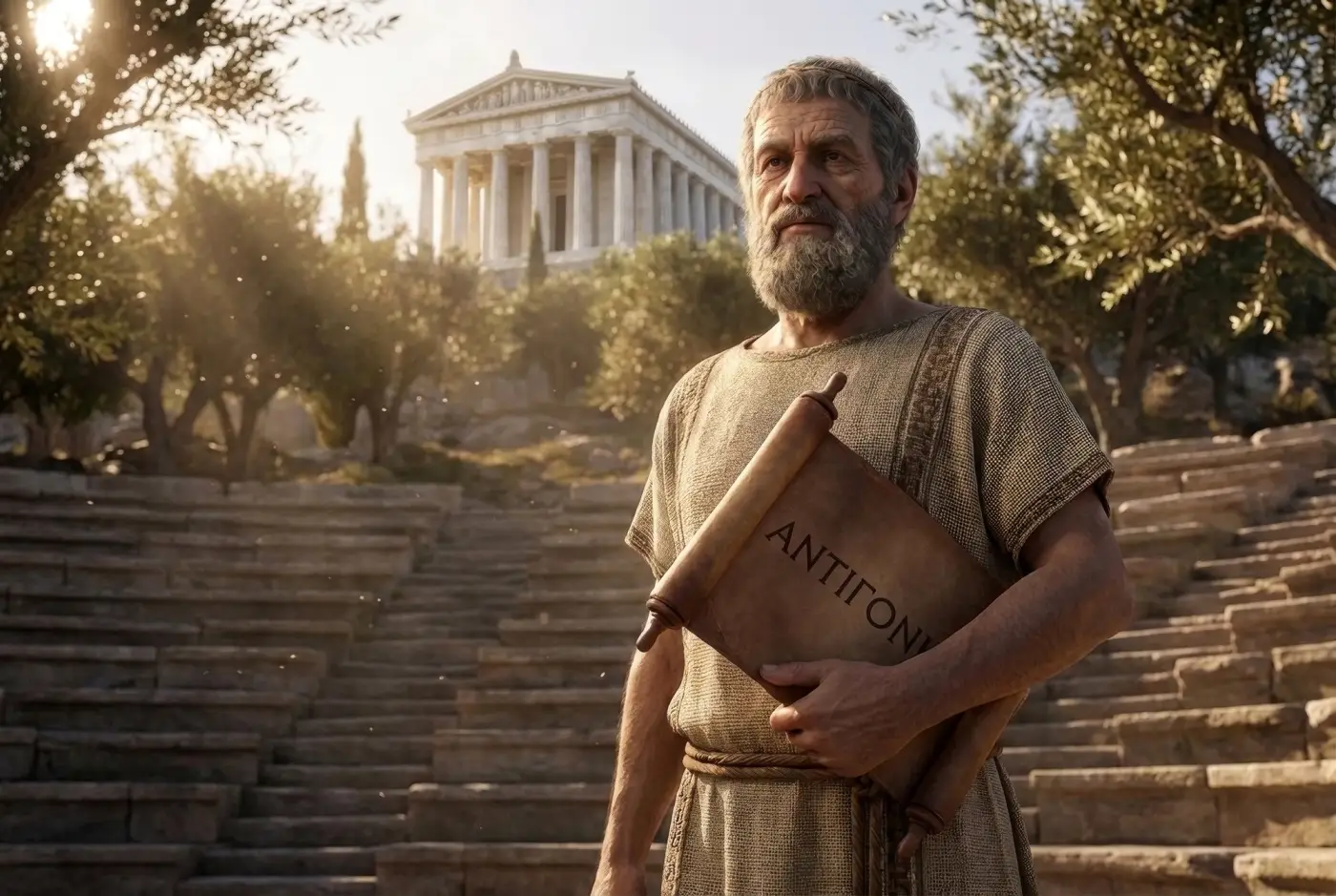
Echoes of Olympus
From mythology to everyday life — in the Echoes of Olympus season, ancient Greece comes alive. Story campaigns, quizzes, and real immersion into a world of philosophy, trade, and legend.
5 episodes freeThe first 5 episodes are free, Premium unlocks the rest.