Did Gladiators Really Fight to the Death? What the Evidence Shows
 AI
AIThumbs down, and that was it? It wasn't that simple
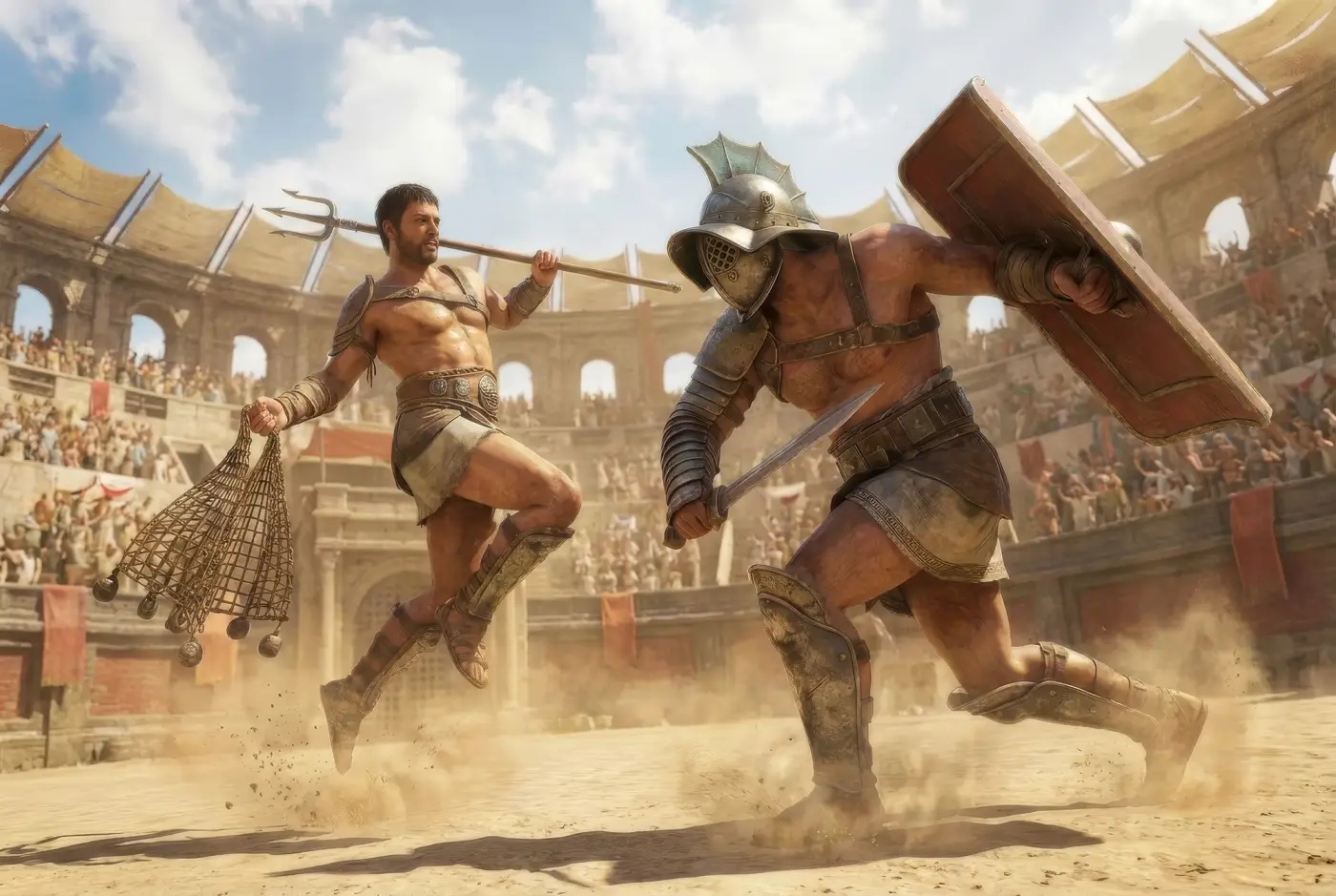
Two men, a sand floor, up to 50,000 roaring spectators, and an emperor lowering his thumb: that's the scene we know from the movies. The loser dies, the winner leaves, the next fight begins. It's a powerful image, and in this form it is hardly documented. Historians, archaeologists, and finds from Pompeii tell a different story: most gladiator fights did not end in death.
But that too is only half the answer. It depends on when and where you look. The numbers shift dramatically over the centuries, and the cliché does have a true core in some eras.
In short: most gladiator fights did not end in death. In Pompeii, about one in five fights ended with the loser's death, other estimates say 10 to 20 percent. Fights to the death existed, but they were the exception, until the situation sharpened in the 3rd century.
 AI
AIFrom the Etruscans to Hollywood
The myth has a real origin. Gladiator fights began as part of funeral rites, among the Etruscans apparently to give the deceased armed companions into the afterlife, and so these early fights usually ended in death. In the time of the Roman Republic, there were fights that ended only with the death of one gladiator, the so-called "munera sine missione." They often took place at the funerals of high-ranking Romans, as a kind of sacrifice funded by the elite.
The thumbs-down that we now take for the death sentence has a later history: it largely goes back to Jean-Léon Gérôme's famous painting "Pollice Verso" of 1872 and was cemented by Hollywood films. The term "pollice verso" appears in ancient authors such as Juvenal, but which gesture exactly was meant, whether the thumb pointed up, down, to the side, or was hidden, is disputed.
 AI
AIProcession, sham fight, and a lot of sand
A day of games followed a set order. It began with a procession of the gladiators through the arena, followed by a sham fight with wooden swords and javelins before the real fights started. The Colosseum's arena measured, depending on the source, only about 76 by 46 up to 88 by 55 meters, smaller than you'd think. The games could last a day, but also many: for the opening in AD 80, Titus held a hundred days of games, and after Trajan's triumph over the Dacians, 5,000 pairs fought for more than four months in AD 107, meaning more than 10,000 men.
With that much going on, not every fight could end in death. Organizers would otherwise have had to keep procuring new fighters, and the program would have ended faster than planned with every death. That explains, at least in part, why death and cost were so closely tied together.
Why gladiators were worth money as long as they lived
Emperor Augustus brought the fights into the state system and banned gladiator fights without mercy, according to Suetonius because of the crippling costs. Behind it lies a sober calculation: gladiators belonged to an owner who had them trained and hired them out. If one died in a fight, the organizer had to pay the owner the full price. At the games in the Colosseum, when a gladiator died, the sponsor had to pay for his replacement.
Every fight survived raised a gladiator's value, and the successful ones were spared for big events. In the imperial period, professional gladiators, according to epigraphic evidence, fought only two or three times a year, and the average age at death was between 22 and 27. They spent most of their time training or in exhibition bouts. Doctors who worked with gladiators even helped to advance the treatment of fractures.
 AI
AI
This is HistoryBytes.
Short lessons, real duels, and immersive visuals from a world of history — download it now.
How many actually died?
It can't be quantified exactly, but the clues are strikingly consistent. A Berkeley researcher who has studied gladiators extensively points to the fight results painted on the walls of Pompeii: there, one in five fights ended with the loser's death. The French historian Georges Ville, analyzing fight reports and tomb inscriptions from the 1st century AD, arrived at roughly 19 of 100 documented fights with a fatal outcome. Since two gladiators took part in every fight, that works out to a death risk of about 10 percent per gladiator per fight. A feature that relied on replicas of gladiator weapons and armor calculates that of ten gladiators, nine survived, and that for every ten pairs there was one death, perhaps two. It fits that inscriptions explicitly announcing "fights without reprieve" or "fights with sharp weapons" marked such clashes as something special: life-threatening fights were apparently rare enough to be advertised. The reconstructionist Lopez, who now runs a research and reenactment troupe, calls it "a real competition, but not a real fight."
The number didn't stay the same. The games were reformed after 27 BC, and the death rate fell. Sources of the 3rd century, by contrast, suggest that about one in two fights ended with the loser's death, and mosaics at Torrenova show the losers of a series of fights dead, probably still in the 4th century. The cliché therefore has its era. It's just not the imperial era people usually imagine.
 AI
AIThe man with the rod
Gladiator fights had rules. A referee, the "summa rudis," himself often a former gladiator, oversaw the fights and could step in. A gladiator could surrender by dropping his shield and extending his index finger. Then the organizer decided whether the loser could leave the arena unharmed. When a fighter was wounded, spectators shouted "Habet" ("He is wounded"), and anyone at his opponent's mercy raised his index finger to ask for mercy.
Even the rules could be deadly, though: the roughly 1,800-year-old tombstone of a gladiator named Diodorus, found at Amisus (today Samsun) on the Black Sea and now in Brussels, tells his own story, and in the view of the ancient historian Michael Carter of Brock University in Canada, he died because of exactly such a rule. When his opponent Demetrius had been knocked down and Diodorus spared him, the referee stepped in, let Demetrius get back up and resume the fight, and Diodorus was killed. The epitaph blames the referee: fate and the cunning treachery of the referee, it says, killed him. Another famous epitaph, that of Urbicus from Florence, urges the opposite: to kill those you have defeated. Skull finds also support the idea of fixed rules: the injuries are single, which suggests that officials intervened once a decisive blow was struck. Fights to the death were so exceptional that they required the emperor's permission, and an inscription from Beroia in Macedonia that had gladiators fight "for their lives" needed an imperial exemption.
 AI
AITwo winners at the opening of the Colosseum
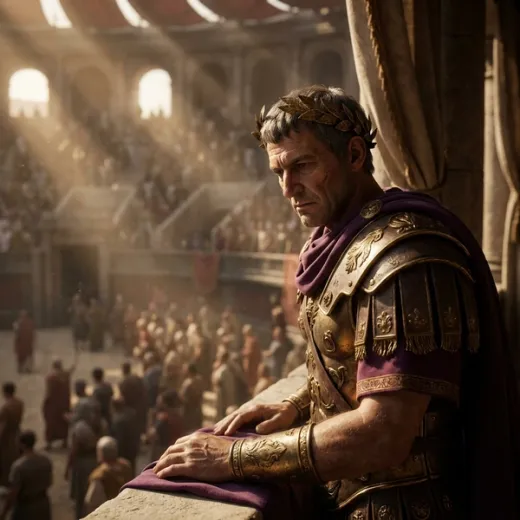
The most famous documented duel shows how much mercy could be part of the show. At the opening games of the Colosseum in AD 80, hosted by Titus, the gladiator Priscus, a Celt, and Verus faced each other, a fight regarded as the highlight of the day. Both were declared winners, and Emperor Titus unexpectedly granted both their freedom. The poet Martial describes the fight in his "Liber de Spectaculis" (29).
That is a single case, but it fits the overall picture of the sources: a fight could also end in mercy and release.
"Ave Caesar" and the thumb
The most famous gladiator greeting is "Ave Caesar, morituri te salutant," "Hail Caesar, those about to die salute you." It is documented only once, in Suetonius, in the year AD 52. Then, condemned prisoners on Lake Fucine were to reenact a sea battle before Emperor Claudius, a naumachia. When they cried out that they were doomed to die, Claudius replied "Aut non," roughly "or not." The men took it as a pardon and refused to fight. According to Tacitus there were around 19,000 condemned men on about a hundred ships. Claudius, says Suetonius, hesitated for a long time over whether to destroy them all with fire and sword, before jumping up from his seat and, not without an undignified stagger, running around the lake to drive them to fight with threats and encouragement. According to Tacitus, they then fought bravely, and after much blood had flowed, the survivors were spared. They weren't ordinary gladiators but men condemned to death, and even this scene is passed down only by Suetonius and Cassius Dio, written long afterward.
The second mistake is the thumb. As mentioned, the image of the thumb pointing down comes mainly from Gérôme's painting of 1872, and the exact gesture was probably more complex than a simple "up" or "down." That doesn't mean there were no gestures, only that we don't know what they meant.
 AI
AIThe arena was everywhere
Gladiator fights took place throughout the empire, and the finds keep multiplying. In April 2025, a team led by Tim Thompson of Maynooth University published in the journal PLOS ONE the first direct physical evidence of a gladiator fighting a lion. The skeleton of a man aged 26 to 35 from the 3rd century comes from the Driffield Terrace cemetery near York, where 82 strongly built young men were found, many of them decapitated. On his pelvis were bite marks from a big cat, which the researchers compared with lion bites from London Zoo. The man was probably an animal fighter, a "venator" or "bestiarius," and the bite wound at the pelvis suggests the lion seized him on the ground and dragged him away. Such games apparently took place there until the 4th century, because Eboracum, today's York, was a hub for generals and politicians, and Constantine was proclaimed emperor there by his troops in 306. The material is part of the British Museum exhibition "Gladiators of Britain."
Austria had its arena too: at Roman Carnuntum on the Danube, in today's Lower Austria, gladiator fights took place. Fighters trained there in gladiator schools, the "ludi gladiatorii," and some volunteered, the so-called "auctorati," attracted by fame, adventure, and pay.
 AI
AISlaves, convicts, and volunteers
Gladiators came mostly from slaves and convicts, with prisoners of war and kidnap victims added. In the empire, though, there were also free people who signed up voluntarily, even men of high standing who had ruined themselves and found at least a livelihood in the arena, however risky. They swore an oath to train, to suffer, and to fight until killed or released. Those sentenced to death in the arena ("ad gladium") had to die within a year, while those sentenced "ad ludum" could be discharged after three years.
That many tombstones show gladiators who lived long enough to retire argues for a different picture than that of the constantly doomed. Grave inscriptions name name, origin, and fights, and some record dozens of victories. Life as a gladiator was dangerous and short, but it was often also an occupation you chose, and sometimes a career that brought name, fame, and money. With the drop in mortality, more free people also volunteered. Some gladiators even became politically important, because turbulent politicians surrounded themselves with gladiators as bodyguards.
 AI
AIOne picture from five angles
Gladiators show why an era needs more than battles and emperors. That's why every season in HistoryBytes is split into five categories, and this story touches all five: the gladiator Diodorus as a person, the Colosseum and Pompeii as places, the naumachia on Lake Fucine in AD 52 as an event, the question of myth and evidence as an idea, Diodorus's tombstone as an object. That's how the Emperors of Rome season, which is completely free to play, builds the whole picture of a time, how people lived, fought, and were entertained.
Seven claims, seven verdicts
To wrap up, the short version. You hear each of these claims often, with varying degrees of truth.
| Claim | Verdict |
|---|---|
| "Most gladiator fights ended in death" | False for the early empire (about 10 to 20 percent, Pompeii roughly one in five fights), but in the 3rd century closer to one in two |
| "Thumbs down meant death" | Uncertain: the image comes mostly from Gérôme's 1872 painting, the gesture is disputed |
| "Ave Caesar, morituri te salutant" | Documented only once, in AD 52, by condemned men at a sea battle |
| "Gladiators were all slaves" | False: there were volunteers and convicts, also men of rank |
| "There were no rules" | False: referees oversaw the fights |
| "Gladiators died young" | Partly: the average age at death was 22 to 27, but many survived for years |
| "Fights to the death didn't exist" | False: they were the exception, but were held on special occasions and with imperial permission |
The winner who had to fight again tomorrow
In the end there's a realization that is less spectacular than the movies and yet more fascinating: gladiators were expensive, trained fighters meant to entertain an audience, and no organizer wanted to lose his investment carelessly. That's why there were rules, doctors, and referees. Death wasn't the normal outcome, but it was always possible, and in some eras it became more frequent. Anyone who wants to replace the cliché has to accept this too: the truth is no all-clear. It's more complicated.
 AI
AIExperience ancient Rome in HistoryBytes
Emperors of Rome
From the first city-states to the mightiest empire of antiquity — Season 1 is completely free to play. Dive into intrigue, conquest, and the rise of Rome.
Completely freeEmperors of Rome is completely free and ad-free.