Did Nero Really Burn Rome? What the Sources Actually Say
 AI
Did Nero really burn Rome?
It isn't proven. Tacitus, the best source, leaves open whether the fire of July 64 was accident or Nero's doing, and Nero was in Antium when it broke out. He didn't play a fiddle, it didn't exist yet, and the song about Troy is only a rumor in Tacitus. Documented are his relief measures and the new building code.
Test your knowledge
That is the answer in brief. If you want to check it, you can answer questions about Nero, the emperors, and ancient Rome in HistoryBytes, in the Emperors of Rome season, with cards and a quiz, before or after you read the article.
This is HistoryBytes.
Short lessons, real duels, and immersive visuals from a world of history — download it now.
The most famous line about a Roman emperor, and it's wrong
"Nero fiddled while Rome burned." Hardly any line about a Roman emperor is as famous, and hardly any contains so many mistakes. The violin was invented some 1,500 years later. The fire broke out while Nero was about 50 kilometers away in Antium. And whether he set it at all is left open even by the historian on whom nearly everything rests.
That doesn't mean Nero was innocent or a good emperor. He had his own mother killed in AD 59, and the aristocrats hated him. Among ordinary people, though, he was long popular, the ancient historian Anthony Barrett calls him "Rome's Golden Boy." In short: the question of the fire is harder to answer than the legend lets on, and at the same time the sources show more than you'd expect. They tell of a city that was bound to burn, of help that helped, and of a building code that changed Rome.
18 to 19 July AD 64: a city of timber and storerooms
The fire began on the night of 18 to 19 July AD 64 in the shops at the Circus Maximus, Rome's racetrack. Tacitus, who was about eight years old in the year of the fire and later wrote from reports and official records, says it broke out in the shops where flammable goods were stored. The wind carried it at once along the whole length of the Circus. There was nothing to stop it: neither mansions with boundary walls nor temples with stone enclosures, only narrow, winding alleys and apartment blocks.
Then it spread to the slopes of the Palatine and the Caelian. The inhabitants fled first to unaffected districts and then to the fields outside the city. After six days the fire was brought under control, but it flared up again and burned three more days. Of Rome's 14 districts, four were untouched, seven were only ruins, and three were completely destroyed. It wasn't the first fire: already in AD 6 a blaze had led to the founding of the Vigiles, a fire brigade and night watch, and more fires followed in AD 12, 14, 22, 26, and 36.
At the time of the fire there were thousands of Vigiles in the city. They poured buckets into houses, moved flammable material out of the way, and tore buildings down as firebreaks. The nine aqueducts delivered water but were not set up for fighting fires. A city built like this burns down sooner or later, and that is the first reason historians today consider an accident possible.
 AI
In Antium, until the flames reached his house
Tacitus writes that Nero was staying at that time in Antium, today's Anzio, about 50 kilometers to the south. He returned, it says, only when the fire approached the house he had built between the Palatine and the Gardens of Maecenas. It could not be stopped, it devoured the palace, the house, and everything around it, among them the Domus Transitoria, Nero's first palace complex.
Then Tacitus reports what Nero did. He opened public buildings and his own gardens to the homeless and had emergency shelters built. He had food brought in from Ostia and the neighboring towns and cut the price of grain to three sesterces. Tacitus concedes that this was popular, and yet writes that it did no good: everywhere the rumor went that at the very moment when Rome was in flames Nero had mounted his private stage and sung of the destruction of Troy, to compare the misfortune of the present with that of the past.
The wording is worth noting: Tacitus doesn't say Nero did it, he says it was said. And he sticks to the fact that the cause is uncertain: whether by chance or through the emperor's malice is unknown, "for each version has its sponsors."
 AI
The later, the more detailed
Everything we know of Nero's behavior stands in three texts that arose long after the event. Tacitus wrote the Annals around AD 117, so some 50 years afterward, from official reports and probably also from works now lost: those of Fabius Rusticus, Cluvius Rufus, and Pliny the Elder. He is regarded as the most reliable source but is not neutral: as scholarship notes, he pushes Nero's guilt close without stating it.
Suetonius wrote around 121 and is plainer: Nero had the fire set openly and watched from the Tower of Maecenas on the Esquiline, in stage costume, and sang of the "Sack of Ilium." Cassius Dio, who wrote around 229, so more than 160 years after the fire, goes furthest: Nero watched the fire from the Palatine, sang, and played the lyre. With each generation the scene thus becomes more detailed, although none of them saw it.
That the fiddle is a mistake is easily said: the instrument arose in the 16th century. Nero sang to the lyre or the cithara, and the English saying "to fiddle while Rome burns" renders the scene with an instrument that did not exist. That he ever sang stands in Tacitus as a rumor, in Suetonius and Dio as fact.
The suspicion and the Golden House
Why was Nero believed to have set the fire? Two things spoke for it. First, the fire flared up again after it was thought to be out, and, according to Tacitus, on the property of Tigellinus, Nero's commander of the Praetorian Guard. It looked as if Nero were aiming at the glory of founding a new city and naming it after himself. The second fire destroyed above all the spacious districts with temples and colonnades.
Second, on the site after the fire Nero built the Domus Aurea, the "Golden House," which covered parts of the Palatine, the Esquiline, and the Caelian and by one figure was about 2.5 square kilometers. That looks like a motive. But it can be read differently: according to the historian Massimo Fini, Nero could have claimed the land anyway, and most of it he already owned. Contemporaries nonetheless noted that he rebuilt quickly. That he profited doesn't prove arson.
 AI
What Nero really did after the fire
The second half of the story is rarely told. Tacitus describes (Annals 15.43) how Rome was rebuilt after the fire: not without plan as after the burning by the Gauls, but with measured lines of streets, broad thoroughfares, a limit on building height, and open spaces. In front of the apartment blocks there were to be colonnades, which Nero promised at his own expense, as well as the clearing of the building sites. The rubble he had carried by the Tiber to the marshes of Ostia, on the very ships that had brought grain.
The buildings were to be built up to a certain height without wooden beams from fireproof stone of Gabii or Alba. Each house got its own wall instead of a shared one, so that a fire wouldn't leap across. Overseers were to watch the water mains that private persons had previously tapped illegally, and every householder had to keep fire-fighting equipment ready in the courtyard. Tacitus also reports criticism: some thought the old layout with its narrow alleys healthier, because it gave shade.
All of that cost a lot. The government raised taxes, burdened the provinces, and debased the coinage. The result shows in the city: historians regard the building code as far-sighted planning whose traces can still be seen in the cityscape. Whether he got thanks for it is doubtful, because the rumors persisted.
 AI
A disputed report
Tacitus also tells that Nero, to stifle the rumor, looked for the guilty and punished the Christians, who were at the time a small and unpopular group in the city (Annals 15.44). Many of them, he says, were put to death cruelly. This report is regarded as one of the earliest Roman evidences of Christians at all.
Scholarship is divided on how sure it is. Besides Tacitus, only the late-antique Sulpicius Severus, who relies on him, mentions the persecution of Christians in connection with the fire. Later Christian authors such as Jerome, Tertullian, Lactantius, and Eusebius do call Nero the first persecutor but do not link it to the fire. Barrett calls this silence "remarkable." Some historians ask whether Tacitus conflated two events, added the report later, or distorted it, and whether there was a centrally organized persecution at all. Others defend him. What is certain: the text shows how Rome then thought about Christians, and it is no proof that they set the fire.
Traces of the fire, but no culprits
The fire is not merely literature. The ancient historian Anthony Barrett in his book "Rome Is Burning" (2020) gathered the new archaeological finds that show traces of destruction, and describes how the fire devastated the city and how the blaze became a turning point for Nero that ultimately led to the end of the dynasty that began with Julius Caesar. The excavations thus document the catastrophe.
Who set it off, the finds don't answer. A burn layer shows that it burned, not who lit it. Tacitus also mentions arsonists and looters who are said to have spread the fire and hindered firefighting and claimed to act on orders, without anyone naming the one who ordered it. And large fires create their own wind, as tests show, so that flying embers can ignite new fires far from the flames, which might explain some reports of additional fires.
 AI
Five open questions
First, the cause: accident or intent, Tacitus himself leaves open, and the present cannot decide it. Second, the arsonists: whether there were organized groups stands only in Tacitus and Dio and is doubted. Third, Nero's behavior: whether he sang is a rumor in Tacitus, a fact in Suetonius and Dio. Who is right here, we don't know, because the sources are shaped by Nero's enemies.
Fourth, the persecution of Christians: whether and how it happened is disputed. Fifth, the motive: Nero used the Golden House, but he already had the land. That the chain of evidence is so thin doesn't mean Nero was innocent. It means one can convict him as little as acquit him, and that the story we know was told mostly by those who hated him.
The evidence at a glance, what a short answer doesn't show
To wrap up, everything at a glance, with fact and story kept apart.
| Category | What belongs here |
|---|---|
| Well documented | Start of the fire on the night of 18 to 19 July 64 in the shops at the Circus Maximus; six days of fire, then three more days; four of 14 districts untouched, seven ruins, three destroyed; Nero's stay in Antium and return (Tacitus); relief (public buildings, gardens, grain price); new building code (streets, height, stone, firewalls, fire-fighting gear); Domus Aurea afterward; archaeological traces of burning (Barrett); a fiddle impossible in AD 64 |
| Handed down | That Nero performed song and lyre (rumor in Tacitus, fact in Suetonius and Dio); arsonists on orders; Tower of Maecenas; Christians as scapegoats (Tacitus); a second fire on the property of Tigellinus |
| Disputed or open | Accident or intent (Tacitus leaves it open); whether Nero sang; whether the persecution of Christians took place as told; whether the Golden House was a motive; size of the Domus Aurea |
One picture from five angles
The burning of Rome shows how many questions lie in a single event. That's why every season in HistoryBytes is split into five categories, and this story touches all five: Nero as a person, the Circus Maximus as a place, the fire of 18 to 19 July AD 64 as an event, the question of how Rome survived a catastrophe as an idea, the fireproof stone wall of the new building code as an object. That's how the Emperors of Rome season builds the whole picture of a city and its emperors, beyond the legends.
A line that outlives the truth
The line about the fiddle has survived because it is so good. An emperor who sings while his city burns is an image for every ruler who doesn't see suffering. The sources show something more uncomfortable: an emperor who was in Antium, who came back, organized relief, planned a better city, and was still held to be an arsonist. Whether he was, stays open. But whoever wants to tell the story honestly must say that it was written by people who hated him, and that the most famous line about him isn't in it at all.
 AI
Sources and date: 6 November 2026
Tacitus, Annals, Book 15, chapters 38 to 44 (around AD 117); Suetonius, Nero, chapters 31 and 38 (around 121); Cassius Dio, Roman History, Book 62 (around 229); Anthony A. Barrett, "Rome Is Burning: Nero and the Fire That Ended a Dynasty" (Princeton, 2020); Miriam T. Griffin, "Nero: The End of a Dynasty" (2001); PBS "Secrets of the Dead: The Great Fire of Rome" (2014). The Tacitus passages follow the translation of Church and Brodribb and the Loeb edition. This page is updated when new finds are published.
Experience the Roman Empire in HistoryBytes
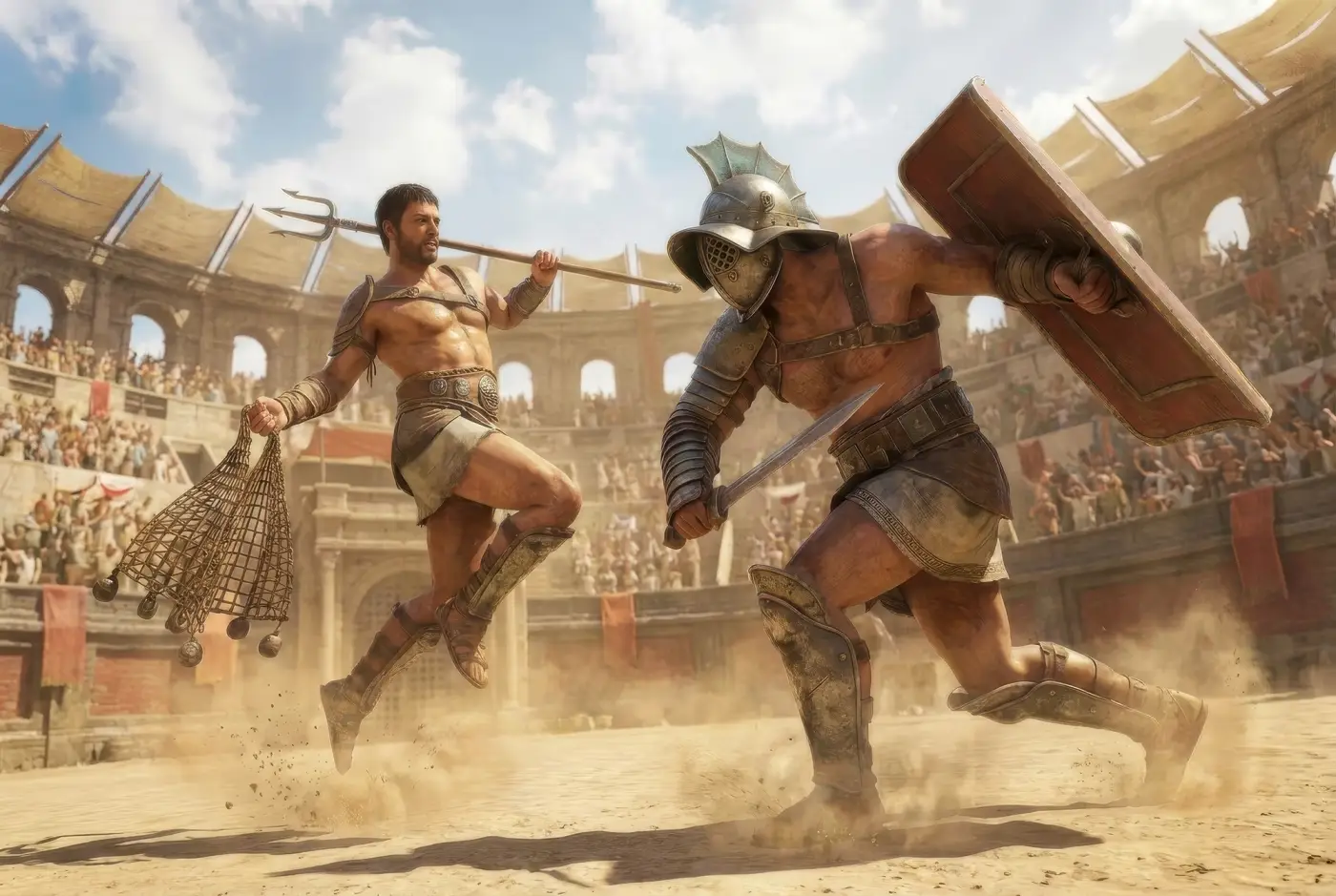
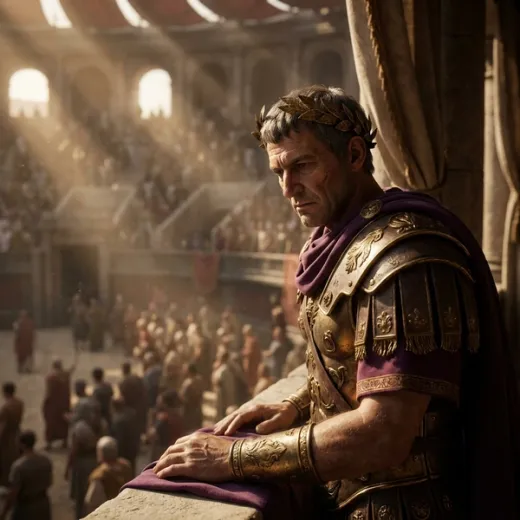
Emperors of Rome
From Caesar to Constantine — in the Emperors of Rome season, the age of the Roman emperors comes alive. Story campaigns, quizzes, and real immersion into a world of power, intrigue, and legions.
Completely freeEmperors of Rome is completely free and ad-free.