Did Vikings Wear Horned Helmets?
 AI
Did Vikings wear horned helmets?
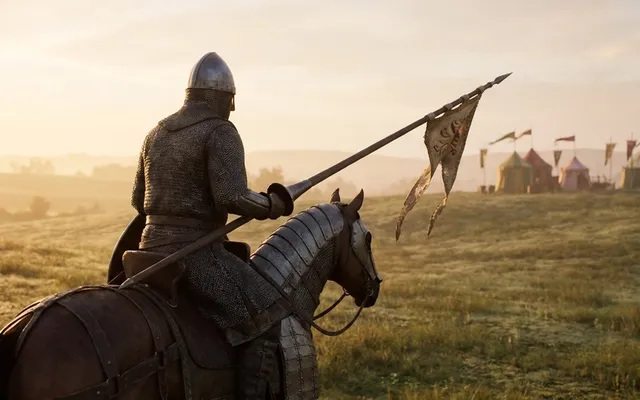
No. Not a single horned helmet is known from the Viking Age. The few helmets found are plain, rounded iron caps, often with an eye and nose guard. The horned Viking was born in the nineteenth century, above all through costumes for Wagner's opera "The Ring of the Nibelung" in 1876. Real Scandinavian horned helmets are about 1,700 years older.
A costume designer, a wife, and a bog in Denmark
The most famous Viking helmet never belonged to a Viking but to an opera singer. Even the composer's wife found the costumes ridiculous. And the only real horned helmets from Scandinavia lay in a bog for almost 3,000 years before a peat cutter came across them.
Bayreuth, summer 1876
In August 1876, Richard Wagner's four-part opera cycle "The Ring of the Nibelung" was performed in full for the first time in the newly built Festival Theatre in Bayreuth. Wagner had the Festival Theatre built specifically for this work, and among the guests were Emperor Wilhelm I and King Ludwig II of Bavaria. It was one of the great cultural events of the decade. The costumes were designed by the painter and illustrator Carl Emil Doepler. He wanted to bring the world of Germanic and Norse legend to the stage, and some of his characters wore helmets with horns or wings.
Not everyone was thrilled. Cosima Wagner, the composer's wife, wrote that the costumes were "reminiscent throughout of Red Indian chiefs." The audience saw it differently. In the years that followed, the "Ring" was staged in dozens of European cities, and Doepler's costumes traveled with it from stage to stage. Within a few decades the horned helmet had become the defining mark of the Viking, in books, in paintings, in advertising, and later in films and comics. Yet there is not a single piece of evidence for it from the Viking Age.
Strictly speaking, no Vikings appear in the "Ring" at all. The opera tells of gods, giants, dwarfs, and heroes from Germanic and Norse legend, such as Wotan, Siegfried, and Brünnhilde. It was the audience that linked the horned stage figures to the seafarers from Scandinavia who had kept Europe on edge between the eighth and eleventh centuries. A theatrical fantasy about gods thus became a picture of real people.

This is HistoryBytes.
Short lessons, real duels, and immersive visuals from a world of history — download it now.
The helmet from the burial mound
What did a real Viking helmet look like? The most important answer is in the Museum of Cultural History at the University of Oslo. In March 1943, in the middle of the German occupation of Norway, a farmer at Gjermundbu near Haugsbygd in the municipality of Ringerike came across a large burial mound. Inside were two cremation burials from the second half of the tenth century, along with weapons, riding gear, gaming pieces, and an iron helmet broken into several pieces.
The Gjermundbu helmet has a rounded iron cap and at the front a kind of spectacles protecting the eyes and nose. A curtain of mail probably hung from its lower edge to cover the neck. It has no horns. According to the excavation reports, the same grave also held remains of a mail shirt, one of the rare finds of its kind from the Viking Age. The dead man was thus wealthy, probably a leader who could afford full equipment. It is often described as the world's only complete Viking helmet. That is only half true: only part of the original helmet survives, by some experts' estimates a quarter to a third. But it is the find that shows most clearly how a Viking helmet was built, and it closely resembles helmets from the period before the Vikings.
 AI
A helmet in the town hall
For a long time the Gjermundbu helmet was considered the only nearly complete Viking helmet. In 2020 a second one joined it, and it had been in England all along. In the 1950s, workmen digging trenches for sewage pipes in the town of Yarm in northern England, in a meander of the River Tees, found an iron helmet. It was put on display in the town hall and labeled as Norman, meaning a helmet from after 1066.
The archaeologist Chris Caple of Durham University examined it more closely. In 2020 he showed in the journal Medieval Archaeology that it is not a later copy but an original from the ninth to eleventh century, comparable to the Gjermundbu helmet. The Yarm helmet, too, is made of riveted, undecorated iron plates, has an eye mask, and holes along its lower edge for a mail curtain. Horns? None. That the helmet survived so well is thanks to the soil: traces of the blue-green mineral vivianite show it lay for a long time in wet, oxygen-poor ground that protected the iron from rusting. Caple stressed that without the workmen's find it would probably have decayed eventually. It is the first Viking helmet found in Britain and probably belonged to a Scandinavian who had settled in the north of England after the raids.
 AI
Five helmets from three centuries
That so few helmets survive from nearly three centuries of the Viking Age, roughly 793 to 1066, has several reasons. Altogether, researchers know of only five: besides Gjermundbu and Yarm, fragments from Tjele in Denmark, from Lokrume on Gotland, and from Kyiv. Iron was expensive and valuable. A helmet was more likely to be repaired, passed down, or melted down than placed in a grave. And with the Christianization of Scandinavia, the custom of burying the dead with weapons came to an end.
What's more, many fighters probably wore no metal helmet at all. Some may have worn caps of hardened leather, which have not survived; others fought bareheaded. The Vikings were not a uniformly equipped army but war bands in which everyone wore what he could afford. An iron helmet was a sign of wealth. That is exactly why it is so telling that none of the helmets found has horns, and that no writer of the time reports horned Norsemen, even though Christian chroniclers liked to describe the Vikings as terrifying as possible. When Norsemen attacked the monastery of Lindisfarne on the coast of northern England in 793, the Anglo-Saxon Chronicle wrote of "heathen men" laying waste to God's church. Monks and scholars described violence, plunder, and godlessness in every detail. Horns would have fit perfectly into such images of terror, but they appear in none of these texts.
The real horned helmets from the bog
They do exist, though: horned helmets from Scandinavia. In 1942 a worker cutting peat in a bog near Veksø on the Danish island of Zealand came across two bronze helmets. Each bears two large, curving horns, along with a face of eyes and a beak reminiscent of a bird of prey. The helmets had evidently been sunk in the bog on purpose, probably as an offering. Today they are in the National Museum of Denmark in Copenhagen. They fit with other finds from the Nordic Bronze Age: rock carvings in Denmark and Sweden also show figures with horns, often in boats or at ceremonies.
For a long time all that was known was that they came from the Nordic Bronze Age. In 2019 a museum employee preparing to photograph them noticed traces of birch tar on one of the horns. Using that sample, the archaeologist Helle Vandkilde of Aarhus University and her team were able to radiocarbon-date them: the helmets were deposited in the bog around 900 BC, most probably between 1006 and 857 BC. That is nearly 2,000 years before the Viking Age. Vandkilde didn't mince words: associating the helmets with the Vikings, she said, is "nonsense."
 AI
Feathers, horsehair, and sun symbols
What were the Veksø helmets for? Hardly for combat. Vandkilde's team believes feathers were fixed to the tips of the horns with birch tar, and that a crest of horsehair adorned the helmets. In the ancient Near East, on Sardinia, and in southwestern Iberia, bull horns and birds of prey were symbols of the sun and of divine power. Similar horned figures appear in rock art and figurines from Sardinia and western Iberia from the same period. The researchers suspect such symbols came north with traders bringing copper and tin, since Scandinavia had almost no metal of its own at the time. The researchers link this to the expansion of the Phoenicians, who from around 1000 BC built trade networks reaching into the western Mediterranean. Through such networks the North was connected to the Mediterranean world long before there were any Vikings.
Horns also appear later in northern art, but within a very particular frame. On the pressed metal plates from Torslunda on Öland and on the seventh-century Sutton Hoo helmet, dancing warriors wear helmets whose "horns" end in bird heads. On the tapestry from the ninth-century Oseberg ship burial, a figure with horned headgear leads a procession, perhaps a priest or the god Odin. All of these depictions belong to the realm of ritual and religion, not the battlefield.
 AI
Romantics, painters, and an opera house
If there were no horned Viking helmets, how did the image get into the world? The literary scholar Roberta Frank traced it in 2000 in a much-cited essay titled "The Invention of the Viking Horned Helmet." In the nineteenth century, Scandinavia and Germany rediscovered their Norse past, and painters, poets, and illustrators created images to go with it. Swedish artists such as Gustav Malmström depicted Vikings with striking headgear, sometimes with wings, sometimes with eagle helmets.
Horns, however, long remained the exception. Frank found hardly any examples before the 1870s; one is an 1851 drawing showing the legendary hero Ragnar Lodbrok in a helmet of goat horns. Even Frithiof, the hero of a famous Swedish epic, wears an "eagle helm" in illustrations for most of the nineteenth century and only gets horns in the late 1870s. The turning point was Bayreuth in 1876. According to Frank, within 20 years the horned helmet had become the symbol of the Viking in advertising, in paintings, and in children's books. Later, comics, films, and sports teams adopted the image. The Minnesota Vikings American football team still has a horned helmet in its logo, and hardly a carnival or Halloween season goes by without plastic horned helmets. The image has taken on such a life of its own that many people are surprised the first time they see a real Viking helmet in a museum: small, plain, rusty, and entirely without horns.
 AI
In combat, horns are a liability
That Vikings did not put horns on their battle helmets is also a matter of common sense. A battle helmet is meant to make blows glance off. That is why the helmets found are round and smooth. Horns would do exactly the opposite: they give an axe or sword a point to catch on, where the blow sticks and wrenches the head aside. In the crush of a shield wall, where men stood shoulder to shoulder, they would also have hampered the man next to you.
Chris Caple used the Yarm helmet to show how a Viking helmet actually worked: it was riveted together from many parts. If it was hit, rivets could pop out and the metal could bend, but the wearer survived. The dents could be knocked out later, and the helmet went into the next fight. Such a helmet was a tool, not a costume. That the Vikings still wanted to look impressive on their ships and in battle is quite possible, but for that they had shields, banners, clothing, and jewelry.
 AI
What remains open
First, how most Vikings protected their heads: with only five known metal helmets, it is unclear whether leather caps were widespread or whether many fighters wore no helmet at all. Second, what the horned headgear on the Oseberg tapestry means: whether it shows a priest, a god, or a figure from legend, and whether such headgear was actually worn in the Viking Age, cannot be said for sure.
Third, exactly how Bronze Age horn symbols reached Scandinavia: the link to Sardinia and Iberia is a reasoned theory, but finds that would document the route between these regions are missing. Fourth, how complete the Gjermundbu helmet really is: its present form is partly reconstruction. And fifth, how many Viking helmets still lie unrecognized in museum stores. The Yarm helmet shows that a find can be mislabeled for decades.
The evidence at a glance, what a short answer doesn't show
To wrap up, everything at a glance, with fact and interpretation kept apart.
| Category | What belongs here |
|---|---|
| Well documented | No Viking helmet with horns known; Gjermundbu helmet, found 1943, 10th century, with eye and nose guard; Yarm helmet, found in the 1950s, confirmed in 2020 as an original from the 9th to 11th century; five known Viking helmets in total; Veksø helmets, found 1942, dated to about 1006–857 BC; Doepler's costumes for the "Ring" in Bayreuth, 1876; Cosima Wagner's criticism |
| Handed down | Feathers and horsehair as decoration on the Veksø helmets (inferred from traces); 1851 drawing of Ragnar Lodbrok with goat horns; Frithiof only gets horns in the late 1870s |
| Disputed or open | Meaning of the horned figure on the Oseberg tapestry; the route of horn symbols from southern Europe to Scandinavia; how common leather helmets were; how complete the Gjermundbu helmet is |
One helmet from five angles
The horned Viking shows how strongly a single image can shape our idea of an entire era. Every season in HistoryBytes is split into five categories, and this story touches all of them: people like the warriors buried at Gjermundbu, places like the fjords of Norway, events like the raids on England, ideas like a warrior's standing, objects like the helmet itself. That's how the Viking Sagas season builds a picture of the Vikings that needs no opera costumes.
The helmet that never was
Did Vikings wear horned helmets? No, and that is actually the more interesting story. Real Viking helmets are plain, sturdy iron caps built to survive blows. The real horned helmets of the North are nearly 3,000-year-old cult objects from the Bronze Age, adorned with feathers and horsehair, symbols of sun and power. And the horned Viking himself is a child of the nineteenth century, born in a costume workshop for an opera house in Franconia. Anyone who draws a Viking with horns today is sketching a singer from Bayreuth rather than a warrior from Norway.
 AI
Sources and date: 22 November 2026
Helle Vandkilde et al., study of the Veksø helmets and horned warriors of the Late Bronze Age, Praehistorische Zeitschrift, with the Aarhus University release and reports in Live Science, Smithsonian, and Archaeology Magazine (2022); Chris Caple, "The Yarm Helmet," Medieval Archaeology 64, no. 1 (2020), pp. 31–64, with the Stockton Borough Council release; Roberta Frank, "The invention of the Viking horned helmet" (2000), in International Scandinavian and Medieval Studies in Memory of Gerd Wolfgang Weber, pp. 199–208; German Historical Museum on Doepler's costumes and Cosima Wagner's verdict; Rudolf Simek, Dictionary of Northern Mythology (2007); History.com and Hurstwic on Viking helmets; Wikipedia ("Gjermundbu helmet," "Yarm helmet," "Veksø helmets," "Horned helmet," "Carl Emil Doepler"). This page is updated when new research is published.
Experience the Viking Age in HistoryBytes


Viking Sagas
From longships to the sagas of the North — in the Viking Sagas season, the world of the Vikings comes alive. Story campaigns, quizzes, and real immersion into a world of raids, trade, and myth.
5 episodes freeThe first 5 episodes are free, Premium unlocks the rest.