William Marshal: How a Landless Knight Became Regent of England
 AI
The best knight who ever lived, and the book that made him so
In 1152, a king held a small boy hostage outside a besieged castle. When he threatened to hang the child, the father is said to have replied that he still had the hammer and the anvil to forge more and better sons. The boy survived and was buried 67 years later, at about 72, as the regent of England. His name was William Marshal.
If you know the series "A Knight of the Seven Kingdoms," you know the type: the knight without land who lives off what he wins with the sword. William Marshal was the real counterpart, a younger son with no inheritance who worked his way up through tournaments and service to kings to become Earl of Pembroke and regent of England.
In short: William Marshal (1146 or 1147 to 1219) served five English kings, grew rich in tournaments, unhorsed Richard the Lionheart in 1189, and ruled from 1216 as regent for the nine-year-old Henry III. Almost everything we know about him comes from a single biography that his family commissioned after his death.
The hammer and the anvil
William's father John Marshal had switched sides around 1139 and supported Empress Matilda against King Stephen, which plunged England into a 15-year civil war, "the Anarchy." In 1152, Stephen besieged Newbury Castle and took the young William hostage so that John would surrender the castle as promised. John used the time to reinforce the castle and warn Matilda's supporters.
When Stephen threatened to hang William, John answered that he should go ahead, he still had the hammer and the anvil to forge more and better sons. After that, a pretence was made of launching the boy at the castle with a catapult, but Stephen could not bring himself to do it. William remained a hostage for months and was freed only after the peace of November 1153.
 AI
Why William's path led through tournaments
William was a younger son of a minor nobleman and had nothing to inherit. At about 12, he was sent to Normandy, to Tancarville Castle, where he was trained as a knight in the household of a relative of his mother: riding, sword and lance, biblical stories, Latin prayers, and the courtly romances that taught the rules of chivalry. In 1166 he was knighted on a campaign in Upper Normandy.
There he also learned that war in the 12th century wasn't only about honor. The historian David Crouch writes that profit was part of it, and that was exactly where the young William struggled: he couldn't turn his victories in combat into ransom or booty. The Earl of Essex is said to have asked him jokingly how he could defeat forty or sixty opponents and not give him even a small share. That changed in 1167, when he rode his first tournament.
This is HistoryBytes.
Short lessons, real duels, and immersive visuals from a world of history — download it now.
Prisoners, horses, and ransom
Tournaments back then were not displays but dangerous, often deadly mock battles in which money was to be won: whoever captured opponents got ransom plus their horses and armor. From 1176 to 1182, William toured the tournament grounds of Europe with the "Young King" Henry, the eldest son of Henry II. He is said to have claimed on his deathbed that he had defeated 500 knights in his tournament career.
He had also been a prisoner himself: in 1168, on a journey of Queen Eleanor of Aquitaine, he was caught in an ambush by Guy de Lusignan, who wanted to capture the queen. Eleanor escaped, William's uncle Patrick, Earl of Salisbury, was killed, and William was wounded in the thigh and taken prisoner. Someone in the castle took pity and smuggled him a loaf of bread with clean linen bandages hidden inside, which may have saved his life. Eleanor paid the ransom, impressed by tales of his bravery. In 1170, Henry II appointed him tutor-in-arms to his son, the Young King.
 AI
The accusation of 1182 and the missing two years
In late 1182, William was accused of having an affair with the Young King's wife, Margaret of France. The historian Thomas Asbridge considers the accusation very likely to have been invented by William's enemies at court, though it can't be proven. David Crouch suggests the real charge was lèse-majesté, triggered by William's own arrogance and greed, with adultery introduced in the biography only as a distraction. By early 1183, William had in any case lost his place, and by May he was cleared of all charges and back.
On 11 June 1183, the Young King died. On his deathbed he asked William to fulfill his crusade vow of 1182, and William left for Jerusalem in late 1183. What he did during the two years there is unknown, the detailed biography is silent. Georges Duby believes William himself wanted it that way, perhaps because of his secret decision to join the Templars. Thomas Asbridge considers it possible that the fights weren't worth telling. Nicholas Paul, by contrast, suggests the stories might have seemed too implausible to the author.
 AI
From penniless to earl
In 1189, William covered Henry II's flight from Le Mans to Chinon. In doing so he met Richard, the later Lionheart, who had turned against his father, and unhorsed him. William could have killed Richard, but killed his horse instead to make the point. He is said to be the only man ever to unhorse Richard. After Henry's death, Richard welcomed him at court anyway, he needed such a man for his crusade.
Shortly before his death, Henry II had promised William the hand of Isabel de Clare, heiress of vast estates in England, Wales, Normandy, and Ireland. Richard confirmed the promise, and in August 1189 the two were married. The knight without land became one of the richest men in the kingdom. He got the title Earl of Pembroke only in 1199. The marriage seems to have been genuine, there is no known mistress, which was otherwise common among nobles and often recorded. At around 50, in May 1197, during a stalled assault on Milli castle, he climbed a scaling ladder onto the wall in full armor and fought on top until reinforcements came.
 AI
From King John to the nine-year-old Henry III
After Richard's death in 1199, William supported John, but relations cooled when in 1204 he paid homage to Philip II of France for his Norman possessions. In 1207 he went to Leinster in Ireland, in 1213 he returned. When the barons rose against John in 1215, William remained loyal and played a leading role in the negotiations over Magna Carta, his name appears first among the lay advisers of the king.
When John died in October 1216, the loyal barons on 11 November in Gloucester chose William, then about 70, as protector of the nine-year-old Henry III and as "rector regis et regni," "governor of the king and of the kingdom." On 20 May 1217 he personally led the army in the Battle of Lincoln. The French commander Thomas of Perche was killed, and the sacking of the city, which had sided with Louis, was later euphemistically called the "Lincoln Fair." On 24 August 1217, Hubert de Burgh defeated the French supply fleet off Sandwich. A few weeks later, in September 1217, William concluded the Treaty of Lambeth with the French Prince Louis, a mild peace for which he was criticized, but which quickly got the French out of England. He reissued Magna Carta, issued the Charter of the Forest, had the royal Exchequer working again and the judges traveling again.
 AI
A Templar on his deathbed
In early 1219, William fell ill. He left the Tower of London for his estate at Caversham and summoned the barons, the young king, the papal legate, and other dignitaries. He entrusted the regency to the legate because he distrusted the Bishop of Winchester and the other magnates. And he fulfilled the vow he had made on crusade: on his deathbed he was received into the Templar order. He ordered that his body and the bier be covered with two silk shrouds he had obtained in the Holy Land decades before.
William died on 14 May 1219 at Caversham and was buried in the Temple Church in London, where his tomb can still be seen. His five sons all became Earl of Pembroke and died without legitimate heirs, according to one tradition because a Bishop of Ferns had cursed the family. Through his daughters he was an ancestor of the Scottish Bruce and Stewart kings and, through a granddaughter, according to Wikipedia, of all English monarchs from Henry VIII.
 AI
The biography the family commissioned
Almost everything in this article comes from the "History of William Marshal" (L'Histoire de Guillaume le Maréchal), a poem of about 19,000 lines that his family commissioned after his death and that was finished around 1226. When the French historian Paul Meyer rediscovered it in 1881, a shadowy figure of Anglo-Norman history became a person whose life could be reconstructed in detail.
That raises a question: how much is family PR? David Crouch wrote an essay on it titled "Biography as Propaganda," and the gaps speak for themselves: the crusade is almost entirely missing, and the adultery charge of 1182 may, according to Crouch, serve to distract from a more serious charge. The story of the hammer and the anvil, the bread with the bandages, and the 500 defeated knights all stand in this one source. They are not invented, but they are colored.
The overview at a glance
To wrap up, the short version, so fact and story don't blur.
| Category | What belongs here |
|---|---|
| Well documented | William's dates (1146 or 1147 to 14 May 1219); knighted in 1166; tutor of the Young King from 1170; marriage to Isabel de Clare in August 1189; Earl of Pembroke in 1199; Magna Carta in 1215; regent from 11 November 1216; Lincoln on 20 May 1217, Treaty of Lambeth in September 1217; death and burial in the Temple Church; Templar admission on his deathbed |
| Handed down | Hammer and anvil at Newbury in 1152; the bread with linen bandages in 1168; 500 defeated knights in his tournament years; that he unhorsed Richard and killed only the horse; the curse of the Bishop of Ferns; the climb onto the wall at Milli |
| Open | Whether the charge of 1182 was invented or meant lèse-majesté; what William did in the Holy Land in 1183 to 1185; whether he was "the best knight" or the biography made him so; his exact birth year; whether he was the fourth or second son of his father |
One picture from five angles
William Marshal shows what a knight's life really looked like: less glamour, more business. That's why every season in HistoryBytes is split into five categories, and this story touches all five: William Marshal as a person, Newbury Castle as a place, the Battle of Lincoln in 1217 as an event, chivalry as an idea, the tournament as the object of profit-seeking, represented here by his armor and his horse. That's how the Tales of Chivalry season builds the whole picture of a time in which knights not only fought but lived from it.
The knight without land
That a man without an inheritance became regent of a kingdom is unusual, but it was possible if he fought well, stayed loyal, and had enough luck. William did all three, and he had enemies who envied him. What remains is a picture made half of facts and half of the story his family told. In the Temple Church in London, the stone figures of knights still lie, and one of them is attributed to him. Whether it shows him, nobody knows for sure, but it suits him that after 800 years we still think we recognize him.
 AI
Experience chivalry in HistoryBytes
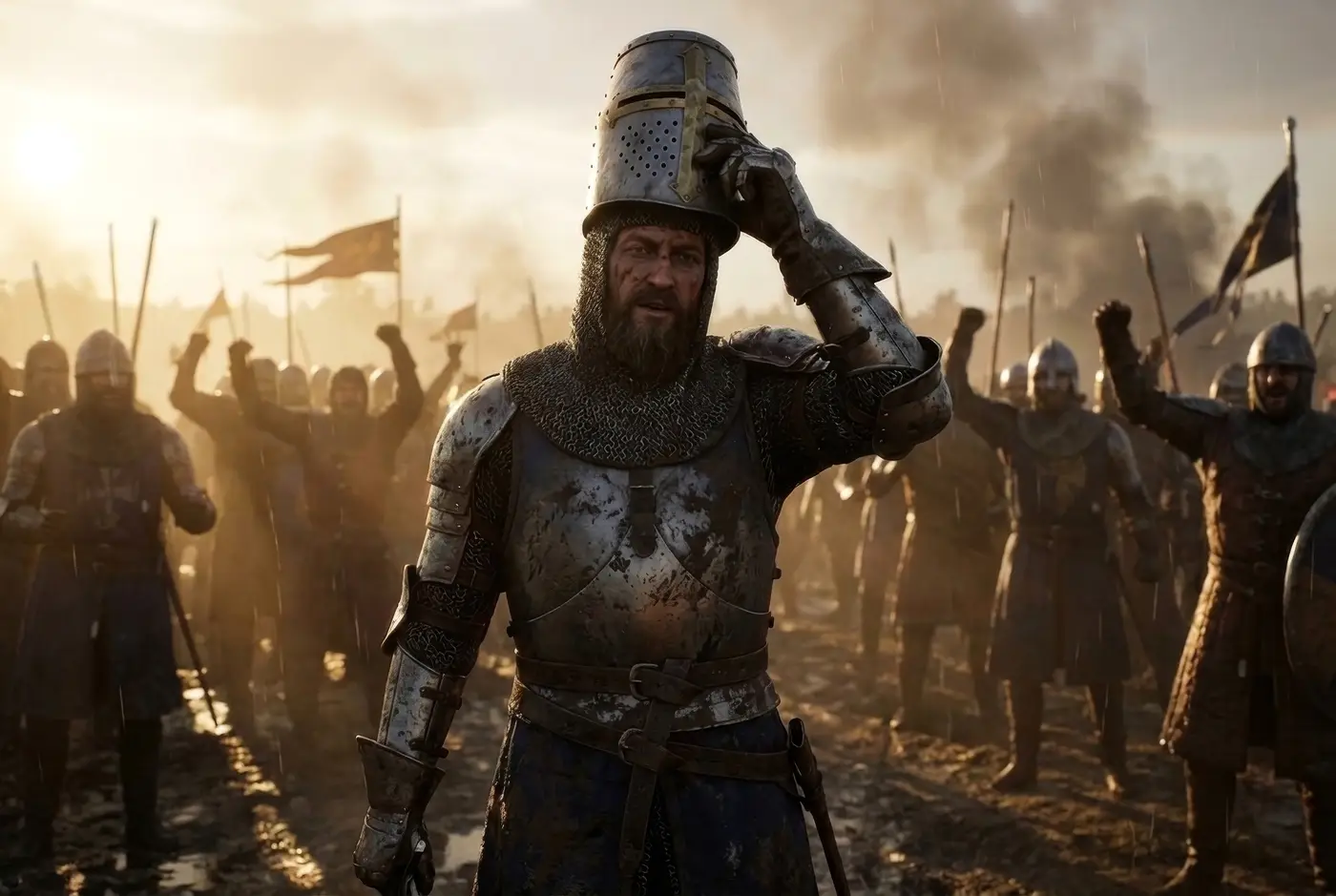
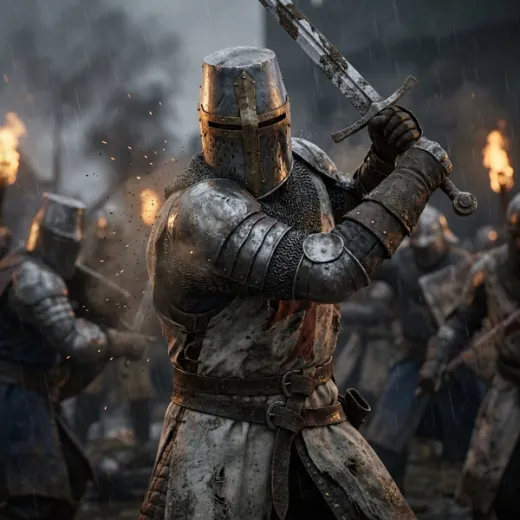
Tales of Chivalry
From squires to crusades — in the Tales of Chivalry season, the age of knights comes alive. Story campaigns, quizzes, and real immersion into a world of honor, castles, and battle.
5 episodes freeThe first 5 episodes are free, Premium unlocks the rest.