Were Vikings Really Buried in Burning Ships?
 AI
Were Vikings really buried in burning ships?
No, not like in the movies. Documented are ships that lay under burial mounds (Oseberg 834, Gokstad around 900) and ships that were burned on land. A burning ship drifting out to sea is known only from sagas. The only eyewitness report came in 921/922 from an Arab envoy on the Volga.
Test your knowledge
That is the answer in brief. If you want to check it, you can answer questions about Vikings, ships, and sagas in HistoryBytes, in the Viking Sagas season, with cards and a quiz, before or after you read the article.

This is HistoryBytes.
Short lessons, real duels, and immersive visuals from a world of history — download it now.
A picture almost everyone knows
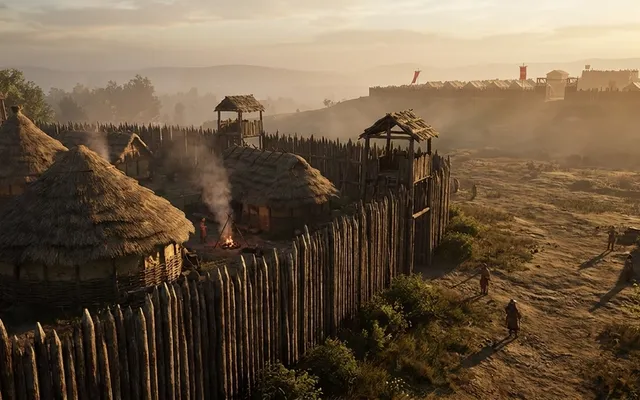
A dead warrior lies in a boat, someone fires a flaming arrow, the sail catches fire, and the ship drifts burning out to the open sea. Almost everyone knows this picture, from films, series, and songs, and almost everyone takes it for a Viking funeral. Nothing like it has been found anywhere so far.
In short: the picture is a blend of a saga, a 19th-century painting, and a Hollywood film. What archaeologists actually found is more exciting and more complicated: huge mounds with whole ships inside, individual ships burned on land, and since 2018 new finds that change the picture. Archaeology Magazine summed up the new view in summer 2025. This article shows where the picture comes from, what the finds say, and what an Arab envoy saw in the year 921.
A painting, a film, and a god
The most famous image comes from the British painter Frank Dicksee. His painting "The Funeral of a Viking" of 1893, today in the Manchester Art Gallery, shows an armored dead man on a burning ship that men push into the sea, mourners and warriors on the shore. It was a 19th-century picture about a people romanticized at the time. The scene had its greatest impact in 1958: in Richard Fleischer's Hollywood film "The Vikings" the story ends with the funeral of Prince Einar, played by Kirk Douglas, and the shooting of the ship with flaming arrows. Since then the flaming arrow has been standard equipment.
Literary roots are few. In the Prose Edda the pyre of the god Baldr is built on a ship that is pushed into the sea as the fire is lit. According to Snorri's Ynglinga saga the legendary Swedish king Haki is also said to have been buried that way. Both cases are myth and legend. From the Viking Age itself no find is known that documents a burning ship on the open sea. Alongside burial in the ground there was indeed cremation on a pyre, but ships were so expensive that including one was reserved for the wealthiest.
 AI
Ships under mounds: Oseberg and Gokstad
The most famous ship graves are not cremations. The Oseberg ship in southern Norway, excavated in 1904, was a vessel of about 22 meters that, by tree-ring dating, was buried in the autumn of 834. In its burial chamber lay two women, together with beds, quilts, tents, clothing, shoes, combs, kitchenware, sleighs, carved animal heads, and a woven tapestry, plus about 15 horses, six dogs, and two cows. The Gokstad ship, excavated since 1880, is almost 80 feet long, about 24 meters, and held a roughly 50-year-old warrior buried around 900.
Both ships were dragged ashore, set in a pit, and buried under a huge mound of earth, so that a "hollow hill" came into being. Archaeologists reckon with about AD 700 to 950 as the period of ship graves, most of which were found in Norway. In Scandinavia there are hundreds, if not thousands, of burial mounds, but most contain only small boats. Ship graves in the strict sense, with vessels of more than 50 feet, are rare, and they were events that came once in a generation, reserved for the most powerful personalities.
The custom is older than the Vikings. The earliest known ship grave lies in England, at Sutton Hoo: there a ship about 90 feet long was buried around 610, apparently for an Anglo-Saxon king. For a long time researchers denied a connection with Scandinavia because the earliest Norwegian and Swedish ship graves were then dated only to the early 9th century. In 2023 Norwegian archaeologists found north of Trondheim the oldest known ship grave outside England, dated to AD 700, a kind of bridge between England and Scandinavia. The dead were given a chamber in the middle of the ship, together with weapons, textiles, household goods, and sacrificed animals, and also food and drink for feasts in the afterlife. From Gjellestad, despite the plundering, comes a bone from the tail fin of a halibut about three meters long.
 AI
Myklebust: The ship in the moat
That ships were burned is documented nonetheless, only differently than in the movies. At the Norwegian ship grave of Myklebust, which the archaeologist Anders Lorange first excavated over 150 years ago, researchers in recent years found a ditch more than three meters wide around the mound, crossed by two bridges, so a kind of moat. It was connected to a nearby creek and could be flooded. In the mound, judging by the hundreds of boat nails and the outline of the charred vessel, lay a ship of about 100 feet, some 30 meters.
In the ship Lorange found a bronze cauldron with the cremated remains of a man in his thirties, together with the bones of a lamb or a goat, a hint that part of the burial took place in spring. Among the burned bones lay an arrowhead, perhaps from a war wound, and around the ship 44 shield bosses, possibly one per crew member. The cauldron was not warped, so not in the fire. The archaeologist Morten Ramstad suspects that the dead man was burned elsewhere, for example after a death on the battlefield or at sea, and his remains came to Myklebust later. The ship was set alight, but that was not the end of the ceremony. Ramstad sees in it evidence that ships were set on fire, as the written sources say.
 AI
The only eyewitness: an Arab envoy
The only detailed eyewitness account of a Norseman's funeral was delivered by Ahmad ibn Fadlan, an envoy of the caliph of Baghdad. He traveled in 921 to the Volga Bulgars and met on the Volga the Rus, traders of Scandinavian origin. His "Risala" describes ten days of rituals after the death of a leader, with animal and human sacrifice, violence, and drinking. At the end a ship that had been hauled ashore from the river was burned with the dead man, and an enslaved young woman, who had been killed as part of the ritual, was burned with him.
Afterward, he writes, the men built at the spot where the ship had stood a round mound, raised a post of birch wood in the middle, and wrote on it the names of the dead man and of the king of the Rus. Important for us: the ship was burned on land, not sent out to sea. Ibn Fadlan also describes one funeral on the Volga, not in Scandinavia. He was an outsider, spoke through an interpreter, and by his own text was confused and appalled. For about ten years researchers have been asking how typical his account really is.
A new picture: the mound as a stage
In 2018 a team of the Norwegian Institute for Cultural Heritage Research (NIKU) discovered with ground-penetrating radar, in the middle of a potato field near Halden in southern Norway, the outline of a buried Viking ship. The Gjellestad ship, named after the farm, was excavated in the following years, with the dig beginning in 2019. The burial was dated by tree rings and radiocarbon to the year AD 800. It was the first Viking ship grave to be excavated in more than a century. It had been plundered in earlier times, and the mound, once about 15 feet high, was leveled by centuries of farming. Only the lower part of the hull survived.
The new excavations shifted the gaze from the ship to the mound. The archaeologist Rebecca Cannell of NIKU collected over ten years hundreds of soil cores from Gokstad and other mounds. Her results: the mounds arose in phases. The turf was stripped, a hollow dug for the ship, the ship dragged in from a beach or riverbank, often a ring ditch dug around it, and grey-blue clay poured around the hull, at Gokstad so that a kind of waterline was created. A gangplank belonged to it too. At Oseberg the oars lay ready, and a large stone at the bow probably served as a mooring point. The archaeologist Jan Bill sees in it a "departure scene."
The building materials too were carefully chosen. From preserved grass, Christian Rødsrud, who led the excavation at Gjellestad, concludes that a mound built in early autumn might have looked like a golden dome above the ship, because at harvest time the grass in the fields was yellow. At other mounds the soil cores show turf squares laid in a brown-and-green checkerboard pattern, alternately grass side down and grass side up. The turf often came from distant riverbanks and was itself a form of wealth, because in Norway's harsh climate it regrew only over decades.
 AI
Beowulf instead of Hollywood
If Ibn Fadlan's text doesn't explain the graves well, what does? Bill proposes a different work as the key: the English heroic epic "Beowulf," which monks wrote down in the 10th or 11th century and which tells of events several hundred years earlier. At the beginning the burial of King Scyld Scefing is described: his men lay him in a ship, load treasure beside him, and let it drift out to sea, without fire. Scyld had, so the poem says, come ashore as a child in an empty boat. His burial in a ship was a return to the sea.
Bill suspects that the great ship graves of the Viking Age could be a kind of reenactment of this origin story. Later rulers would have used the legend to tie themselves to a glorious ancestor and to legitimize their rule. A second observation supports the new view: in the sagas it does not say a king was "buried" but that he was "mounded." The archaeologist Lars Gustavsen concludes from this that the mound itself was as important as the dead man. The archaeologist John Ljungkvist speaks of "theater," a show like a state funeral today.
 AI
Five open questions
First, how typical Ibn Fadlan's account is of Scandinavia: it describes one funeral on the Volga, through an interpreter, by an outsider. Second, whether there was anywhere a ship that was sent burning out to sea: from the Viking Age no evidence is known, the scene comes from myths and legends. Third, how often ships were burned and how often not: both occur, but the number of well-investigated graves is small.
Fourth, whether the ship graves were reenactments of an origin story: that is an interpretation by Bill, not evidence. Fifth, whether the burials were mainly displays of power: Gustavsen considers the way the mounds were built more important than their size, other researchers see in them chiefly signs of power. What is certain is only that the ceremonies were elaborate and planned and that no two ship graves are alike.
The evidence at a glance, what a short answer doesn't show
To wrap up, everything at a glance, with fact and story kept apart.
| Category | What belongs here |
|---|---|
| Well documented | Ships under burial mounds: Oseberg (buried 834, two women), Gokstad (around 900, a roughly 50-year-old warrior); period of ship graves about AD 700 to 950, mostly Norway; Myklebust: a burned ship in a mound with a moat, 44 shield bosses, a cauldron with remains of a man; Gjellestad (found 2018, dated AD 800): mound built in phases, plundered; Ibn Fadlan's eyewitness account (921/922): ship burned on land, mound above it; Dicksee's painting (1893), the film "The Vikings" (1958) |
| Handed down | Baldr's pyre on a ship pushed into the sea (Prose Edda); King Haki (Ynglinga saga, legendary); Scyld Scefing's ship without fire ("Beowulf") |
| Disputed or open | How typical Ibn Fadlan's account is; whether any ship was ever sent burning out to sea (no evidence); Bill's thesis of reenacting the origin story; display of power or community ritual; how many ships were burned |
One picture from five angles
The burning ship shows how a picture can become stronger than any finding. That's why every season in HistoryBytes is split into five categories, and this story touches all five: Ahmad ibn Fadlan as a person, Oseberg as a place, the funeral on the Volga as an event, the question of how a people honored its dead as an idea, the Gokstad ship as an object. That's how the Viking Sagas season builds the whole picture of a world in which ships were more than vehicles.
The ship that never sailed
The burning ship on the sea is a beautiful picture and a mistake. The Vikings who buried their powerful in ships did something different and, in a way, more impressive: they dragged a ship ashore, set it in a pit, surrounded it with blue clay as if with water, and built over it a mound meant to outlast generations. Sometimes the ship burned, mostly it did not. And although it never put out, it stood for a departure. That tells more about the people who built it than any 19th-century painting.
 AI
Sources and date: 13 November 2026
Andrew Curry, "Setting Sail for Valhalla," Archaeology Magazine (July/August 2025); Ahmad ibn Fadlan, "Risala" (921/922), in the translation by James E. Montgomery ("Mission to the Volga," New York University Press, 2017); Prose Edda (Snorri Sturluson), Baldr's funeral; Snorri Sturluson, Ynglinga saga; "Beowulf" (opening section); History.com, "Why the Vikings Buried Their Dead in Ships"; Emma Groeneveld, World History Encyclopedia, image caption on Dicksee's "The Funeral of a Viking"; Manchester Art Gallery (painting of 1893); Richard Fleischer, "The Vikings" (1958). This page is updated when new finds are published.
Experience the Viking Age in HistoryBytes
Viking Sagas
From longships to the sagas of the North — in the Viking Sagas season, the world of the Vikings comes alive. Story campaigns, quizzes, and real immersion into a world of raids, trade, and myth.
5 episodes freeThe first 5 episodes are free, Premium unlocks the rest.