Did the Spartans Really Throw Babies Off a Cliff?
 AI
Did the Spartans really throw babies off a cliff?
There is no proof. Only Plutarch describes it, some 800 years after Lycurgus supposedly gave Sparta its laws. In the Kaiadas gorge researchers found in 2007 the bones of 46 men aged 18 to 35, none of babies. According to Thucydides it was where criminals were executed. Greeks occasionally exposed children, but a state program is not documented.
Test your knowledge
That is the answer in brief. If you want to check it, you can answer questions about ancient Greece, Sparta, and the Persian Wars in HistoryBytes, in the Echoes of Olympus season, with cards and a quiz, before or after you read the article.

This is HistoryBytes.
Short lessons, real duels, and immersive visuals from a world of history — download it now.
A picture almost everyone knows
Elders in a circle, a newborn, a thumb turned down, and then the fall into a gorge: the image of Spartans killing weak children is known to almost everyone, from films, books, and videos. It has settled in so firmly that hardly anyone asks where it comes from. The answer is uncomfortable: it comes from a single text by an author who never experienced Sparta the way he describes it.
In short: the bones found in the notorious gorge do not come from children, and Sparta's contemporaries are silent on the subject. That doesn't mean Greeks never exposed children, and it doesn't mean Sparta treated the weak gently. But a claim repeated so often deserves a close look at what really lies in the sources and in the ground. That is the look we take here, step by step, from the source to the find.
Plutarch, 800 years later
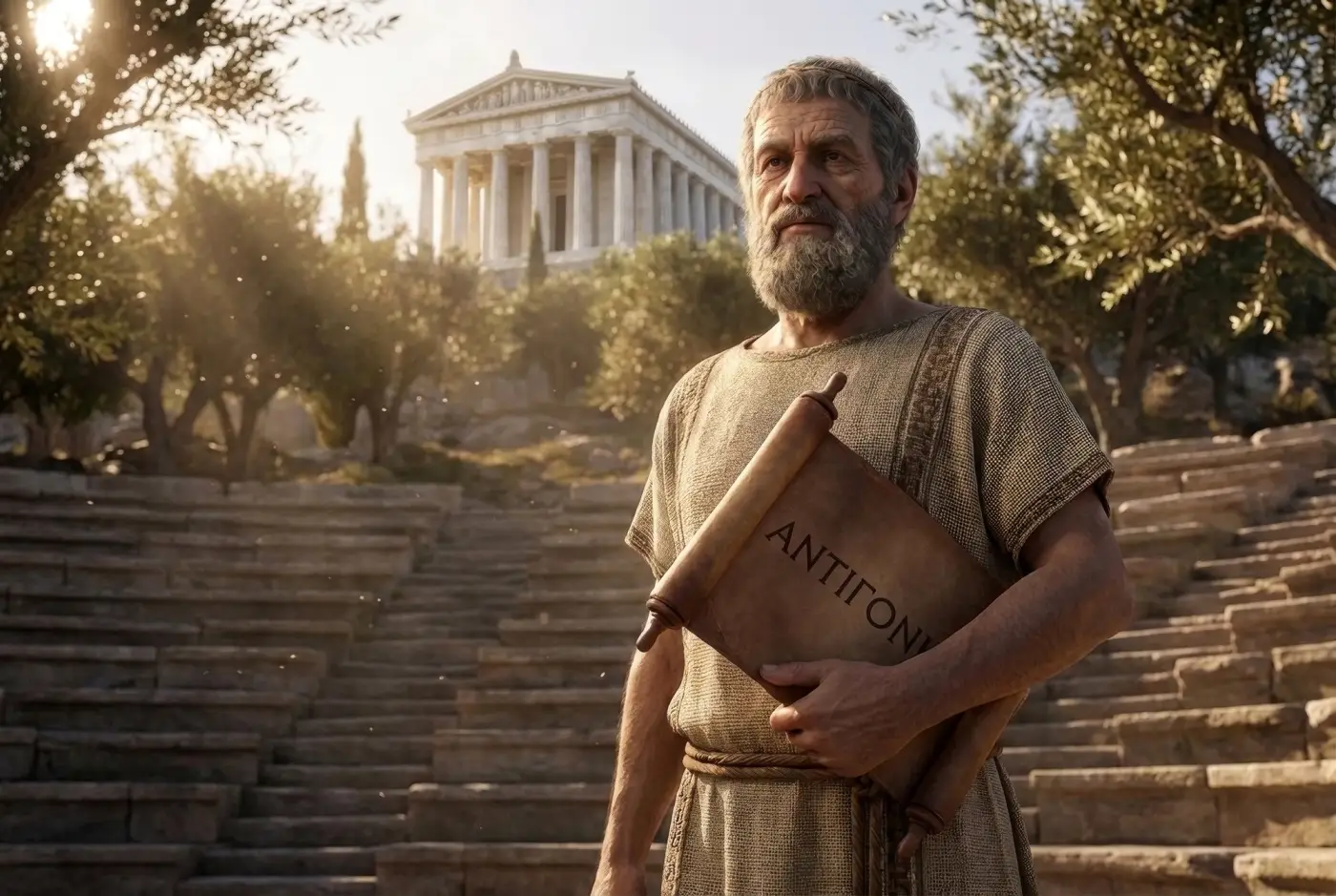
The story stands in chapter 16 of Plutarch's Life of Lycurgus. According to Plutarch a newborn in Sparta did not belong to the father. He had to bring it to a place called the Lesche, where the elders of the tribes examined it. If it was sturdy and healthy, they ordered it reared and assigned it one of the 9,000 land lots. If it was weak or deformed, they sent it to the "Apothetai," the "place of rejection," a chasm-like place at the foot of Taygetus, in the conviction that a life which nature had denied health and strength from the start was of no value either to itself or to the state.
What matters is who wrote this and when. Plutarch lived from about AD 46 to 120, a Greek in the Roman Empire and a moral philosopher. Lycurgus, to whom he attributes the rule, was a legendary lawgiver who is supposed to have lived probably in the 8th century BC. Between the two lie some 800 years. Plutarch also did not write sober history but biographies meant to show models, and his picture of Sparta is admiring and morally colored.
 AI
Who else speaks of it: nobody
Plutarch is, by the state of research, the only historical source for a systematic killing of children in Sparta for reasons of "selection." No contemporary confirms it. Xenophon, a Greek author of the 4th century BC who knew Sparta well and described how Lycurgus wanted to make the state strong, mentions nothing of it. That he would have said so if it fit his admiration for Sparta is an obvious thought, but it is no proof.
Two other names often come up: Plato and Aristotle. Both write that in an ideal state deformed children should not be raised (Plato in the "Republic," Aristotle in the "Politics" 1335b). But they describe wished-for states, not reality. By one count, from the 5th century BC to the 2nd century AD there are in Greek and Latin texts only five major passages that deal with killing children for physical defects, and they mostly describe individual cases or thought experiments.
The myth grew later. It fit the picture of a hard Sparta that Plutarch and others cultivated, and it lent itself to later times as an example. The classicist Debby Sneed says the story has been used "for some pretty nefarious ends." That is the reason a close look pays off. The myth also appears in the history of eugenics, where Plutarch's account is cited as an early example of selecting newborns, although no contemporary vouches for it.
Greek legend does know exposed children, however, such as Oedipus and Paris. That shows the idea was familiar, but it shows only a storytelling tradition and not everyday life. An older reading sees in exposure and abortion a form of birth control in small Greek families. That too is an interpretation and not a count.
Kaiadas: a place of execution, not a children's cemetery
The gorge is called Kaiadas (also Keadas) and is not a cliff but a cave in the slopes of Taygetus near Sparta, whose location archaeologists determined from ancient texts. That it was a place of death is secure, but what it was used for, a contemporary says: Thucydides tells (1.134) that the Spartans wanted to throw the regent Pausanias, whom they suspected of treason, into the Kaiadas, "where they cast criminals," but then decided to bury him nearby. The tradition of the Messenian hero Aristomenes, who in the Second Messenian War is said to have been thrown in with 50 companions and according to legend escaped, also fits this purpose.
In 2007 there were numbers. The anthropologist Theodoros Pitsios of the Athens Faculty of Medicine reported, after more than five years of analysis of the bones from the depths, that only remains of adolescents and adults between 18 and 35 had been found. The bones dated from the 6th and 5th centuries BC and came from 46 men, which confirmed the statements of the sources that the Spartans threw prisoners, traitors, or criminals in. According to reports, arrow and spear heads were also found. "It is probably a myth," Pitsios said, "the ancient sources of this so-called practice are rare, late and imprecise."
The fall into the gorge was, by one interpretation, a disgraceful death because the body remained unburied. The place thus stands more for punishment of adults than for children.
One more thing stands out: Plutarch does not name the Kaiadas in that chapter. He speaks of the Apothetai, the "place of rejection," and that the two are the same place is, by this account, a later equation. Perhaps the story was tied to the gorge because people were put to death there anyway. The myth and the place are thus two separate traditions that grew together only later.
 AI
Greek parents also cared for weak babies
That no babies lay in the gorge does not yet answer the larger question of how the Greeks overall treated disabled newborns. Here the classicist Debby Sneed of California State University, Long Beach published in December 2021 a study in the journal "Hesperia," a scholarly journal of the American School of Classical Studies at Athens. Her result: abandoning disabled infants was not an accepted part of Greek culture, even if it may have happened occasionally. Her evidence is the ground.
In 1931 excavators found in a well in Athens the remains of more than 400 infants. An analysis of 2018 showed that they had mostly lived only a few days, which fits the usual pattern of high infant mortality in antiquity and not targeted killing. In graves all over Greece there lie small, bulbous clay bottles with spouts, some with baby tooth marks on the mouthpiece. Added to that are written testimonies that parents, midwives, and physicians used special measures for congenital disabilities. Sneed writes that it was neither legally required nor usual to kill or expose disabled children.
There is also a dissenting voice: the classicist Beaumont distinguishes between killing and the more passive exposure and considers it possible that unwanted babies were left in a public place in the hope that someone would take them in. He too considers Sneed's work important because it forces assumptions to be checked.
 AI
Agesilaus II and the question of the gap
One individual case is often named: Agesilaus II, one of Sparta's most famous kings, was lame and yet reigned for about four decades. If culling disabled children had been the rule in Sparta, by the logic of the story he would not have survived. That does not refute Plutarch, for an individual case can have been an exception, and in the view of some specialists the absence of infants in the gorge does not refute him either. But the case shows that the story is not as seamless as it reads.
The gap runs both ways. That no infant bones lay in the gorge does not prove no child was ever exposed. The ground investigated only one place, and children's bones often survive less well than those of adults. At the same time: whoever claims the Spartans systematically killed children must prove it, and the evidence is a single text, 800 years younger than what it describes. Sparta knew, according to Plutarch, one remarkable feature: there, unlike elsewhere in Greece, an outsider, an elder, could intervene in the father's control over his child. That shows the state's claim, not evidence of child killing.
 AI
Six open questions
First, whether Plutarch recorded a genuine Spartan tradition that was lost or passed on a story he thought typical. That cannot be decided because his source is unknown. Second, whether individual children were exposed in Sparta, as may occasionally have happened in Greece. For that there is no evidence, but no counter-proof either.
Third, the role of the elders: Plutarch describes an examination by the tribal elders that no other author knows. Fourth, how many of the 46 men from the gorge were prisoners, traitors, or criminals: Pitsios reports that after the sources, but the analysis is by his words not yet complete, and it covers only part of the bones. Fifth, how far Sneed's results can be transferred to Sparta, since she relies mainly on Athens and other places and less on Sparta itself. Sixth, whether Plutarch's "Apothetai" are the Kaiadas at all or another place no longer known, since Plutarch himself does not name the cave.
The evidence at a glance, what a short answer doesn't show
To wrap up, everything at a glance, with fact and story kept apart.
| Category | What belongs here |
|---|---|
| Well documented | Plutarch (Lycurgus 16, around AD 100) is the only source for the selection; Xenophon is silent; Thucydides (1.134) names the Kaiadas as the place where criminals were thrown; excavation (Pitsios, 2007): 46 men aged 18 to 35 from the 6th and 5th centuries BC, no infants; Athenian well (1931) with over 400 infants, mostly a few days old (analysis 2018); clay bottles in children's graves; Sneed's study (Hesperia, December 2021) |
| Handed down | The examination by the elders at the Lesche; the assignment of one of 9,000 land lots; Aristomenes and his 50 companions in the Kaiadas; the wished-for states of Plato and Aristotle |
| Disputed or open | Whether Plutarch recorded a genuine tradition; whether individual children were exposed in Sparta (no evidence, no counter-proof); role of the elders; exposure as a passive form (Beaumont); transferability of Sneed's results to Sparta |
One picture from five angles
The story of the gorge shows how a single text shapes a picture across two thousand years. That's why every season in HistoryBytes is split into five categories, and this story touches all five: Plutarch as a person, the Kaiadas on Taygetus as a place, the excavation of 2007 as an event, the question of how a state treats its newborns as an idea, the small clay bottles from the graves as an object. That's how the Echoes of Olympus season builds the whole picture of a world that is both more familiar and stranger than the films show.
What the bones say and what they don't
The bones in the gorge tell of men who died as criminals, traitors, or prisoners, and of a state that made punishment public. They tell nothing of babies. That doesn't make Sparta friendlier: it was a state that separated children early from their parents and ruled the helots, an unfree population. But it shows how easily a picture arises that can be told better than proven. That the story survives so stubbornly also has to do with its appeal: it turns a distant state into a clear picture on which one can hang strength, hardness, and inhumanity. Whoever wants to be precise says: Plutarch claims it, the ground doesn't confirm it, and proof of a systematic practice is missing. That is less spectacular than the legend and therefore perhaps more honest. This precision, too, belongs to the truth about Sparta.
Whoever checks a claim about Sparta in the future has three simple questions: who writes this? When? And from what angle? In Plutarch's case the answer is: a moral philosopher, 800 years later, admiring the state of Lycurgus, which he knew from older texts. That does not make him worthless, but it shows how much weight the claim can bear.
 AI
Sources and date: 10 November 2026
Plutarch, Life of Lycurgus, chapter 16 (around AD 100); Thucydides, History of the Peloponnesian War, 1.134; Xenophon, Constitution of the Lacedaemonians; Plato, Republic (460c) and Aristotle, Politics (1335b); Debby Sneed, "Disability and Infanticide in Ancient Greece," Hesperia (December 2021) and the coverage in Science; Theodoros Pitsios, Faculty of Medicine of the University of Athens, AFP report of 10 December 2007; summaries by Greek Reporter (January 2026). This page is updated when new research is published.
Experience ancient Greece in HistoryBytes
Echoes of Olympus
From mythology to everyday life — in the Echoes of Olympus season, ancient Greece comes alive. Story campaigns, quizzes, and real immersion into a world of philosophy, trade, and legend.
5 episodes freeThe first 5 episodes are free, Premium unlocks the rest.