Was Helen of Troy Real? What the Evidence Actually Shows
 AI
AIThe face that was never described
"Was this the face that launched a thousand ships and burnt the topless towers of Ilium?" The most famous line about Helen isn't from Homer but from Christopher Marlowe's play "Doctor Faustus" of 1604, about two thousand years after the time the story is set. Homer himself never describes her face in detail. That fits the question at hand: how much of Helen is history, how much is storytelling?
In short: there is no evidence for Helen as a historical person. What is documented is that a city burned at Troy around 1180 BCE, and that Hittite texts know of a land called Wilusa and a people called the Ahhiyawa, which fit Ilios and the Achaeans well. The rest is tradition, and tradition is strikingly contradictory: even in antiquity, some authors didn't let Helen travel to Troy at all.
 AI
AIBetween beauty and shame
In the familiar version, Helen is the daughter of Zeus and Leda, wife of the Spartan king Menelaus. When Paris, a prince of Troy, is asked to settle a quarrel among three goddesses over who is the most beautiful, Aphrodite promises him Helen as a reward. Paris travels to Sparta, Helen follows him, whether willingly or by abduction the tradition leaves open, and the Trojan War begins.
Homer doesn't draw her as a cold object of beauty but as a woman who regrets her choice: in the Iliad, Helen speaks openly about her shame, and the Trojan king Priam absolves her of blame. At the war's end, in Homer's version, she returns to Menelaus. Already the Odyssey includes a side note that would have big consequences later: Menelaus and Helen are driven off course to Egypt on the way home. And in Euripides' "Trojan Women," the Trojan queen Hecuba demands Helen's punishment after the city falls, while Helen defends herself by pointing to Paris and the actions of the gods.
 AI
AIStesichorus, Herodotus, and Euripides
As early as the 6th century BCE, the poet Stesichorus wrote a famous recantation poem, the "Palinode": Helen never sailed to Troy. According to tradition, he had first slandered her in a poem and been struck blind, and only the recantation restored his sight. The story is preserved through Plato. In Stesichorus, Helen is also said to have been the mother of Iphigenia, with Theseus.
Herodotus picks up the idea in the 5th century and turns it into a sober-sounding variant: Paris and Helen, fleeing, were driven by a storm to Egypt. There, King Proteus disapproved of Paris's conduct and kept Helen, along with her treasure, until her husband could collect her. The Greeks, he says, didn't know this, didn't believe the Trojans that they didn't have Helen, and destroyed Troy as a result.
In 412 BCE, Euripides took this line into the fantastical in his play "Helen": Hera, furious that Paris decided the goddesses' contest against her, replaces the real Helen with a phantom made of clouds, which Paris takes to Troy, while Hermes carries the real Helen to Egypt. There she waits for ten years under the eye of King Theoclymenus, the son of Proteus. When Menelaus is also stranded in Egypt after the war, it turns out the woman at his side was only a phantom. An entire war over an illusion.
 AI
AI
This is HistoryBytes.
Short lessons, real duels, and immersive visuals from a world of history — download it now.
An argument with a catch
Herodotus gives his version an argument that sounds surprisingly modern: if Helen had really been in Troy, the Trojans would have handed her over immediately, no king would risk his city and family for a single woman. He says he heard the story from Egyptian priests. As additional evidence, he cites a temple to the "foreign Aphrodite" within the precinct of Proteus, which he says proves Helen lived there.
Herodotus also has a barb for Homer: the poet knew the Egyptian truth but suppressed it, because a quiet stay on the Nile makes poor material for an epic. Whether or not you believe Herodotus, he shows that Greeks of the 5th century were already questioning the story, some seven hundred years after the supposed war.
A side note makes Herodotus's version even more intriguing. According to one assessment, Homer names the Egyptian ruler of that time Polybus, whom Herodotus apparently equated with Proteus, and researchers suspect behind this figure the pharaoh Tausret, who ruled in the late 19th dynasty. Whether the Egyptians Herodotus later questioned truly preserved a memory of a queen who ruled when Troy fell remains speculation. But it is one of the nicer open questions of this story.
Burned walls, arrowheads, and Hittite clay tablets
Troy is no fantasy. Since Heinrich Schliemann began digging at the hill of Hisarlik in northwestern modern Turkey in 1870, it has been clear that not one but at least nine cities lie stacked there. The layer most often linked to the Trojan War, Troy VIIa, was destroyed around 1180 BCE: it shows traces of burning, spear and arrow points, and signs of a siege, such as large buried storage vessels and stockpiles of stones.
Hittite cuneiform texts know a land called Wilusa in northwestern Anatolia, which research identifies with Troy, and a people called the Ahhiyawa, whom many scholars connect with the Mycenaean Greeks. The king of Wilusa, Alaksandu, signed a treaty with the Hittite king Muwatalli II around 1280 BCE, and his name is probably a rendering of the Greek name Alexandros, Paris's second name. However, Alaksandu lived at least half a century before the period usually associated with the war.
Another text, the Manapa-Tarhunta letter from the 13th century BCE, reports a Hittite attack on Wilusa. It is sometimes read as evidence of a historical Trojan War, but mainly contributes something else: its geographic details narrow down the location so far that Troy is the only major fortified city that fits. There is also an irony: Hittites and Ahhiyawa demonstrably clashed over Wilusa, yet the Greeks seem to have completely forgotten the Hittites later, even though the two were in contact in Mycenaean times. Later Greek tradition knows nothing of all this.
Research remains cautious in its conclusion. The ancient historian Trevor Bryce warns that with such thin material, you can read any desired conclusion into it, and the Hittite sources don't suggest that Greeks themselves attacked Wilusa. There were probably one or more conflicts over Troy, but none of it describes Homer's ten-year war, and none of it mentions Helen.
 AI
AIThe sanctuary near Sparta
A completely different trail leads to Sparta. At Therapne stood a sanctuary now called the Menelaion. Helen and Menelaus were said to be buried there after their deaths. Although it's named for the man, the sanctuary and cult originally belonged to Helen, with Menelaus added later as her husband. The orator Isocrates writes that at Therapne, Helen and Menelaus were worshipped as gods, not as heroes. And Herodotus already knows the sanctuary: he tells how the third wife of the Spartan king Ariston, strikingly ugly as a child, became a beauty through Helen's intervention at Therapne.
Newer finds suggest that the area around the Menelaion in the southern Eurotas valley was the center of Mycenaean Laconia. Some researchers conclude from this that Helen preserves the memory of an older goddess later absorbed into the heroic legend. That isn't certain, but it would explain why Spartans worshipped a woman known in the Iliad for her shame.
 AI
AIHow a queen became a tree goddess
On Rhodes, Helen was worshipped as "Helen Dendritis," Helen of the Tree. The myth behind it is dark: according to tradition she fled to Rhodes, where her old friend Polyxo took her in, and Polyxo had servants dressed as Furies hang her from a tree. That explains the Rhodians' sanctuary, so the account in Pausanias goes. In Therapne too, "Helen of the Trees" appears, and scholars read it as a sign of a vegetation and fertility goddess.
An ancient poem has girls decorate a tree for Helen and carve into its bark that every passerby should read: "Revere me. I am Helen's tree." A queen who drove men to war and a goddess to whom trees were dedicated: both images existed side by side in antiquity without getting in each other's way.
 AI
AIEven her death is not settled
If Helen's life is told so contradictorily, that goes all the more for her end. In Homer, she returns to Menelaus in Sparta. In Euripides' "Orestes," Apollo says she escaped death and will live as a goddess in the sky beside Hera and Hebe, near her brothers, the Dioscuri. The Spartan tradition has Helen and Menelaus buried at Therapne. On Rhodes, she ends at the tree. And Pausanias also knows stories about her death and about a "White Island."
This variety fits everything we've seen so far: Helen never belonged to a single story. Every region, every poet, and every era wrote her the life that was needed at the moment.
From Marlowe to the millihelen
Back to the most famous line. "Was this the face that launched a thousand ships?" asks Doctor Faustus in Marlowe, as Helen appears to him as an apparition. The famous phrasing is therefore not ancient but Elizabethan. In the 20th century, the writer Isaac Asimov turned it into a joke and coined the unit "millihelen": the amount of beauty needed to launch a single ship.
Modern literature has never let go of the Helen question either. In 1961, the poet H.D. published "Helen in Egypt," a long poem that picks up the old doubling: a phantom Helen in Troy, a real woman in Egypt. That a 20th-century poem asks the same question as Stesichorus nearly 2,600 years earlier says a lot about how open the story still is today.
 AI
AIThe overview at a glance
To wrap up, the short version. With Helen, there are unusually many layers between what finds and texts support, what researchers debate, and what storytellers added.
| Category | What belongs here |
|---|---|
| Documented | Destruction of Troy VIIa around 1180 BCE with traces of burning and weapon finds; Hittite texts on Wilusa (Troy) and Ahhiyawa; King Alaksandu's treaty around 1280 BCE; a cult for Helen at Therapne that Herodotus and Isocrates know |
| Disputed | Whether a Trojan War in Homer's sense happened; whether Alaksandu was the model for Paris; whether Helen preserves an older goddess; whether Herodotus's Egypt version rests on tradition |
| Legend | Helen as a historical queen of Sparta; the ten-year war; the Judgment of Paris; the phantom in Euripides; the "thousand ships" |
One picture from five angles
Helen shows why an era needs more than one person. That's why every season in HistoryBytes is split into five categories, and Helen's story touches all five: she herself as a person, Troy as a place, the destruction of Troy VIIa as an event, the question of whom to believe among contradictory accounts as an idea, the Hittite treaty with Alaksandu as an object. In the Echoes of Olympus season, which runs from the mythical age to 146 BCE, that builds the whole picture of a world where history and legend constantly run into each other.
A woman before a mirror
In the end there is no yes and no no, just precision: Helen as a person is not documented, Troy as a setting very much is, and tradition made several women out of one. A queen who came to Troy willingly or by force, a woman who spent the war in Egypt, a phantom made of clouds, a goddess of trees. The painter Evelyn De Morgan placed her before a mirror in 1898, with Troy in the background. Perhaps that is the most fitting image: we only ever see Helen in what storytellers have projected onto her.
 AI
AIExperience ancient Greece in HistoryBytes
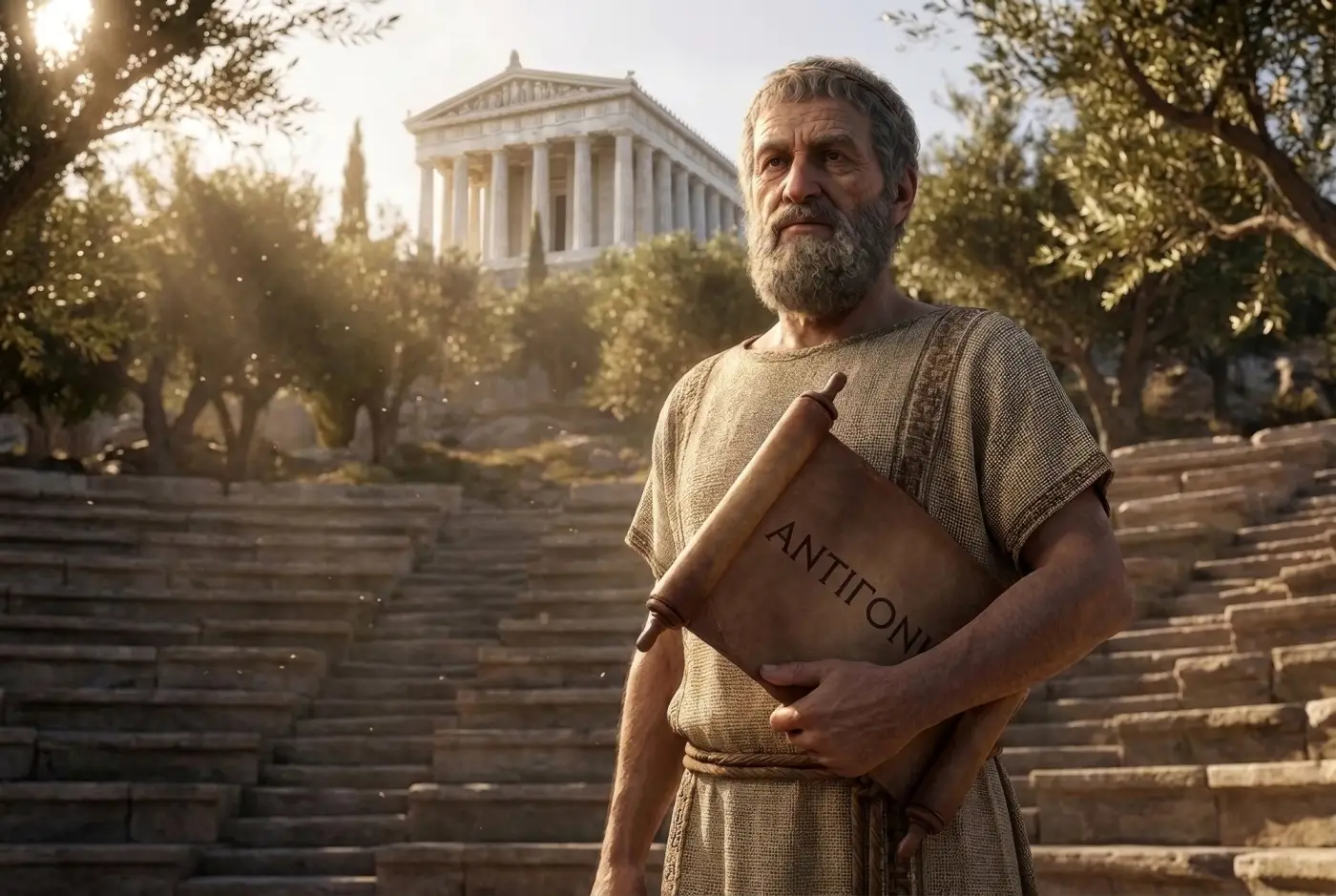
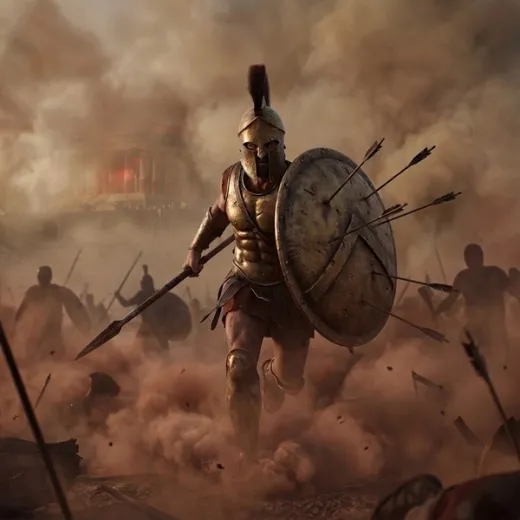
Echoes of Olympus
From mythology to everyday life — in the Echoes of Olympus season, ancient Greece comes alive. Story campaigns, quizzes, and real immersion into a world of philosophy, trade, and legend.
5 episodes freeThe first 5 episodes are free, Premium unlocks the rest.